







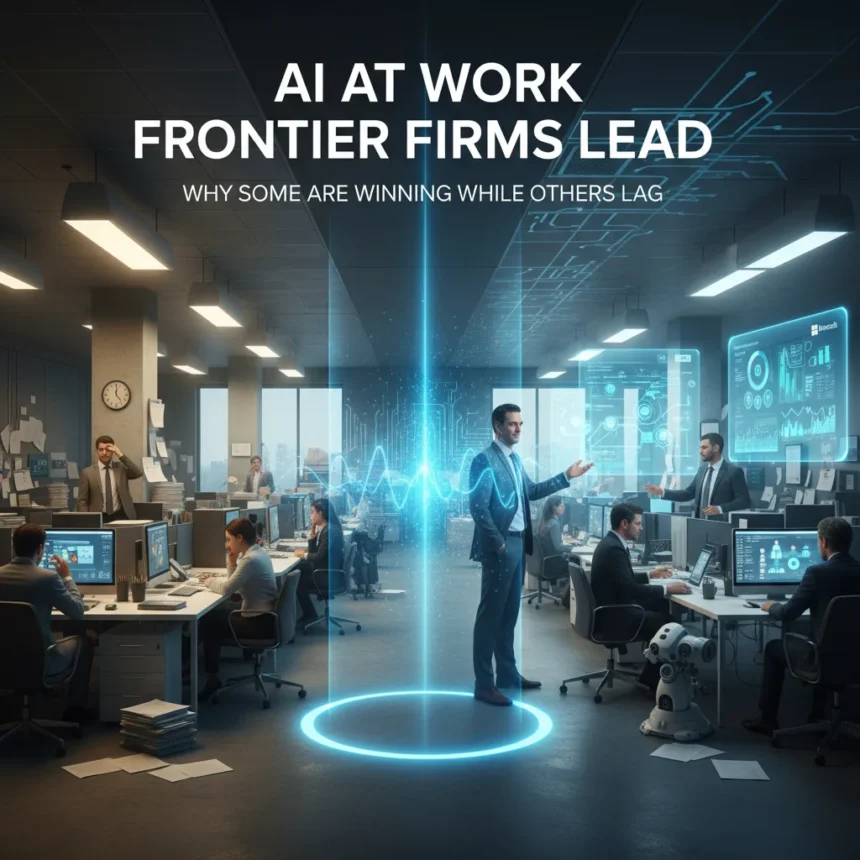
AI at work strategy separates winners from laggards in 2025. Most business leaders recognize the world is changing, but far fewer have a clear picture of what to do about it, according to Microsoft’s latest Work Trend Index research. The gap is widening fast: a distinct group of organizations—Microsoft calls them Frontier Firms—are already redesigning workflows around AI, while the majority remain stuck experimenting with disconnected pilots.
Key Takeaways
- Frontier Firms treat AI as a strategic partner, not a productivity tool, embedding it into core workflows and decision-making.
- Most organizations suffer from AI inertia: pilot projects that never scale and limited cross-functional coordination on AI initiatives.
- The performance gap between Frontier Firms and others is widening, with leaders already seeing measurable benefits in productivity and innovation.
- Successful AI adoption requires clear governance, leadership commitment, and investment in employee upskilling and ethical-use frameworks.
- Organizations must move from experimentation to systemic AI integration or risk falling behind in a rapidly competitive landscape.
The AI Inertia Problem Most Businesses Face
The majority of organizations are trapped in a cycle of experimentation without execution. They launch AI pilots, see initial promise, then fail to scale across the business. Cross-functional coordination breaks down. Projects remain siloed. Meanwhile, Frontier Firms have already moved past this phase, embedding AI into how people collaborate, make decisions, and learn—not just how fast they complete tasks.
This inertia is not accidental. It stems from a lack of clear AI strategy, undefined governance structures, and leadership teams that treat AI as a technology problem rather than a business transformation challenge. Without a coherent vision, even well-funded AI initiatives fragment into disconnected experiments that drain resources without delivering enterprise-wide impact.
What Frontier Firms Do Differently
Frontier Firms operate from a fundamentally different playbook. They develop a clear AI vision aligned with business outcomes, then systematically redesign workflows to embed AI into the fabric of daily work. Rather than bolting AI onto existing processes, they ask: How does AI change what we do and how we do it?



These organizations invest heavily in three areas that others neglect. First, they upskill employees and foster AI-literate leadership, ensuring that teams understand not just how to use AI tools but why the transformation matters. Second, they establish governance and ethical-use frameworks before scaling, avoiding the compliance disasters that catch slower movers. Third, they measure impact rigorously—tracking productivity gains, innovation metrics, and employee engagement—rather than celebrating pilot success and moving on.
Frontier Firms also treat AI as a shared capability, not a siloed technology project. Cross-functional teams collaborate on AI strategy from day one. Finance, HR, operations, and product teams all have a seat at the table. This breaks down the departmental silos that paralyze most organizations and enables coordinated rollouts that actually stick.



Why the Gap Is Widening
The widening gap between Frontier Firms and the rest reflects a critical inflection point. Organizations that move now—defining coherent AI strategies, investing in governance, and redesigning core workflows—will compound their advantages over the next 18 to 24 months. Those that continue experimenting in isolation will fall further behind.
Frontier Firms are already seeing tangible benefits in productivity, innovation, and employee engagement. They are not just working faster; they are working differently. They collaborate across time zones more effectively. They make better decisions by combining human judgment with AI-generated insights. They innovate faster because AI handles routine work, freeing teams to focus on strategy and creativity.
Microsoft’s Copilot ecosystem and AI-enabled tools provide infrastructure that Frontier Firms use to embed AI into everyday work—from writing and analysis to coding and customer service. But tools alone do not create transformation. Strategy, governance, and organizational alignment do.
The Path Forward for Organizations
Moving from experimentation to systemic AI integration requires a deliberate progression. Organizations must first recognize AI as a strategic imperative, not just a technical trend. Then they develop a clear AI vision and roadmap aligned with specific business outcomes—not generic productivity gains, but measurable improvements in customer satisfaction, time to market, or decision quality.



Next comes the hard part: embedding AI into core workflows and collaboration patterns rather than treating it as an add-on. This means redesigning how teams work together, how decisions get made, and how knowledge flows through the organization. It requires continuous iteration based on real-world usage and feedback, not a one-time deployment.
The current moment is a critical window. Organizations must either define a coherent AI strategy now or risk falling behind competitors who are already redesigning business processes around AI. Waiting for more certainty, more tools, or a clearer market picture is itself a strategy—one that leads to obsolescence.
Is AI inertia holding back your organization?
AI inertia is the state of launching disconnected AI pilots without scaling them across the business or establishing clear governance and cross-functional coordination. Most organizations experience this because they lack a coherent AI strategy and treat AI as a technology problem rather than a business transformation challenge. Frontier Firms escape inertia by embedding AI into core workflows and establishing clear governance from the start.
How do Frontier Firms differ from other organizations in their AI adoption?
Frontier Firms treat AI as a strategic partner and redesign workflows around it, rather than bolting AI onto existing processes. They invest in employee upskilling, establish governance and ethical-use frameworks before scaling, measure impact rigorously, and coordinate AI strategy across departments. This systemic approach enables them to move from experimentation to measurable business-level impact faster than organizations that treat AI as a siloed project.
What should organizations prioritize first when building an AI strategy?
Organizations should start by recognizing AI as a strategic imperative and developing a clear AI vision aligned with specific business outcomes—not generic productivity gains. Then establish governance and ethical-use guidelines, invest in employee upskilling, and design core workflows around AI rather than treating it as an add-on. Continuous iteration based on real-world usage and feedback, combined with cross-functional coordination, accelerates the transition from experimentation to systemic impact.
The divide between Frontier Firms and the rest will only widen as AI reshapes how work gets done. Organizations that act now—with clear strategy, committed leadership, and systemic integration—will lead their industries. Those that continue experimenting in silos will find themselves playing catch-up in a landscape they no longer recognize.
This article was written with AI assistance and editorially reviewed.
Source: TechRadar




