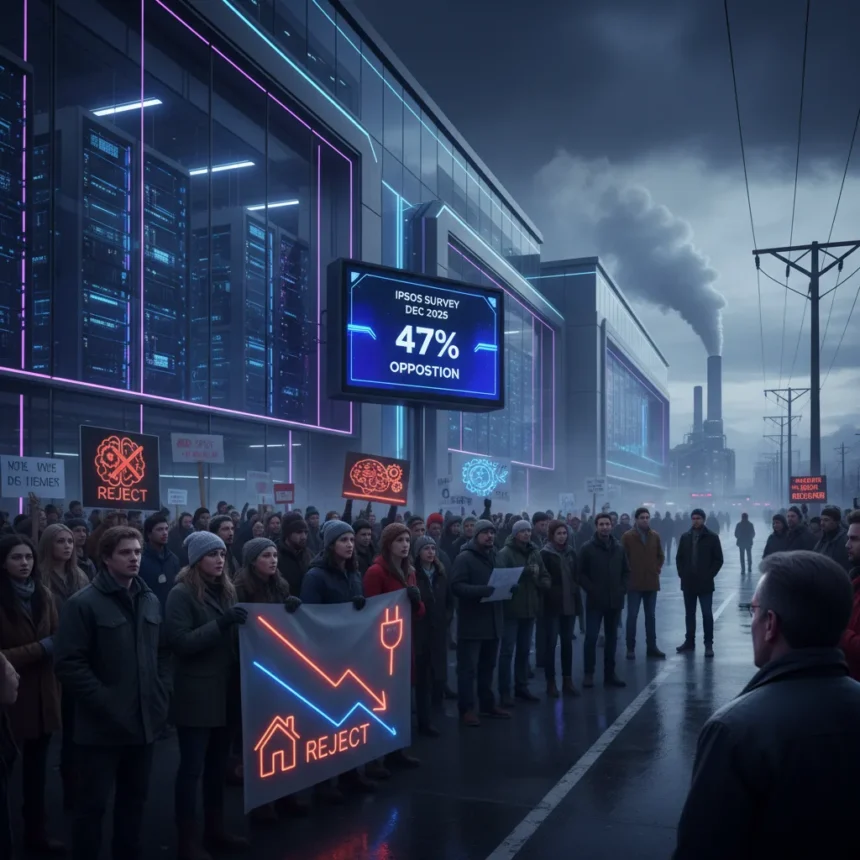
AI data center opposition is hardening across America. A December 2025 Ipsos survey of 1,000 U.S. adults found that 47% of Americans oppose construction of new AI data centers in their neighborhood, while just 35% support such projects. The finding arrives as communities from Pennsylvania to Virginia wage pitched battles against proposed mega-facilities, and it signals a deepening public skepticism about the infrastructure demands of generative AI.
Key Takeaways
- 47% of Americans oppose AI data centers near their homes; 35% support; 18% are neutral.
- Opposition surges to 54% when people learn about energy and water consumption impacts.
- Support collapses to 28% if respondents are told data centers could raise local energy costs.
- Younger Americans (18-34) show higher opposition at 52% across all demographics.
- Support jumps to 71% if data centers promise to create local jobs.
What’s Driving AI Data Center Opposition
The core issue is environmental and economic. Sixty-two percent of Americans believe AI data centers consume excessive electricity, while 57% say they use too much water. These concerns are not abstract—they translate into real opposition when people understand the stakes. When survey respondents were informed about the energy and water footprint of AI data centers, opposition jumped from 47% to 54%. The math is even starker on cost: support dropped to just 28% when people learned that nearby data centers could increase local energy bills.
This disconnect between abstract support and concrete opposition reflects a broader pattern. Americans like the idea of AI infrastructure in theory. But when they learn about power demands, water consumption, and rising utility costs, enthusiasm evaporates. The survey captures a moment when public sentiment is shifting from curiosity to resistance.
Regional Backlash and Real-World Impact
The survey numbers align with on-the-ground reality. In Archbald, Pennsylvania, six proposed AI data centers sparked such fierce community pushback that four of seven town council members resigned from their positions. The scale of the projects—equivalent to 51 Walmart Supercenters compressed into 17 square miles—made the impact impossible to ignore. Virginia offers an even starker warning: support for new data centers collapsed from 69% in 2023 to just 35% in 2025, a stunning reversal driven by multi-gigawatt projects like Prince William County’s proposed Digital Gateway.



Some companies are responding by building in secret. Developers have begun siting data centers in undisclosed locations specifically to avoid NIMBY backlash before permits are finalized. Others are experimenting with community-first approaches. Microsoft has signaled it will cover energy cost increases and replenish water supplies in host communities, attempting to shift the narrative from burden to partnership. These strategies suggest the industry recognizes that AI data center opposition is not a passing complaint—it is a structural constraint on future growth.
The Jobs Factor Changes Everything
One variable dramatically shifts public opinion: employment. When survey respondents were told that data centers would create local jobs, support surged to 71% while opposition plummeted to 22%. This single finding exposes the underlying tension. Americans are not reflexively opposed to AI infrastructure. They are opposed to bearing the costs while distant corporations capture the benefits. A data center that brings wages, tax revenue, and construction work to a struggling region looks fundamentally different from one that simply raises power bills and depletes aquifers.



The demographic breakdown reveals nuance. Younger Americans (18-34) show the highest opposition at 52%, suggesting Gen Z is more environmentally conscious or skeptical of corporate promises. Republicans oppose at 50%, Democrats at 45%, and Independents at 48%—a remarkably tight spread that suggests AI data center opposition transcends partisan lines. This is rare political common ground, and it matters.
Why This Matters Now
The survey arrives at a critical inflection point. AI demand is exploding, power grids are straining, and data center buildouts are already delaying housing projects and pricing out electricians in Texas. Energy supplies are being squeezed by the sheer scale of new AI infrastructure. Yet the public increasingly understands what is at stake. When people know the facts—about energy consumption, water usage, and cost impacts—they say no. The 47% opposition figure is not the ceiling. It is the floor, and it rises sharply with information.
For the AI industry, this is a reckoning. You cannot build your way to trillion-dollar valuations if half the country opposes your infrastructure. The survey does not prove that AI data centers should not be built. It proves that the current model—where companies externalize costs onto communities and capture profits elsewhere—is politically unsustainable. Either the industry finds ways to genuinely benefit host communities, or it will face escalating resistance, longer permitting timelines, and ultimately, constrained growth.
Can the Industry Win Back Public Trust?
The jobs finding offers a roadmap. Communities will accept AI data centers if they see tangible local benefit. That means not just construction jobs, but permanent operations roles, real tax contributions, and genuine investment in local infrastructure. It means transparent communication about energy and water impacts, not secret builds. It means sharing profits through lower energy costs or community funds, not just paying minimum wage to security guards. Microsoft’s community-first approach is a start, but it is one company’s initiative, not an industry standard.



The alternative is a future where AI infrastructure is built only in places with weak environmental oversight, minimal local opposition, or desperate economic circumstances. That path leads to a two-tier system: wealthy, organized communities that block data centers, and struggling regions that accept them because they have no choice. That is a recipe for environmental injustice and political backlash that will eventually constrain the entire industry.
Do younger Americans oppose AI data centers more than older generations?
Yes. Americans aged 18-34 show the highest opposition at 52%, compared to the 47% national average. This suggests younger voters are more attuned to environmental concerns or more skeptical of corporate promises about local benefits.
What happens to opposition if data centers create local jobs?
Opposition collapses dramatically. When survey respondents were told that data centers would create local jobs, support surged to 71% while opposition fell to just 22%. This is the single most powerful variable in the survey, indicating that job creation is the key to winning community acceptance.
How much does awareness of energy and water use increase opposition?
Significantly. When respondents were informed about AI data centers’ high energy and water consumption, opposition rose from 47% to 54%. Information matters—the more people know about the actual impact, the more they resist.
The bottom line is stark: AI data center opposition is real, broad-based, and growing with information. The industry faces a choice between building with community consent through genuine benefit-sharing, or building in secret against mounting resistance. The survey suggests the first path is possible if the incentives are right. The second path leads nowhere—except to a future where AI infrastructure becomes as politically toxic as coal plants.
Edited by the All Things Geek team.
Source: Tom's Hardware