





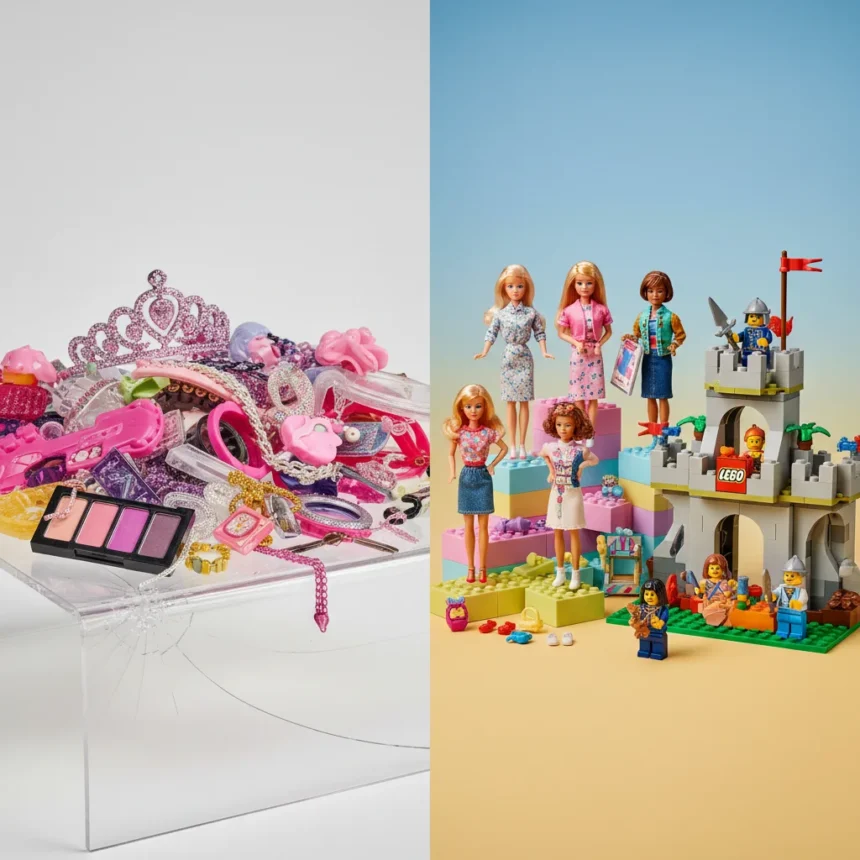
Brand strategy retail has become the difference between survival and collapse for legacy retailers, and Claire’s provides a cautionary tale. The accessories chain that once dominated mall culture faced serious financial difficulties, while Barbie and Lego demonstrated how to evolve a brand without abandoning its core identity. The gap between these outcomes reveals not just business acumen but fundamental choices about cultural relevance.
Key Takeaways
- Claire’s struggled to maintain cultural relevance as shopping habits shifted away from mall-based retail.
- Barbie and Lego succeeded by expanding beyond their original products into entertainment and lifestyle ecosystems.
- Brand strategy retail requires consistent identity evolution, not reactive pivoting.
- Legacy brands must balance nostalgia with forward momentum to survive market disruption.
- Retail accessibility alone cannot sustain a brand without cultural narrative.
The Barbie Blueprint: Entertainment as Brand Extension
Barbie’s 2023 film success was not accidental—it represented decades of strategic brand building that extended far beyond dolls. The film generated massive cultural conversation because Barbie had already established itself as more than a product; it was a cultural reference point. The doll brand maintained relevance by treating entertainment, fashion collaborations, and lifestyle positioning as core to its identity, not as side projects. This approach allowed Barbie to reach audiences who had never owned a doll but recognized the brand’s cultural weight.
Claire’s, by contrast, remained primarily a physical retail destination selling ear piercings and hair accessories. While Barbie invested in narrative and cultural positioning, Claire’s competed mainly on convenience and price. The difference is stark: one brand created reasons for people to engage beyond a transaction, while the other relied on location-based foot traffic. As malls declined, Barbie’s cultural ecosystem kept it relevant; Claire’s lost its primary distribution advantage without building alternative touchpoints.
Lego’s Ecosystem Strategy: From Toys to Total Experience
Lego avoided the fate of many toy retailers by refusing to be defined as merely a product category. The brand built theme parks, films, video games, and educational partnerships that made Lego a lifestyle ecosystem rather than a shelf item. Each extension reinforced the core brand identity—creativity, building, imagination—while reaching new demographics and use cases. Parents bought Lego for children; adults bought it for themselves; educators integrated it into curriculum.

Claire’s never developed this kind of ecosystem thinking. The brand remained transactional: customers came to get their ears pierced, buy clip-on earrings, or grab a hair accessory. There was no Lego Movie equivalent, no theme park experience, no educational partnership, no content that made Claire’s part of a larger cultural narrative. The brand existed to serve a functional need, not to create cultural meaning. When that functional need shifted—as online shopping and direct-to-consumer brands made mall visits unnecessary—Claire’s had no cultural moat to fall back on.
Why Location-Based Retail Lost Without Cultural Narrative
The fundamental flaw in Claire’s strategy was treating retail location as sufficient brand value. Shopping mall foot traffic was once a powerful distribution advantage, but it was never a sustainable brand strategy. Barbie and Lego understood that physical distribution is tactical; cultural relevance is strategic. They invested in the latter while maintaining the former, creating multiple reasons for customers to engage with the brand across different contexts.



Claire’s relied on habit and convenience. A teenager would pop into Claire’s between stores because it was there, not because the brand had created compelling reasons to seek it out. Once that habit broke—once online shopping made the mall trip optional—the brand had nothing else to offer. No content, no entertainment value, no lifestyle positioning, no reason for Gen Z to care about Claire’s beyond a functional need that could be met elsewhere, often cheaper.
The retail landscape has fundamentally changed. Brands that survive do so by creating cultural narratives that transcend physical location. Barbie proved that a legacy product can become a cultural phenomenon through consistent brand evolution. Lego proved that ecosystem thinking—creating multiple touchpoints and reasons to engage—builds resilience. Claire’s did neither. It remained a place to buy things rather than a brand with cultural meaning, and that distinction proved fatal as the places themselves became optional.
What Claire’s Could Have Built: A Missed Opportunity
Imagine if Claire’s had invested in youth culture content, partnered with musicians and fashion designers, created an app-based community, or developed entertainment properties around self-expression and identity. The brand had natural advantages: it served a life milestone (first ear piercing), it was synonymous with childhood and adolescence, it understood the teen market. Instead of building on those advantages, Claire’s treated them as commodities—services to be delivered as cheaply as possible in convenient locations.
Barbie and Lego both understood that their products were entry points to larger narratives. Barbie told stories about identity, aspiration, and cultural conversation. Lego told stories about creativity and building. Claire’s never told a story beyond “we have what you need.” That absence of narrative became the absence of brand value. When the retail location disappeared, there was nothing left.



The Lesson for Legacy Retail Brands
The contrast between Claire’s failure and Barbie and Lego’s success offers a clear lesson: brand strategy retail cannot rely on distribution alone. Physical location, pricing, and product selection are table stakes—necessary but not sufficient. Brands that survive market disruption do so by creating cultural meaning that extends beyond the transaction. They invest in entertainment, community, lifestyle positioning, and narrative. They treat their core audience as a cultural group to be engaged, not just as customers to be served.
Claire’s had the opportunity to become a cultural brand for youth self-expression. Instead, it remained a retail destination. That choice—or rather, the failure to make that choice consciously—explains why Barbie and Lego thrived while Claire’s struggled. The accessory chain’s decline was not inevitable; it was the result of strategic decisions that prioritized short-term retail convenience over long-term brand building. In a world where location no longer guarantees foot traffic, that bet was always going to fail.
Could Claire’s have competed with online-first alternatives?
Yes, but only by building a brand narrative that online-first competitors could not replicate. Claire’s had decades of cultural history and trust with its core demographic. Instead of leveraging that, the brand allowed itself to be commoditized. A strategic pivot toward content, community, and lifestyle positioning could have created reasons for customers to choose Claire’s over cheaper online alternatives. Barbie and Lego proved this works; Claire’s proved what happens when a brand does not try.
What makes Barbie and Lego different from other legacy toy brands?
Both brands treated cultural evolution as central to their strategy, not peripheral. They invested in entertainment, partnerships, and lifestyle positioning that kept them relevant across generations. They understood that a doll or building block is not the product—the product is the cultural narrative and the experience of engaging with that narrative. Most legacy toy brands competed on nostalgia or price; Barbie and Lego competed on meaning.
Claire’s collapse was not the result of market forces beyond its control—it was the result of strategic choices that treated retail location as a brand asset rather than a distribution channel. Barbie and Lego learned the difference. That learning is what separated the brands that survived from the ones that did not.
Edited by the All Things Geek team.
Source: Creativebloq




