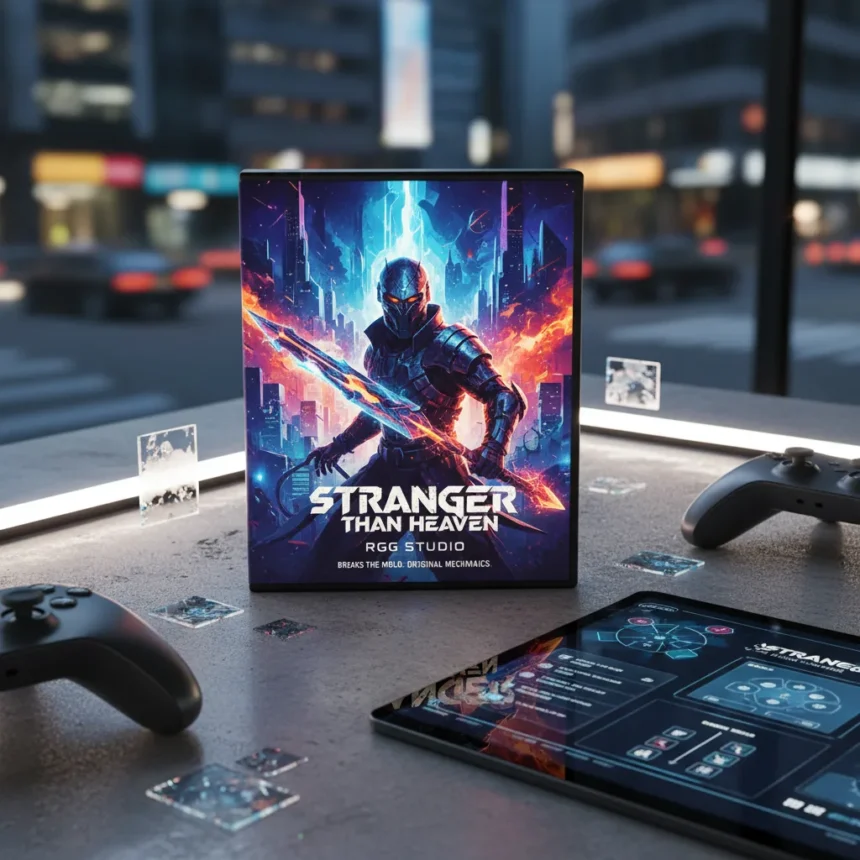
Stranger Than Heaven action-RPG from RGG Studio represents something genuinely rare in gaming: a new entry that does not simply remix established formulas but actually challenges what an action-RPG can be. After years of incremental iterations and safe sequels, this title breaks enough conventions to feel genuinely fresh.
Key Takeaways
- Stranger Than Heaven action-RPG introduces mechanics that diverge significantly from genre standards
- RGG Studio’s design philosophy prioritizes originality over familiar comfort mechanics
- The game stands apart from established action-RPG franchises through structural innovation
- Gameplay systems reflect a willingness to abandon genre conventions entirely
- This approach offers players a fundamentally different action-RPG experience
Why Stranger Than Heaven Action-RPG Matters Right Now
The action-RPG space has become predictable. Most titles follow a template: open world or linear level design, a protagonist with growing power, boss fights that test mastery of learned patterns, loot systems that drive progression. Stranger Than Heaven action-RPG abandons this playbook. Instead of building another game around what worked for Dark Souls, Elden Ring, or The Witcher 3, RGG Studio constructed something that feels genuinely novel in how it structures combat, narrative, and progression.
This matters because players are fatigued by incremental innovation. A new action-RPG that simply adds a grapple mechanic or adjusts stamina management does not cut through the noise anymore. Stranger Than Heaven action-RPG succeeds by rejecting the assumption that all action-RPGs must follow the same foundational architecture. The result is a game that forces players to unlearn habits built by thousands of hours in other titles.
Four Design Choices That Set Stranger Than Heaven Action-RPG Apart
The Stranger Than Heaven action-RPG distinguishes itself through deliberate structural choices that most competitors would never attempt. Rather than iterating on proven systems, RGG Studio took risks that pay off in genuinely fresh gameplay.


First, the game reimagines how progression interacts with combat difficulty. Instead of traditional leveling curves that make early enemies trivial by mid-game, Stranger Than Heaven action-RPG maintains challenge scaling that forces constant adaptation. Players cannot simply outlevel content through grinding. This design choice directly contradicts the modern action-RPG expectation of power fantasy progression, yet it creates tension and engagement that stat-based advancement often fails to deliver.
Second, the narrative structure refuses to follow the hero’s journey template. Most action-RPGs position the player character as the central figure whose choices reshape the world. Stranger Than Heaven action-RPG instead treats the protagonist as one voice among many in a world that operates on its own logic. This shift fundamentally changes how story moments land and why players care about outcomes that do not directly reward them mechanically.


Third, the combat system incorporates systems that punish button-mashing in ways that traditional action-RPGs do not. Rather than rewarding player input with guaranteed damage output, Stranger Than Heaven action-RPG demands precision timing and tactical positioning that cannot be overcome through stat advantages alone. This creates a skill ceiling that persists regardless of gear quality or character level.
Fourth, the game’s approach to world design rejects the collectible-driven open world format. Instead of populating the map with markers, chests, and side quests designed to keep players engaged through completion metrics, Stranger Than Heaven action-RPG trusts environmental storytelling and organic discovery. This makes exploration feel purposeful rather than obligatory.
How Stranger Than Heaven Action-RPG Compares to Genre Standards
Comparing Stranger Than Heaven action-RPG to established franchises highlights just how different RGG Studio’s approach is. Games like Dark Souls built their reputation on punishing difficulty paired with methodical combat. Players learn enemy patterns, master dodge timing, and gradually overcome challenges through skill development. Stranger Than Heaven action-RPG takes a different path: it maintains difficulty through unpredictability and systemic complexity rather than pattern recognition.
Where Elden Ring expanded Dark Souls’ formula by adding open-world exploration and build variety, Stranger Than Heaven action-RPG questions whether those additions actually improve the core experience. The result is a game that feels less like a refinement and more like a genuine alternative to the established action-RPG template.


The Witcher 3 proved that action-RPGs could succeed through narrative depth and character development. Stranger Than Heaven action-RPG respects that lesson but applies it differently, prioritizing world consistency over player-centric storytelling. This creates immersion through a different mechanism—one where the world feels lived-in rather than authored for the player’s benefit.
What This Means for Action-RPG Design Moving Forward
Stranger Than Heaven action-RPG demonstrates that the genre still has untapped design space. Too many recent action-RPGs assume that players want what worked before, just with higher fidelity graphics or more content volume. This game proves that audiences respond to genuine innovation when it is executed with confidence.
The success of Stranger Than Heaven action-RPG’s unconventional approach suggests that other studios might reconsider their reliance on proven formulas. Not every action-RPG needs to be Dark Souls-adjacent. Not every open world needs to be packed with collectibles. Not every protagonist needs to be the center of the narrative universe. These design choices are not laws—they are habits.
Is Stranger Than Heaven action-RPG worth playing if I love traditional action-RPGs?
Yes, but with the understanding that it will challenge your expectations. If you have spent hundreds of hours in Dark Souls, Elden Ring, or similar titles, Stranger Than Heaven action-RPG will feel deliberately different in ways that might frustrate before they click. The game respects your skill but refuses to reward it in ways you expect. That friction is intentional.
How does the progression system in Stranger Than Heaven action-RPG work differently?
Instead of traditional experience-based leveling, Stranger Than Heaven action-RPG uses a system where player skill and tactical decisions matter more than character stats. Gear and upgrades provide marginal advantages rather than transformative power spikes. This keeps combat challenging throughout the entire game and prevents the common action-RPG problem where late-game content becomes trivial once you have optimized your build.
Does Stranger Than Heaven action-RPG have multiplayer or online features?
The research brief does not contain specific information about multiplayer or online functionality for Stranger Than Heaven action-RPG. Check the official RGG Studio channels or game listing for the most current feature details.
Stranger Than Heaven action-RPG matters because it proves the genre is not exhausted. In a landscape dominated by safe iterations and incremental upgrades, RGG Studio delivered something that respects player intelligence and refuses to apologize for being different. That alone makes it worth your attention.
Edited by the All Things Geek team.
Source: TechRadar