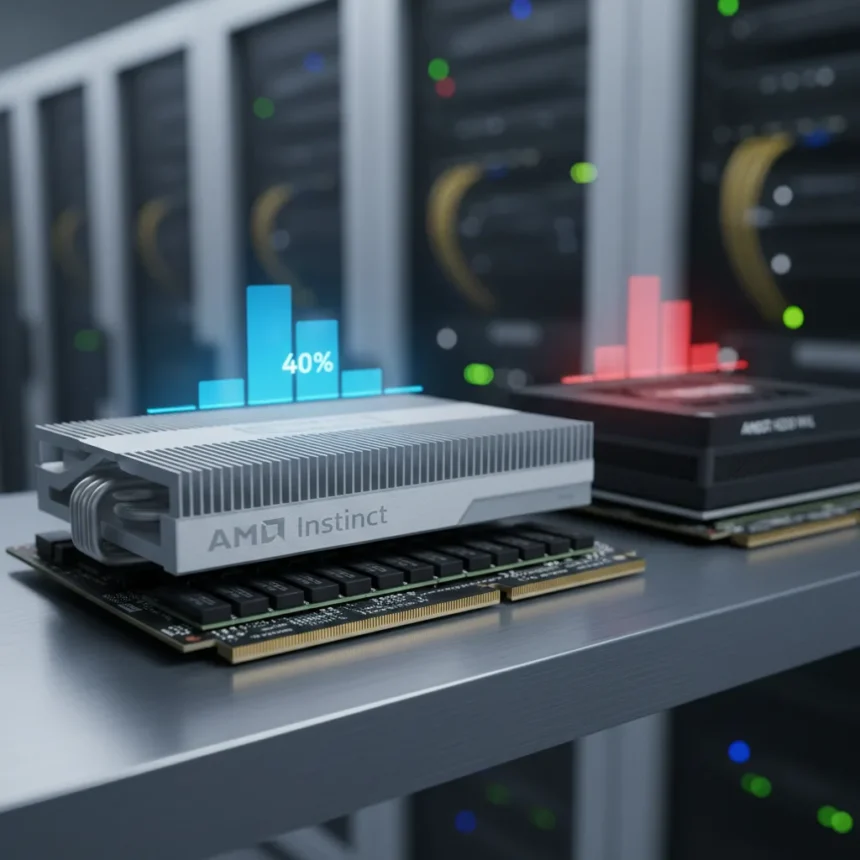
The AMD Instinct MI350P is a PCIe-based AI accelerator card made by AMD, announced on May 22, 2025, designed as a drop-in upgrade for existing air-cooled enterprise servers. It features 144GB of HBM3E memory and is built on AMD’s 4th Gen CDNA architecture, with AMD Performance Labs claiming roughly 40% higher theoretical FP16 and FP8 compute performance compared to Nvidia’s H200 NVL.
Key Takeaways
- The AMD Instinct MI350P targets enterprises that need AI performance without replacing their entire PCIe server infrastructure.
- It carries 144GB of HBM3E memory — half the 288GB found in the flagship MI355X OAM module.
- AMD claims roughly 40% higher theoretical FP16 and FP8 compute performance versus Nvidia’s H200 NVL, per AMD Performance Labs as of May 22, 2025.
- The MI350P supports next-gen datatypes including MXFP6, MXFP4, and MXFP8/OCP-FP8 for AI inference and training efficiency.
- No pricing or launch date has been confirmed by AMD at the time of announcement.
What Makes the AMD Instinct MI350P Different From AMD’s Own Lineup
The AMD Instinct MI350P occupies a deliberate middle position in AMD’s accelerator stack. It’s not the flagship — that title belongs to the MI355X, which packs 288GB of HBM3E, 78.6 TFLOPs of FP64 performance, and up to 10.1 PFLOPs in MXFP6/MXFP4 on a single GPU. The MI350P cuts those specs roughly in half, trading peak headroom for compatibility with the far larger installed base of standard PCIe servers.
That’s a real trade-off worth understanding. The MI355X and MI350X OAM modules are designed for rack-scale deployments — purpose-built systems with liquid cooling and custom interconnects. Most enterprise data centers aren’t built that way. The MI350P slots into existing air-cooled servers without infrastructure overhaul, which for many IT teams is the difference between a project that gets approved and one that doesn’t.
The MI350X, AMD’s air-cooled OAM variant, carries 288GB of HBM3E and 8 TB/s of memory bandwidth. The MI350P adapts the same CDNA 4 architecture for PCIe form factor while accepting lower total memory capacity as the cost of broader server compatibility.


How the AMD Instinct MI350P Stacks Up Against Nvidia H200 NVL
AMD’s headline claim for the MI350P is direct: roughly 40% higher theoretical FP16 and FP8 compute performance compared to Nvidia’s H200 NVL, according to AMD Performance Labs calculations as of May 22, 2025. That’s a significant gap on paper, and FP8 performance matters specifically for modern AI inference workloads where precision can be traded for throughput.
The caveat matters here. These are theoretical peak figures from AMD’s own labs, not independent benchmarks run across real-world workloads. Theoretical compute peaks and production inference throughput are different things — software optimization, memory bandwidth utilization, and workload characteristics all affect where a card actually lands in practice. AMD’s numbers give a useful directional signal, but enterprises evaluating the MI350P against H200 NVL systems should treat the 40% figure as a starting point for their own testing, not a guaranteed outcome.



That said, the H200 NVL is no longer a new product, and a 40% theoretical compute advantage — even if real-world gains come in lower — represents a meaningful generational step. For AI inference deployments running FP8 precision, the MI350P’s support for MXFP8/OCP-FP8 and the newer MXFP6 and MXFP4 datatypes gives it architectural flexibility that older Nvidia PCIe cards simply don’t offer.
Why the PCIe Form Factor Is the Real Story
The PCIe form factor is what makes the MI350P strategically interesting. AMD already has more powerful accelerators — the MI355X outclasses the MI350P on every raw spec. But rack-scale AI infrastructure requires capital expenditure that most enterprises aren’t ready to commit to in a single cycle. The MI350P answers a different question: what can you do with the servers you already have?
Supermicro’s H14 platform is one example of existing server infrastructure confirmed to support MI350 Series platforms. That kind of compatibility with named, shipping hardware matters to procurement teams who need to validate upgrade paths before signing off. Drop-in PCIe acceleration — no new chassis, no liquid cooling retrofit, no rack redesign — is a compelling pitch when AI workloads are growing faster than infrastructure budgets.
The MI350P also supports the same next-gen datatype stack as its OAM siblings: MXFP6, MXFP4, MXFP8, and OCP-FP8. These formats are increasingly central to efficient AI inference and training, allowing models to run at lower numerical precision without unacceptable accuracy loss. Supporting them in a PCIe card brings that capability to a much wider range of deployments.



Is the AMD Instinct MI350P worth upgrading to from older PCIe accelerators?
For enterprises running older PCIe AI accelerators, the MI350P offers a meaningful step up in both raw compute and datatype support. The 144GB HBM3E capacity and support for MXFP4/MXFP6 inference formats represent a genuine architectural advance over previous-generation PCIe options. Whether the upgrade pencils out depends on workload type and current hardware — but the drop-in compatibility removes the usual infrastructure barrier.
How does the MI350P compare to the flagship MI355X?
The MI355X is the more powerful card by a wide margin — it carries 288GB of HBM3E versus the MI350P’s 144GB and delivers 78.6 TFLOPs of FP64 compute on a single GPU. The MI350P has roughly half the cores and memory of the MI355X. The trade-off is form factor: the MI355X requires OAM-based rack-scale infrastructure, while the MI350P fits standard PCIe air-cooled servers.
When will the AMD Instinct MI350P be available and at what price?
AMD has not disclosed pricing or a specific launch date for the MI350P as of the May 22, 2025 announcement. The card is positioned for enterprise and data center deployment through AMD’s Instinct accelerator lineup, but buyers will need to wait for AMD or its partners to confirm availability and cost.
The AMD Instinct MI350P won’t win a spec sheet comparison against AMD’s own flagship OAM modules — it’s not supposed to. What it does is bring CDNA 4 architecture, 144GB of HBM3E, and a claimed 40% theoretical compute edge over Nvidia’s H200 NVL into the infrastructure most enterprises actually run today. That’s a more useful product than a paper-launch powerhouse that requires a full rack redesign to deploy. AMD’s challenge now is to back the theoretical numbers with competitive real-world performance — and to get pricing right in a market where Nvidia’s software ecosystem still commands a loyalty premium.
Edited by the All Things Geek team.
Source: Tom's Hardware