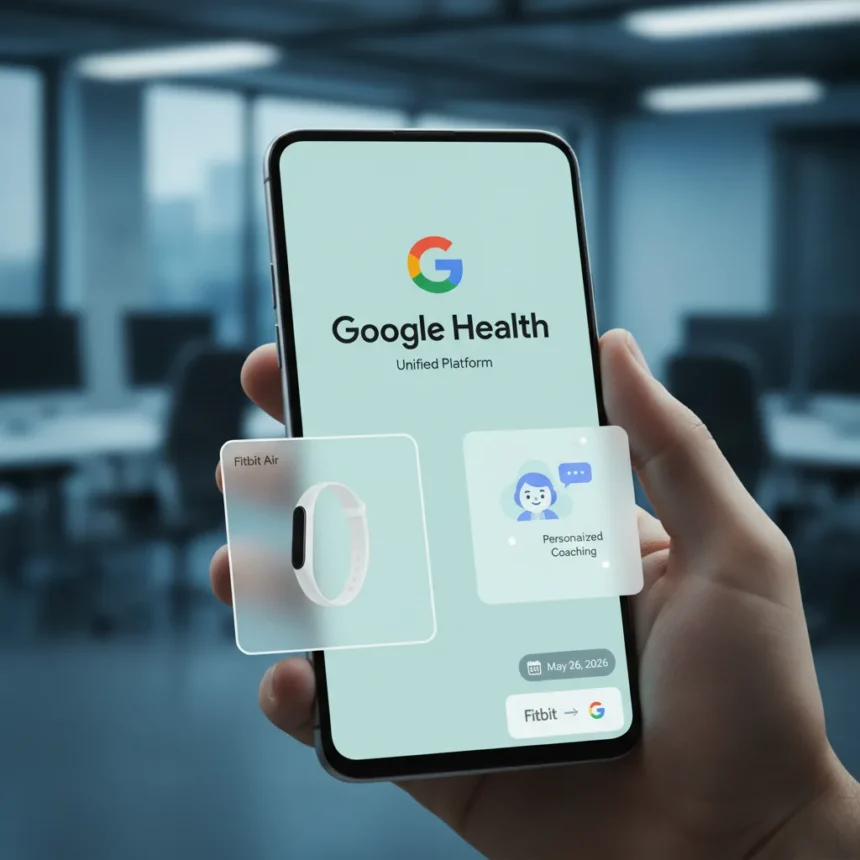
Fitbit app rebrands to Google Health on May 26, 2026, marking the final step in Google’s integration of the fitness brand it acquired in January 2021. The rebrand eliminates what remains of independent Fitbit branding, folding the legacy Google Fit app into a single Google Health ecosystem while introducing AI-powered coaching and a new screenless tracker called Fitbit Air.
Key Takeaways
- Fitbit app mandatory rollover to Google Health begins May 26, 2026, with full transition of Premium service
- Google Fit app features merged into Google Health; legacy users must migrate
- Fitbit Air screenless tracker launches simultaneously, weighs 12g, offers 7-day battery life
- Google Health Coach provides AI-driven workout plans, sleep tips, recipes, and injury advice
- Fitbit Premium subscription rebranded as Google Health subscription with mandatory redesign
The Fitbit app rebrands to Google Health: Why now?
Google has been quietly consolidating Fitbit into its broader health ecosystem since the 2021 acquisition. The company rebranded the app to Fitbit by Google in August 2022, then to Google Fitbit in March 2024. This May 2026 rebrand represents the final erasure of independent Fitbit identity, folding the entire service under the Google Health umbrella. The timing aligns with the launch of Fitbit Air, a screenless fitness tracker designed specifically for the new Google Health platform, signaling Google’s shift toward AI-driven health coaching rather than device-centric fitness tracking.
Long-time Fitbit users have grown increasingly frustrated with mandatory Google account requirements and successive rebrands. The transition to Google Health consolidates what were once separate apps—Fitbit and Google Fit—into a single interface, eliminating user choice about ecosystem fragmentation. For those invested in Fitbit’s original simplicity, the move feels like erosion rather than evolution.
What changes for existing Fitbit users
Fitbit Premium subscribers will see their service automatically rebranded as a Google Health subscription starting May 26, 2026, with a sweeping redesign that strengthens Google branding throughout the interface. Core Premium functionality—AI coaching, advanced insights, and personalized recommendations—will remain intact, but the visual overhaul and ecosystem shift signal that Fitbit as a recognizable brand is ending. Existing Fitbit device owners will continue to sync with the new Google Health app, though the experience will feel fundamentally different from the original Fitbit interface.


Users who have avoided Premium will gain access to Google Health Coach in the free tier, a significant shift from Whoop’s paid-only model. This positions Google to compete more aggressively in the screenless fitness tracker space, where Whoop has dominated by bundling hardware with mandatory subscriptions. Fitbit Air, by contrast, works with both free and paid Google Health tiers, making it more accessible to casual fitness trackers.
Fitbit Air and the screenless tracker revolution
Fitbit Air, the screenless tracker launching alongside the rebrand, weighs just 12 grams with a fabric band and stores seven days of detailed minute-by-minute motion data plus one day of workout data. The device echoes original Fitbit trackers—simple, unobtrusive, designed to be worn and forgotten. It offers seven-day battery life, iPhone compatibility, and deliberately omits notifications, apps, and live stats to maintain focus on passive background health tracking. Google designed Fitbit Air specifically for Google Health Coach, enabling the AI system to deliver personalized recommendations based on continuous motion and sleep data.


Compared to Whoop, Fitbit Air undercuts on both price positioning and accessibility. Whoop requires a paid subscription and works exclusively within its ecosystem; Fitbit Air functions with Google Health’s free tier, making it an entry point rather than a commitment. The device targets users who want passive health tracking without the friction of notifications or the cost of premium wearables, positioning Google to expand beyond Fitbit’s core audience of active fitness enthusiasts.
Google Health Coach: The real story
Google Health Coach—formerly Fitbit Coach—is the centerpiece of this rebrand, functioning as an AI personal assistant that provides workout plans, sleep optimization tips, recipes, and injury advice based on individual health data and stated goals. Unlike generic fitness apps, Health Coach learns from continuous data streams across Google Health’s ecosystem, including Fitbit Air’s motion tracking, sleep data, and user inputs. The system delivers recommendations that adapt to changing fitness levels, recovery patterns, and lifestyle factors.
This represents Google’s bet that AI-driven coaching will matter more than device hardware in the next era of fitness tracking. By bundling Health Coach with both free and Premium tiers, Google signals confidence that personalized AI recommendations will drive subscription conversions without requiring expensive wearables. Fitbit Air serves as the ideal data source for Health Coach, but users with older Fitbit devices will also benefit from the coaching features, creating an upgrade path that does not require new hardware.
What this means for the broader fitness ecosystem
The Fitbit app rebrand to Google Health reflects a larger strategic shift: Google is moving from acquiring and maintaining Fitbit as a standalone brand to absorbing it into a unified health platform that competes directly with Apple Health, Whoop, and Garmin. By eliminating Fitbit branding entirely, Google removes the last vestige of independent identity, making clear that Fitbit devices are now simply sensors feeding Google’s AI coaching engine. This consolidation also eliminates the awkwardness of maintaining two separate Google fitness apps—Google Fit and Fitbit—which confused users and diluted Google’s market presence.


For competitors, the move signals that Google is willing to invest heavily in AI coaching as a differentiator. Whoop has built its business on premium hardware bundled with mandatory coaching; Google is undercutting that model by offering coaching at the free tier. Garmin, meanwhile, focuses on advanced multisport tracking and offline navigation, a niche Google is not targeting. The rebrand positions Google as the mainstream AI fitness platform, betting that most users care more about personalized recommendations than specialized sports features.
Is Fitbit Air worth upgrading to?
Fitbit Air makes sense if you want a truly minimal tracker that syncs with Google Health Coach’s AI recommendations. The 12-gram weight, seven-day battery, and fabric band design appeal to users frustrated by heavy smartwatches or frequent charging. However, the lack of notifications, apps, or live stats means you cannot check your heart rate or steps without opening the app—a significant trade-off for minimalism. If you rely on real-time fitness data or notifications, Fitbit Air is not the right choice.
Will I lose features when Fitbit Premium converts to Google Health?
Google has not announced specific feature cuts, but the mandatory redesign and ecosystem consolidation create uncertainty. Core Premium features—AI coaching, advanced insights, and personalized recommendations—will transfer to Google Health, but the interface overhaul may alter how you access them. Long-time Fitbit Premium users should expect a learning curve and potentially streamlined navigation, though the underlying coaching functionality should remain intact.
Can I use Fitbit Air without a Google account?
No. Google has mandated Google account requirements for all Fitbit devices since the 2021 acquisition. Fitbit Air will require a Google account to sync and access Google Health Coach. This is a significant friction point for users who have resisted Google ecosystem integration, but it reflects Google’s strategy of treating Fitbit as part of its broader health platform rather than as an independent device ecosystem.
The Fitbit app’s rebrand to Google Health in May 2026 completes Google’s transformation of Fitbit from an independent fitness brand into a component of its AI-driven health platform. For existing users, the transition means accepting Google branding, mandatory account integration, and a redesigned interface in exchange for access to increasingly sophisticated AI coaching. For new users, Fitbit Air offers a genuinely minimal tracking option that works with free Google Health, positioning Google to compete with Whoop without requiring premium subscriptions. The real question is not whether the rebrand will happen—it will—but whether users who valued Fitbit’s simplicity will embrace Google’s AI-first vision of fitness tracking.
Edited by the All Things Geek team.
Source: TechRadar