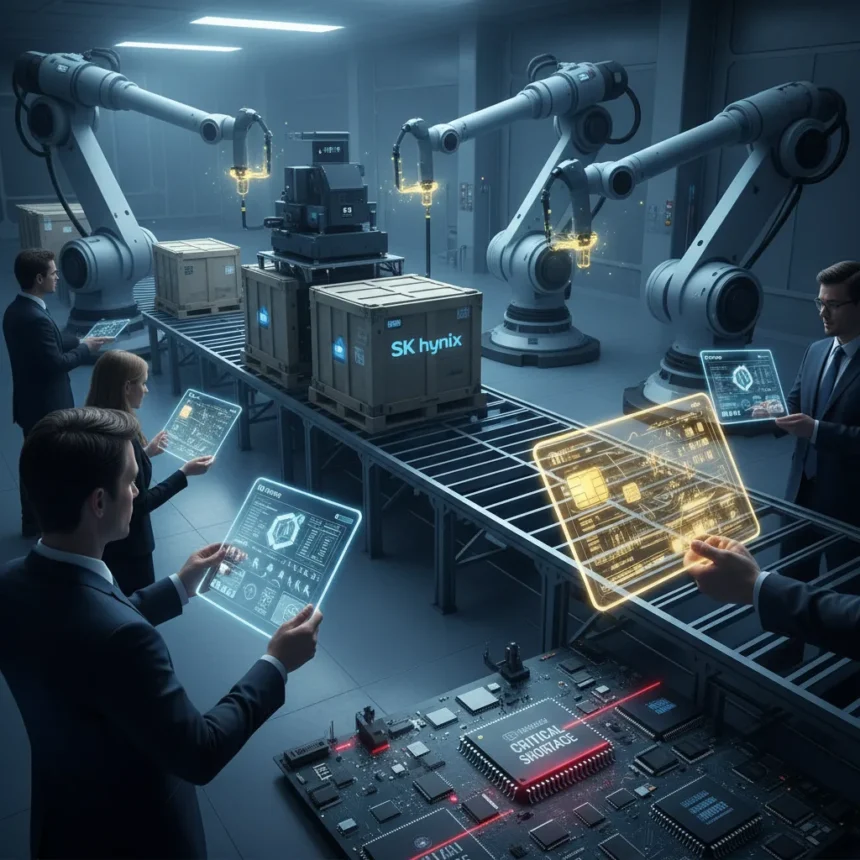
The AI memory shortage has reached a breaking point. SK hynix’s memory production capacity has hit zero, forcing customers to take an unprecedented step: directly purchasing Extreme Ultraviolet lithography machines and funding new fabrication lines to unlock supply. These offers, totaling hundreds of millions of dollars, reveal how desperate the semiconductor industry has become as AI-driven demand for high-bandwidth memory outpaces production at breathtaking speed.
Key Takeaways
- SK hynix’s HBM production capacity is completely exhausted, with no room for additional output without major capital infusions.
- Customers are offering to buy EUV machines and fund fab construction directly, a practice unheard of in semiconductor supply agreements.
- HBM demand has surged 5x year-over-year, with SK hynix’s HBM sales expected to double in 2024.
- SK hynix controls the majority of HBM3E supply for Nvidia’s H100 and H200 GPUs, making it a critical chokepoint.
- Memory shortages are forecast to persist until 2027 and beyond, with customers already reserving supply 2-3 years in advance.
How the AI memory shortage became critical
SK hynix’s CEO Kwang-Hyun Kim laid bare the scale of the problem: “Our customers are so desperate for capacity that they are offering to buy the EUV machines themselves and fund the fab lines.” An SK hynix executive added bluntly: “Capacity is zero. We have no more room to expand without these kinds of deals.” This is not hyperbole. The company’s overall memory sales grew 70% in Q2 2024, with HBM contributing over 20 of total revenue. That growth came despite zero available spare capacity—a situation that would be mathematically impossible without customers directly funding expansion.
The root cause is unambiguous: Nvidia’s AI GPU boom. SK hynix is the leading supplier of HBM3E memory, the specialized chip architecture that makes H100 and H200 GPUs function at scale. As data centers worldwide race to deploy AI infrastructure, demand for HBM3E has exploded. Customers are now reserving supply 2-3 years in advance, treating it as a strategic asset rather than a commodity. When normal supply channels cannot meet demand, customers bypass them entirely and write checks for equipment.
The unprecedented economics of AI memory shortage
Extreme Ultraviolet lithography machines cost approximately $200 to $380 million each, according to industry standards. SK hynix recently ordered $8 billion worth of EUV equipment to expand capacity. Yet even that massive outlay is insufficient. Customers are now offering to cover those costs directly, plus fund the construction of new fabs—a capital expenditure that normally falls entirely on the manufacturer. The total value of these offers exceeds hundreds of millions of dollars, though exact per-deal figures remain undisclosed.



This arrangement inverts the traditional semiconductor supply chain. Manufacturers typically invest in capacity, then sell output at market rates. Now, customers are becoming quasi-investors, absorbing capital risk to secure future supply. It is a signal of desperation that reverberates across the industry. SK hynix plans to invest $15.5 billion in 2024 alone, focusing heavily on HBM production. Even with that commitment, the company cannot move fast enough to meet demand.
Why SK hynix dominates and Samsung cannot fill the gap
SK hynix holds a commanding lead in HBM3E production, the specific memory type required for Nvidia’s latest GPUs. Samsung, the other major DRAM manufacturer, is also facing capacity constraints and has warned of AI-driven shortages lasting until 2027 and beyond. However, Samsung trails SK hynix significantly in HBM3E supply to Nvidia. Micron, the U.S.-based competitor, has lower exposure to the HBM shortage but operates at a smaller scale in advanced memory production. The result is a single-source bottleneck: SK hynix controls the supply that matters most, and customers have no viable alternative.



This concentration of supply explains why customers are willing to fund fab construction. They have no other choice. A shortage of commodity DRAM might be solved by switching suppliers or accepting higher prices. A shortage of HBM3E means data center AI deployments grind to a halt. That is leverage no supplier has ever wielded before, and SK hynix is exploiting it—not through price increases alone, but by extracting capital commitments from customers desperate to secure future allocations.
When will the AI memory shortage end?
Samsung and SK hynix have warned that AI-driven memory shortages could persist until 2027 and beyond. That timeline assumes aggressive fab expansion, which is now underway. SK hynix’s $15.5 billion investment, combined with customer-funded capacity additions, should accelerate production. However, building a new fab takes years. Equipment orders placed today may not result in production until 2026 or 2027. In the interim, the supply crunch will only worsen as AI adoption accelerates globally.
The AI memory shortage represents a fundamental mismatch between supply and demand that capital alone cannot quickly resolve. Even with customers bankrolling expansion, the semiconductor industry’s manufacturing timelines are measured in years, not quarters. Nvidia, cloud providers, and AI startups will continue competing fiercely for limited HBM supply throughout 2025 and 2026.
Is SK hynix raising prices due to the AI memory shortage?
The research brief does not specify HBM3E pricing or price increases. SK hynix’s revenue growth and the customer-funding phenomenon suggest strong pricing power, but exact price levels are undisclosed. Customers are clearly willing to pay premium rates, given their willingness to fund fab construction outright—a move that would only make economic sense if HBM supply commanded significant margins.


How long will customers keep funding SK hynix fab expansion?
Customer funding will likely continue as long as HBM supply remains critically scarce. Once new fabs come online and capacity normalizes, the incentive for customers to absorb capital costs disappears. However, that normalization is years away. Until 2027 or beyond, expect customer-funded expansion to remain a feature of the memory supply chain.
Will Samsung or Micron catch up to SK hynix in HBM production?
Samsung is expanding HBM capacity and faces the same customer pressure as SK hynix, but it trails in HBM3E supply to Nvidia. Micron operates at smaller scale. SK hynix’s lead in HBM3E is unlikely to erode significantly before 2027, meaning the company will continue commanding premium economics and customer-funded expansion.
The AI memory shortage has fundamentally altered semiconductor economics. Customers are no longer passive buyers waiting for supply to materialize—they are now active investors in manufacturing capacity, a role traditionally reserved for chipmakers. SK hynix’s zero available capacity and the hundreds of millions in customer-funded expansion offers reveal an industry under extreme stress, one where demand for AI chips has outpaced the manufacturing infrastructure built to serve it. Until new fabs reach production, this imbalance will only deepen, keeping SK hynix in the driver’s seat and customers at the mercy of supply scarcity.
Edited by the All Things Geek team.
Source: Tom's Hardware