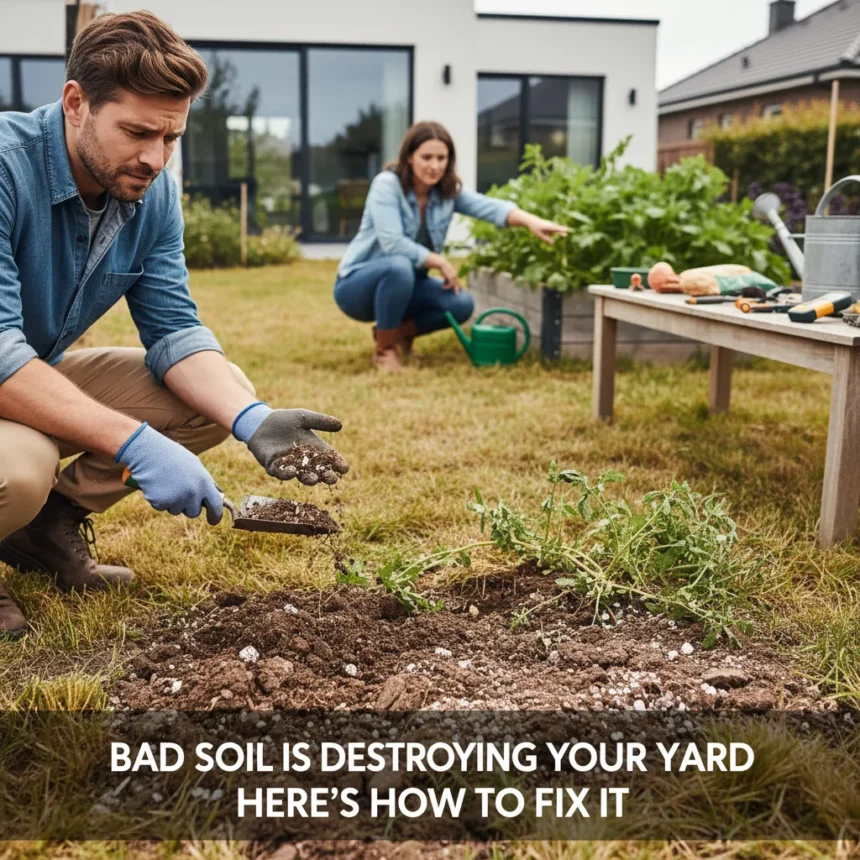
Bad soil destroying yard health is one of the most overlooked problems homeowners face. Poor soil quality undermines everything from grass growth to flower vitality, yet most people never investigate what lies beneath their feet until damage becomes visible.
Key Takeaways
- Soil problems are the root cause of most yard failures, not weather or plant genetics.
- Compacted, nutrient-depleted, and poorly draining soils are the three most common issues.
- Professional soil testing reveals exactly what your yard needs before you invest in fixes.
- Amending soil with organic matter works faster than waiting for natural decomposition.
- Regular soil maintenance prevents expensive yard overhauls years later.
Why Bad Soil Destroying Your Yard Happens in the First Place
Soil degradation occurs through multiple pathways, and most are preventable. Construction activity compacts soil, removing air pockets that plant roots need. Heavy foot traffic, especially on clay-heavy ground, accelerates this compression. Over time, topsoil erodes from rain and wind, leaving behind depleted subsoil that cannot support healthy plant growth. Nutrient depletion happens when you harvest plants, mow grass, or allow fallen leaves to be removed instead of decomposing back into the earth.
The real problem: most homeowners treat soil as inert material rather than a living ecosystem. Soil contains billions of microorganisms, fungi, and beneficial insects that break down organic matter and make nutrients available to roots. When you kill this ecosystem through chemical overuse, compaction, or neglect, the soil stops functioning. A yard with dead soil will fail no matter how much water or fertilizer you add, because the biological infrastructure that makes nutrients accessible simply does not exist anymore.
The Three Soil Problems Ruining Most Yards
Gardening experts consistently identify three dominant soil issues that destroy yards. First is compaction, where soil particles are pressed so tightly together that water cannot drain and roots cannot penetrate. Second is nutrient depletion, where essential elements like nitrogen, phosphorus, and potassium have been exhausted by years of plant growth without replenishment. Third is poor drainage or waterlogging, where soil either sheds water too quickly (sandy soil) or traps it (clay soil), creating conditions where roots rot or plants desiccate.


Compacted soil is especially destructive because it creates a cascading failure. Water pools on the surface instead of soaking in, so grass drowns in wet spots while other areas dry out. Roots cannot expand, so plants stay stunted. Microorganisms cannot survive in anaerobic conditions, so the soil becomes biologically dead. You can identify compacted soil by pressing a screwdriver into moist ground—if it stops within two inches, you have a serious problem.
Nutrient depletion manifests as yellowing leaves, weak growth, and increased pest susceptibility. Soil testing reveals the exact deficiency, but most homeowners guess and apply the wrong fertilizer, wasting money and potentially making things worse. Poor drainage is equally destructive but often misdiagnosed as a watering problem. Homeowners water less, thinking the soil is wet enough, when actually the real issue is that water cannot move through the soil profile at all.



How to Test Your Soil Before Attempting Fixes
Professional soil testing is the only reliable way to understand what you are actually dealing with. A soil test measures pH, nutrient levels, organic matter percentage, and texture composition. This data tells you exactly what amendments to add and in what quantities, eliminating guesswork. Most university extension services offer affordable soil testing for under thirty dollars, and results arrive within two weeks with specific recommendations tailored to your region and climate.
Without testing, you risk spending hundreds on amendments that do nothing. Adding lime to already-alkaline soil makes it worse. Adding nitrogen to nitrogen-rich soil promotes disease. A soil test prevents these expensive mistakes and gives you a baseline to measure improvement against. After you implement fixes, retest in one to two years to confirm the soil is actually improving.
Proven Fixes for Bad Soil Destroying Your Yard
Once you know your soil’s specific problems, fixes follow logically. For compacted soil, aeration is the first step—either mechanical core aeration or deep-tine forking breaks up the hardpan and restores air pockets. Follow aeration immediately with organic matter amendment. Compost, aged manure, or shredded leaves worked into the top four to six inches rebuild soil structure and reestablish the microbial ecosystem.
For nutrient depletion, amendment depends on your test results. If nitrogen is low, compost or a nitrogen-rich fertilizer addresses it. If phosphorus is deficient, bone meal works well. If potassium is lacking, wood ash or potassium sulfate corrects it. The key is applying the right nutrient in the right quantity—too much is as harmful as too little. Organic amendments like compost release nutrients slowly, feeding soil life while building long-term fertility. Synthetic fertilizers provide quick results but do nothing to improve soil structure or biology.



For drainage problems, the fix depends on whether drainage is too fast or too slow. Sandy soil that drains too quickly needs organic matter to increase water retention. Clay soil that drains too slowly needs organic matter to improve structure and create larger pores. In both cases, compost is the universal answer. Adding two to three inches of compost to the top six inches of soil transforms both extremes toward ideal balance. This takes effort, but it is far cheaper than replacing soil entirely or installing drainage systems.
Why Organic Matter Is the Foundation of Soil Recovery
Organic matter is not optional—it is the single most important ingredient in any soil recovery plan. Compost, aged manure, leaf mold, and shredded leaves all count. Organic matter improves clay soil by creating pore space and improving drainage. It improves sandy soil by increasing water-holding capacity. It feeds beneficial microorganisms that suppress disease and make nutrients available to roots. It buffers pH, reducing the need for lime or sulfur. It darkens soil, increasing heat absorption and extending the growing season.
The mistake most homeowners make is adding too little. A light dusting of compost does almost nothing. You need two to three inches worked into the top six inches of soil to see meaningful improvement. This sounds like a lot, but it is the difference between recovering your yard in one season versus fighting poor soil for years. Calculate your square footage, multiply by 0.17 (the amount needed to add two inches), and order compost in bulk—it is dramatically cheaper than bagged compost from garden centers.
How Long Does Soil Recovery Actually Take?
This is where patience matters. Heavily degraded soil with severe compaction and nutrient depletion improves noticeably within one season after aggressive amendment, but true recovery takes two to three years of consistent care. Moderately poor soil improves within one season. Slightly degraded soil shows improvement within weeks. The timeline depends on how bad the damage is, how much amendment you add, and whether you stop the behaviors that caused degradation in the first place.
The worst mistake is expecting instant results. Soil is a living system, and biology cannot be rushed. Microorganisms need time to colonize, reproduce, and establish food webs. Roots need time to explore and expand. Organic matter needs time to decompose and integrate. If you keep tilling, compacting, or applying chemicals, you reset the clock. Patience combined with consistent care beats heroic one-time interventions every time.
Can You Recover Soil Without Replacing It Entirely?
Yes. Unless your soil is contaminated with heavy metals or toxic chemicals, amendment works. Even severely compacted clay or depleted sandy soil recovers with proper treatment. The only scenario where replacement makes sense is if you have a small area—a raised bed or container garden—where the cost of new soil is comparable to amendment. For large yards, amendment is always more economical and more sustainable.
The key is committing to the process. If you amend once and then return to old habits—heavy foot traffic, removing all organic matter, ignoring soil health—degradation returns. Soil recovery requires ongoing care: mulching to protect the surface, avoiding unnecessary tilling, leaving fallen leaves to decompose, rotating plants, and reapplying compost every few years. This is not excessive maintenance—it is basic stewardship that any gardener should expect.
FAQ
What is the fastest way to fix bad soil?
Aeration combined with three inches of compost amendment shows the fastest results, typically within four to eight weeks for grass and eight to twelve weeks for ornamental plants. This approach addresses compaction, adds nutrients, and rebuilds soil biology simultaneously. Faster than this is not realistic—soil biology cannot be rushed.
How much does professional soil testing cost?
University extension services typically charge under thirty dollars for comprehensive soil testing. Private labs may charge fifty to one hundred dollars but often provide more detailed analysis. The investment pays for itself by eliminating guesswork and preventing expensive amendment mistakes.
Can I use kitchen compost on my yard if I have bad soil?
Yes, kitchen compost is excellent for amendment. However, if your soil is severely degraded, homemade compost alone is usually insufficient—you need volume. Bulk compost from landscape suppliers is more economical for large areas. Use homemade compost for smaller beds and containers while ordering bulk compost for yard-wide recovery.
Bad soil destroying your yard is fixable, but it requires understanding what is actually wrong before you can fix it. Get a soil test, amend aggressively with organic matter, and commit to ongoing care. Your yard will recover, and you will understand soil health in a way that prevents future problems.
Where to Buy
My soil store MySoil Soil Test Kit: | 17% OFFFelco F2 Pruning Shears$71$86shop now | Amazing StuffGarden Gloves$9.99shop now | 17% OFFLegigo6-Pack Tomato Cage for Garden Plant Support- Up to 48inch $27.54$32.99shop now
Edited by the All Things Geek team.
Source: Tom's Guide