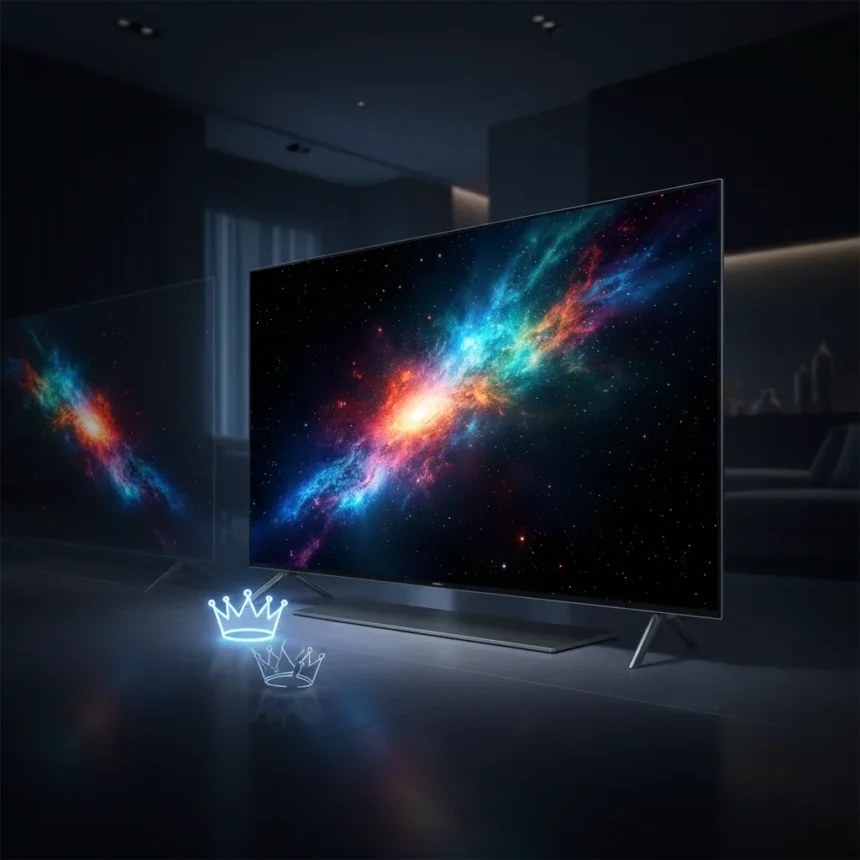
The Hisense UR9 RGB Mini LED is the first TV to bring RGB Mini LED technology to the mainstream market, and it challenges OLED like never before. The 65-inch model (65UR9STUK) launched in 2024 across the UK and Europe with a starting price of £2,699, though current discounts often bring it down to £2,200–£2,500. This VA LCD panel with Mini LED backlight delivers 3000 nits peak brightness in HDR, near-OLED black levels in dark scenes, and 98% DCI-P3 color coverage—a combination that forces a genuine reckoning with OLED’s decade-long dominance.
Key Takeaways
- RGB Mini LED uses individual red, green, blue sub-pixels per dimming zone for precise color control, unlike traditional white-only Mini LED.
- Peak brightness of 3000 nits matches professional displays and vastly exceeds OLED’s 1000–1500 nits, ideal for bright rooms.
- 144Hz native refresh rate with 13.5ms input lag makes it superior to mid-range OLEDs for PlayStation 5 and Xbox Series X gaming.
- Minor blooming in high-contrast patterns prevents it from achieving OLED’s perfect blacks, but dimming precision minimizes the issue.
- What Hi-Fi? awarded it 5 stars and Best TV 2024 in the £2,000–£3,000 category.
What RGB Mini LED Actually Does
RGB Mini LED is not just a marketing term—it is a fundamental architectural shift in how local dimming works. Traditional Mini LED TVs like the TCL C855 use white-only backlights divided into thousands of zones. Each zone dims or brightens as a single unit, which means a red object and a blue object in the same zone cannot be controlled independently. The Hisense UR9 solves this by splitting each dimming zone into individual red, green, and blue sub-pixels, allowing the TV to control color and brightness with far greater precision. The result is color that stays vibrant even in dark scenes, where traditional Mini LED would crush saturation to maintain contrast.
This architecture delivers what reviewers call near-OLED black levels. In dark scenes, the UR9 achieves the deep, inky blacks that made OLED the reference standard for a decade. But here is where it diverges: when a bright object appears in a dark scene—a lightsaber in a space film, a neon sign in a noir thriller—the UR9 can reach 3000 nits of brightness while OLED tops out around 1000–1500 nits. That is not a marginal difference. In a bright living room or during daytime viewing, OLED becomes nearly unwatchable. The UR9 remains fully visible and detailed.
Brightness, Contrast, and the Blooming Question
Peak brightness of 3000 nits is genuinely exceptional for a consumer TV. What Hi-Fi? lab tests confirmed this figure in HDR content, and the TV’s Hi-View Engine Pro AI processing ensures that brightness does not wash out color accuracy. The 98% DCI-P3 color gamut means colors are not just bright—they are accurate. Skin tones do not shift orange, and grass does not become neon green when the backlight ramps up.



The trade-off is blooming: a faint halo of light that bleeds around bright objects on dark backgrounds. In cross-pattern test sequences (white lines on black), the UR9 shows minor blooming. This is not the severe blooming of budget Mini LEDs, but it is noticeable if you are comparing it directly to an OLED, which has zero blooming because each pixel produces its own light. For film and general viewing, this matters less than you might think. Real content rarely features pure white lines on pure black. In actual films, the blooming is subtle enough that most viewers do not see it. Gamers and test-pattern enthusiasts will notice it. Everyone else will move on.
Gaming Performance and Motion Handling
The Hisense UR9 has a 144Hz native refresh rate and supports VRR (variable refresh rate) and ALLM (auto low-latency mode). Input lag measured at 13.5ms is low enough for competitive gaming. Both HDMI 2.1 ports support 4K/144Hz, so PlayStation 5 and Xbox Series X owners can run games at high frame rates without compromise. This is where the UR9 pulls decisively ahead of mid-range OLEDs. Most OLED TVs max out at 120Hz, and many budget OLEDs lack HDMI 2.1 entirely. For gamers, the UR9 is the faster, more responsive choice.



Motion handling is sharp. The VA panel’s fast response times mean motion blur is minimal, and the precise local dimming prevents the ghosting artifacts that plague some Mini LED sets. If you play fast-paced shooters or racing games, the difference between this and a 60Hz OLED is immediately apparent.
Audio and Smart Features
The 2.1.2-channel sound system delivers 80W total output with four 10W midrange drivers, two 15W woofers, and two 5W up-firing tweeters. Dolby Atmos and DTS:X support is included. For a TV speaker system, this is genuinely good—not a replacement for a soundbar, but capable of delivering immersive audio without external amplification. The VIDAA U7.6 smart OS is fast and customizable, with support for Netflix, Prime Video, Disney+, Apple TV+, and Freeview Play. Wi-Fi 6E and Bluetooth 5.3 ensure reliable connectivity, and eARC simplifies soundbar pairing.
Hisense UR9 vs. OLED: The Real Verdict
The UR9 does not dethrone OLED—it simply plays a different game. OLED remains superior for off-axis viewing (colors and contrast stay perfect at extreme angles, while the UR9 dims slightly) and for achieving mathematically perfect blacks with zero blooming. But the UR9 wins decisively in peak brightness, gaming performance, and price. A LG C4 or Samsung S95D OLED costs similarly but cannot match the UR9’s 3000-nit peak or 144Hz gaming speed. For bright rooms, gamers, and anyone who values motion handling, the UR9 is the better choice. For dark-room cinema enthusiasts who sit directly in front of the TV, OLED’s off-axis superiority and perfect blacks may still matter more.
Compared to other Mini LEDs, the UR9 is in a different league. The TCL C855 uses traditional white-only dimming and suffers from more blooming and color crushing in dark scenes. The Samsung QN90D has less precise dimming zones. The UR9’s RGB architecture is genuinely the first of its kind at this price point, and the performance gap is tangible.



Design and Connectivity
The UR9 is slim—just 4.3cm thick without the stand—with minimal bezels and a central pedestal that adjusts for height. Wall mounting is straightforward via VESA 400×300. At 28.5kg, it is manageable for two people. The four HDMI ports (two HDMI 2.1) cover most setups, and the inclusion of Wi-Fi 6E and Bluetooth 5.3 future-proofs connectivity. Ethernet is available for wired networks.
Is the Hisense UR9 worth the price?
At its current discounted price of £2,200–£2,500, the Hisense UR9 offers exceptional value. You are getting OLED-rivaling contrast, superior brightness, and gaming features that most OLEDs lack for less money. If you game, live in a bright room, or want the best picture quality without OLED’s brightness limitations, it is worth buying. If you are a dark-room purist and can tolerate minor blooming, it is still an excellent choice.
Does the UR9 have motion blur issues like other Mini LEDs?
No. The VA panel’s fast response times and precise local dimming minimize motion blur and ghosting. Gaming motion is sharp and responsive, rivaling dedicated gaming monitors in clarity.
Can the UR9 handle 4K/120Hz gaming on PS5?
Yes. Both HDMI 2.1 ports support 4K/120Hz, and the UR9 goes further with native 144Hz support for PCs and next-gen consoles. The 13.5ms input lag is low enough for competitive gaming.
The Hisense UR9 is not a perfect TV—no TV is. But it is the first RGB Mini LED to prove that the technology can challenge OLED in the mainstream market. For most viewers, it will deliver better real-world picture quality than an OLED in a bright room, and for gamers, it is simply the faster, more responsive choice. What Hi-Fi? named it Best TV 2024 in its price category, and that verdict stands. If you are shopping for a premium TV in 2025 and you game or live in a bright space, the UR9 deserves serious consideration.
Where to Buy
Edited by the All Things Geek team.
Source: What Hi-Fi?