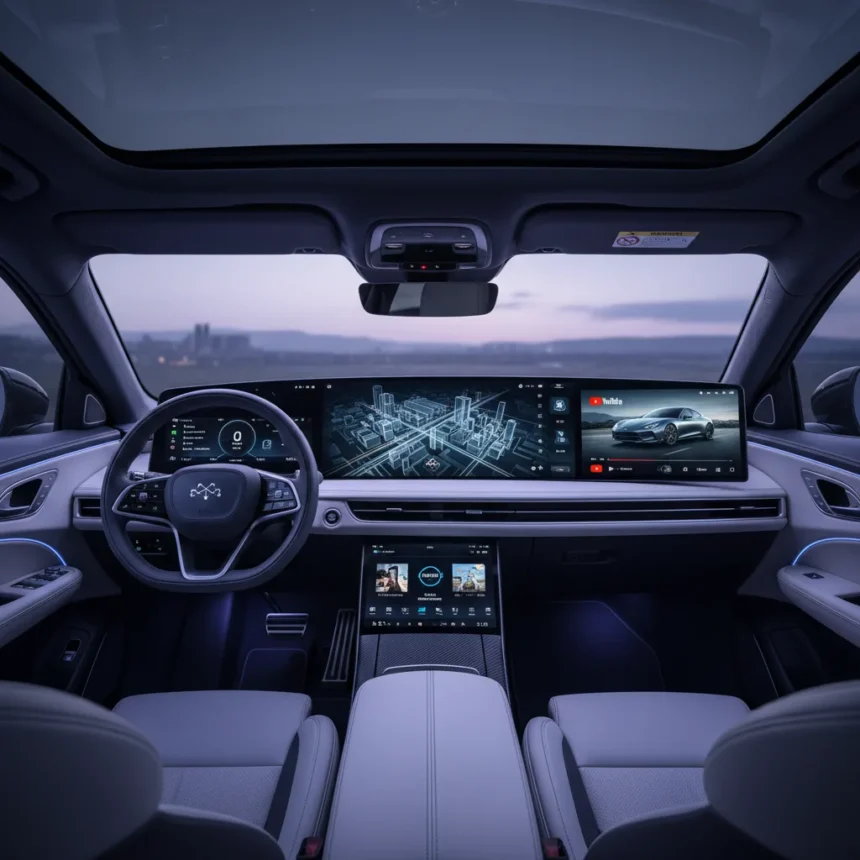
Android Auto’s AI upgrade represents Google’s most ambitious push yet to transform in-car infotainment, moving beyond simple phone mirroring into a deeply integrated, context-aware driving companion. The Android Auto AI upgrade, announced at Google I/O 2025, introduces Gemini AI, full-screen video playback for parked cars, Dolby Atmos spatial audio, and the biggest Google Maps redesign in over a decade—all rolling out throughout 2025 to over 250 million compatible vehicles worldwide.
Key Takeaways
- Android Auto AI upgrade replaces Google Assistant with Gemini for smarter contextual understanding across apps, messages, and vehicle systems
- Immersive Navigation in Google Maps delivers 3D visuals, enhanced lane guidance, and traffic light overlays—called the biggest Maps upgrade in over a decade
- Video playback support allows YouTube streaming in full HD at 60fps when parked, with Dolby Atmos spatial audio on compatible screens
- New Material 3 design overhaul includes customizable widgets, bolder typography, and pinnable information like weather, contacts, and smart-home controls
- Rolling out to 100+ vehicle models from 16 automotive brands, plus Android Auto app on phones
Android Auto AI Upgrade: What Google Is Actually Changing
Google’s redesign tackles a problem that has plagued Android Auto for years: it feels like an afterthought, a phone screen forced into a dashboard. The Android Auto AI upgrade changes that by treating the car as a first-class computing environment rather than a secondary display. The new Material 3 Expressive design language brings slicker animations, bolder typography, and genuine personalization—users can now pin key information directly to the home screen, from weather updates and favorite contacts to smart-home shortcuts like garage door controls. It is the most visible change, but the real transformation runs deeper.
Gemini integration is where the Android Auto AI upgrade actually matters. Unlike the older Google Assistant, Gemini understands context across your entire digital life—messages, emails, calendars, apps—and applies that understanding to driving. Google’s examples include auto-sharing addresses pulled from text messages, assisting with replying to messages, handling food orders, checking vehicle information, interpreting dashboard warning lights, controlling climate settings, and even determining whether items fit in your trunk. This is not just voice commands. It is a system that anticipates what you need.
Immersive 3D Navigation and Video Streaming: The Feature Set That Matters
The Android Auto AI upgrade’s navigation overhaul is substantial. Immersive Navigation in Google Maps now delivers detailed 3D visuals for roads, buildings, and terrain, enhanced lane guidance with traffic light indicators, and stop sign overlays—Google calls it the biggest Maps upgrade in over a decade. For Google built-in cars with onboard cameras, the system can use that hardware for even more precise lane-level guidance. This is not cosmetic. Better lane clarity and traffic light warnings reduce driver confusion at complex intersections.



Video playback is the feature that gets headlines, though it comes with a critical limitation: YouTube streams in full HD at 60fps only when the car is parked. This is a safety-first design choice, not a bug. Dolby Atmos support for immersive spatial audio on compatible car screens means entertainment when stationary actually sounds premium—a real advantage over older infotainment systems that compressed audio into tinny speakers. YouTube Music and Spotify are getting visual updates as part of the same rollout.
Hardware Requirements and Global Rollout Timeline
The Android Auto AI upgrade is not universal. It requires compatible hardware—Dolby Atmos speakers for spatial audio, displays capable of handling the new visual demands, and manufacturer approval. Google has secured partnerships with 16 automotive brands across more than 100 vehicle models running Android Automotive OS. The system adapts to various screen shapes and sizes, including ultrawide and circular displays, which matters as automakers experiment with different dashboard layouts. Rollout is happening throughout 2025, though exact regional timelines are not yet specified. For Android Auto app users on phones, the update will arrive through Google Play. For Google built-in cars, it depends on manufacturer implementation schedules.



Over 250 million Android Auto-compatible cars are on roads globally, making this one of the largest infotainment user bases in the world. Not all of them will receive every feature immediately—older hardware cannot support Dolby Atmos or 3D navigation without upgrades. This creates a tiered rollout where newer cars and recent Android Auto users see the full suite while older vehicles get incremental updates. It is a pragmatic approach, but it also means the Android Auto AI upgrade experience will vary significantly depending on your car’s age and hardware.
How the Android Auto AI Upgrade Compares to What Came Before
The previous Android Auto relied heavily on Google Assistant, a system designed for phones and smart speakers, not cars. It was reactive—you asked it a question, it answered. Gemini changes that to proactive assistance. The older design also treated video and spatial audio as non-starters for driving; the new system separates safety (no video while moving) from entertainment (full video when parked). The Material 3 redesign replaces a dated interface that felt borrowed from Android phones. These are not incremental tweaks. They represent a fundamental shift in how Google thinks about in-car software.
Compared to older infotainment systems from traditional automakers, the Android Auto AI upgrade brings a clear advantage: it is powered by Google’s AI infrastructure and maps data, which are years ahead of proprietary automotive solutions. Traditional car makers build infotainment in-house or license aging platforms; Google is deploying real-time machine learning and contextual AI directly to the dashboard. That gap will only widen as Gemini improves.
What This Means for Drivers and the Automotive Industry
The Android Auto AI upgrade signals that in-car software is no longer an afterthought. Google is investing heavily because cars now have screens, compute power, and connectivity that rival tablets. The shift also reflects a broader industry trend: as electric vehicles proliferate and autonomous features advance, the infotainment system becomes a central user experience. A better interface and smarter AI reduce driver distraction and frustration—genuine safety improvements, not just marketing.


For drivers, the practical benefit is less fumbling with phones while driving. Gemini can read a text and draft a reply without taking your eyes off the road. Immersive Navigation shows you exactly which lane to use before you need to switch. Video streaming when parked means you can watch something while waiting for a passenger. These are small conveniences individually, but collectively they make the driving experience less chaotic.
Is the Android Auto AI upgrade rolling out to my car in 2025?
The update is rolling out throughout 2025 to over 250 million compatible vehicles, but the exact timing depends on your car manufacturer and whether you use Android Auto via phone or have a Google built-in system. Newer cars and recent Android Auto app users will see updates first. Check your car’s infotainment settings or the Google Play Store for Android Auto to see if an update is available.
What is the difference between Android Auto and Google built-in cars?
Android Auto is phone projection—you plug in your phone and its interface appears on your car’s screen. Google built-in (Android Automotive OS) is native software installed directly in the car’s hardware by the manufacturer. The Android Auto AI upgrade benefits both, but Google built-in cars can use deeper hardware integration, like onboard cameras for more precise lane guidance in Immersive Navigation.
Can I watch YouTube videos while driving in the Android Auto AI upgrade?
No. YouTube streams in full HD at 60fps only when the car is parked, a deliberate safety restriction. Once you start driving, video playback stops. This is by design—Google prioritizes safety over convenience.
The Android Auto AI upgrade is not a miracle cure for in-car software. It is, however, the first time Google has treated the car as a serious platform rather than a secondary screen. Gemini’s contextual understanding, 3D maps, and parked video streaming represent real improvements in how drivers interact with their vehicles. The rollout will be gradual and hardware-dependent, but for the 250 million drivers who have Android Auto compatible cars, the next few months will bring the most significant infotainment update in years.
Edited by the All Things Geek team.
Source: TechRadar