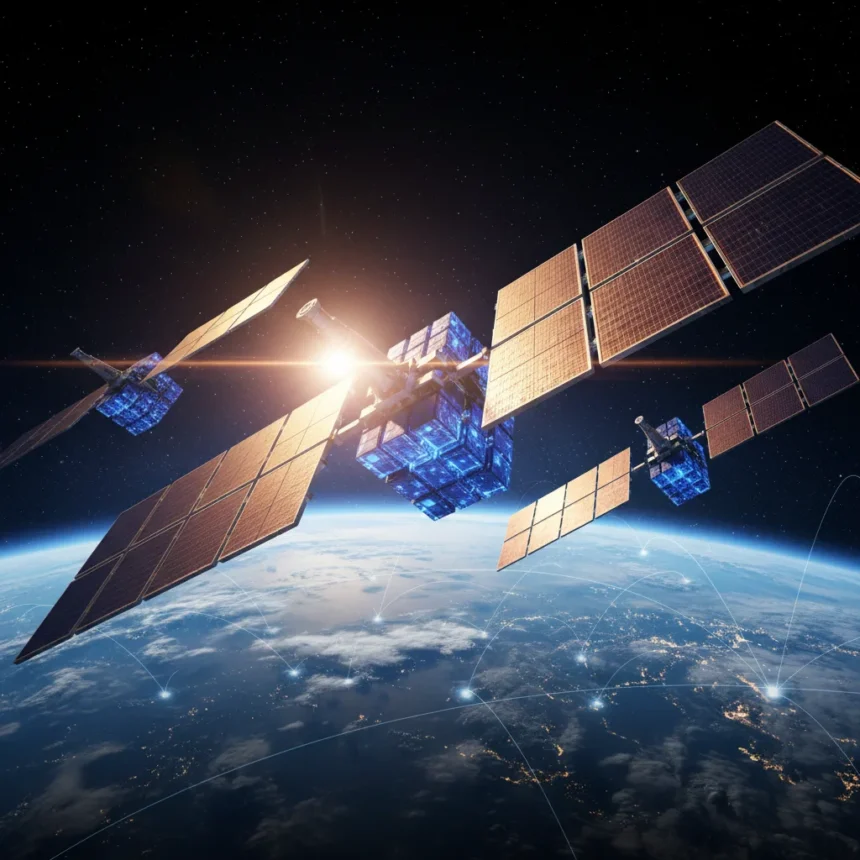
Space data centers are about to become real. Google is pursuing Project Suncatcher, an ambitious research moonshot to scale machine learning compute in orbit using solar-powered satellite constellations equipped with Tensor Processing Units (TPUs) and free-space optical inter-satellite links. The project represents a fundamental shift in how the world might power AI infrastructure as terrestrial energy demands spiral out of control.
Key Takeaways
- Project Suncatcher deploys TPU-equipped satellites in dawn-dusk sun-synchronous orbits for near-constant solar power generation.
- Space-based solar panels generate up to 8x more power than terrestrial solar installations due to continuous sunlight exposure.
- Satellites communicate via laser optical links to distribute machine learning tasks across the constellation.
- Two prototype satellites scheduled for launch in early 2027 via partnership with Planet.
- Full viability depends on launch costs dropping below $200/kg by the mid-2030s, driven by companies like SpaceX.
Why AI Energy Demands Are Pushing Google Toward Orbit
The math is brutal. Training and running state-of-the-art AI models consumes staggering amounts of electricity, and terrestrial data centers face hard physical limits on cooling and power density. Space offers an alternative: unlimited sunlight and zero atmosphere to dissipate heat. Google’s space data centers concept sidesteps these constraints by placing compute hardware where solar energy is most abundant and most constant. The dawn-dusk sun-synchronous orbit that Project Suncatcher targets keeps satellites in perpetual twilight, maximizing solar exposure without the day-night cycle that cripples terrestrial solar farms. This architectural choice alone could enable continuous operation without battery storage overhead.
The efficiency gain is staggering. Satellites in these orbits generate up to 8x more power per square meter than ground-based solar panels. That power advantage directly translates to lower operational costs per unit of compute—the holy grail for AI infrastructure economics. If Google can achieve its target launch cost of roughly $200 per kilogram by the mid-2030s, space-based data centers become cost-competitive with terrestrial facilities on a per-kilowatt-per-year basis. That threshold is achievable only if launch costs continue falling at the rate SpaceX has demonstrated.
How Project Suncatcher’s Architecture Actually Works
Project Suncatcher is not a single satellite—it is a constellation of networked nodes. Each satellite carries TPUs for machine learning workloads and free-space optical communication equipment for laser-based links to neighboring satellites. This distributed architecture allows tasks to be split across multiple orbital nodes, turning the entire constellation into a single logical compute fabric. Data flows between satellites via laser beams rather than radio, enabling higher bandwidth and lower latency than traditional satellite communication.

The constellation operates in a carefully orchestrated dance. Satellites maintain their dawn-dusk sun-synchronous orbits, staying perpetually on the terminator line between Earth’s day and night side. This positioning keeps solar panels pointed at the sun continuously while avoiding the thermal extremes of full daylight or total darkness. Ground stations would uplink training data and models, the constellation would process them in parallel across its nodes, and results would downlink to Earth. The laser inter-satellite links are the critical innovation—they allow compute to remain in orbit rather than requiring constant back-and-forth communication with terrestrial facilities.
The 2027 Prototype and Path to Viability
Google is not waiting until the 2030s to test this vision. Two prototype satellites are scheduled for launch in early 2027 via a partnership with Planet, an Earth imaging company. These orbiters will validate three critical unknowns: whether TPU hardware functions reliably in the radiation environment of low Earth orbit, whether machine learning models train effectively in space, and whether free-space optical links work as designed. Success in any one of these areas would be noteworthy. Success in all three would shift space-based compute from theoretical to demonstrable.



The 2027 launch is the inflection point. If the prototypes fail, the entire moonshot stalls. If they succeed, Google gains proof that space data centers are not just physically possible but operationally viable. That validation would likely trigger investment from other cloud providers and trigger a wave of space infrastructure development. The prototype timeline is aggressive—roughly two years away—which suggests Google has already solved enough of the engineering challenges to commit to hardware development.
Why Launch Costs Are the Real Bottleneck
Every economic analysis of space data centers bottoms out on a single variable: launch cost per kilogram. Google’s target of $200/kg by the mid-2030s is not arbitrary. It is the price point where deploying compute in space becomes cheaper than building and powering equivalent terrestrial data centers. SpaceX’s Falcon 9 reusability program has driven launch costs down by an order of magnitude over the past decade. If that trajectory continues, $200/kg is plausible. If launch costs stall, space data centers remain a research curiosity.
This dependency on SpaceX’s roadmap is both a strength and a vulnerability. SpaceX has publicly committed to further cost reductions through Starship development, but aerospace timelines slip routinely. Google cannot control SpaceX’s engineering progress, which means Project Suncatcher’s commercial viability rests partly on external factors. That said, Google’s willingness to announce the project and commit to 2027 prototypes suggests internal confidence that launch costs will cooperate.
Space Data Centers vs. Terrestrial Alternatives
Traditional data centers offer proven economics and instant deployment. You build a facility, plug in servers, and they work. Space data centers require solving radiation hardening, thermal management in vacuum, and orbital mechanics—problems terrestrial facilities never face. The payoff is energy efficiency and unlimited scalability, but only after solving those problems at scale.



Starcloud and other emerging space infrastructure companies are exploring similar concepts, but Project Suncatcher’s advantage lies in Google’s access to custom silicon (TPUs designed specifically for AI workloads) and its research infrastructure. A space-based TPU is not simply a terrestrial TPU launched into orbit—it must be redesigned to tolerate cosmic radiation, operate in vacuum, and manage heat dissipation without convection. Google’s silicon expertise and AI research depth give it an edge competitors lack.
What Happens If Project Suncatcher Succeeds?
If the 2027 prototypes validate the core concepts, the implications ripple across the entire AI industry. Cloud providers would face pressure to develop space infrastructure or risk being outcompeted on energy efficiency. Launch providers would see demand for orbital deployment skyrocket. Satellite manufacturers would pivot to building compute-capable platforms rather than communications or imaging hardware. The geopolitical implications are equally profound—nations with advanced space capabilities and AI expertise would dominate AI infrastructure economics.
For Google specifically, space data centers would solve the energy constraint that currently limits AI scaling. Terrestrial data centers can only grow so large before power grids buckle. Orbital infrastructure breaks that ceiling. Google could train larger models, run more inference workloads, and offer cheaper AI services to customers—a competitive advantage worth billions.
Is Project Suncatcher realistic or just hype?
The 2027 prototype timeline and partnership with Planet suggest Google has moved beyond theoretical research. The project is grounded in physics that works—satellites have operated in space for decades, solar power in orbit is proven, and optical communication links are mature technology. What is unproven is scaling all three together in a constellation optimized for machine learning workloads. That is hard engineering, but not impossible engineering.
How much will space data centers cost compared to terrestrial facilities?
Google targets cost parity with terrestrial data centers on a per-kilowatt-per-year basis by the mid-2030s, assuming launch costs drop to roughly $200 per kilogram. That assumes success in reducing launch costs and scaling orbital infrastructure. Actual pricing will depend on how quickly SpaceX and other providers achieve those cost targets, and whether Google can manufacture and deploy satellites at scale.
When will space data centers be commercially available?
The earliest realistic timeline is the mid-2030s, after the 2027 prototypes are validated and launch costs fall to the target threshold. That is a decade away. Interim milestones include the 2027 prototype launch and validation of TPU performance in orbit. Full commercial deployment would require constellation-scale satellite manufacturing, which is itself a multi-year engineering challenge.
Project Suncatcher is not science fiction—it is a credible research program with hardware launching in two years. Whether it reshapes AI infrastructure depends on engineering execution and launch cost trajectories beyond Google’s direct control. The 2027 prototypes will answer the hard technical questions. The mid-2030s will answer whether the economics work. Until then, space data centers remain the most ambitious bet on the future of AI compute.
Edited by the All Things Geek team.
Source: Tom's Hardware