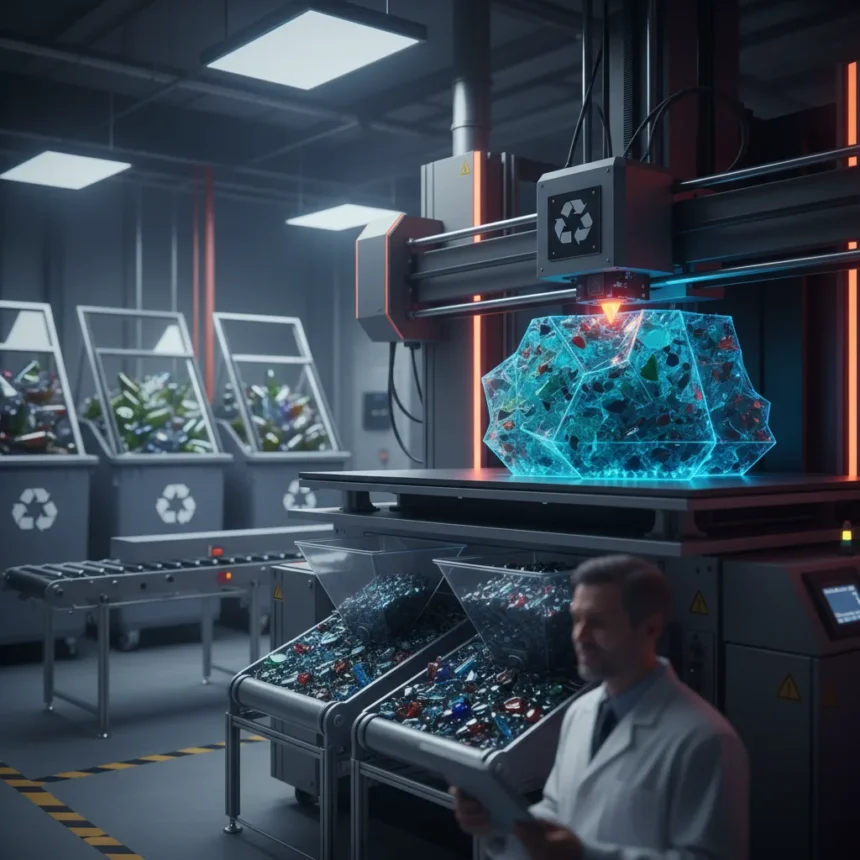
3D printing recycled glass represents a fundamental shift in how manufacturers can turn waste streams into finished products. A new binder jet process combines glass powder with an adhesive agent in successive layers to build three-dimensional objects, offering a pathway to reduce both material costs and environmental impact in industries from architecture to industrial design.
Key Takeaways
- Binder jet technology applies adhesive to glass powder layers to create solid objects without melting.
- Recycled glass feedstock reduces reliance on virgin materials and diverts waste from landfills.
- The process works at lower temperatures than traditional glass manufacturing, cutting energy consumption.
- Applications span decorative items, architectural elements, and functional components.
- Startup innovation is pushing 3D printing recycled glass toward commercial viability.
How Binder Jet Technology Transforms Recycled Glass
The binder jet process differs fundamentally from traditional 3D printing methods. Instead of melting or heating glass, the system spreads a thin layer of glass powder and applies a liquid adhesive that binds particles together. The platform then lowers, and another powder layer is applied. This cycle repeats until the object is complete. The result is a solid glass structure built entirely through room-temperature adhesion, eliminating the energy-intensive furnace work that dominates conventional glass manufacturing.
This approach makes recycled glass a practical feedstock. Post-consumer glass—bottles, jars, windows—can be crushed into powder without complex reprocessing. The adhesive bonds the particles regardless of their origin or prior use, meaning manufacturers can blend different glass colors and types into a single print. The flexibility opens doors to products that would be economically impossible through traditional casting or molding.
Why 3D Printing Recycled Glass Matters Now
Manufacturing waste and energy consumption are driving urgent pressure on industries to innovate. Glass production alone accounts for roughly 2% of global industrial energy use, much of it spent on heating furnaces to extreme temperatures. A technology that eliminates that heating step while consuming post-consumer waste addresses two critical pain points simultaneously. For startups and manufacturers, 3D printing recycled glass becomes not just an environmental gesture but a competitive advantage.

The timing also reflects broader market demand. Architects and designers increasingly specify sustainable materials in projects. Consumers and corporate buyers are scrutinizing supply chains. A manufacturing method that can deliver custom glass components on-demand, using recycled feedstock, and without the carbon footprint of traditional production, aligns with these shifting expectations. Early adoption by forward-thinking manufacturers can establish brand differentiation and capture market share in sustainability-conscious segments.
Technical Advantages and Current Limitations
The binder jet approach offers distinct advantages over other additive manufacturing methods. Unlike selective laser sintering (SLS), which requires high-powered lasers and generates significant heat, binder jet operates with minimal thermal input. Unlike fused deposition modeling (FDM), which is limited to polymers, binder jet works with ceramic and glass powders, enabling production of materials with inherently superior hardness, chemical resistance, and thermal stability.



Current limitations remain real. Binder jet-printed glass objects may be more porous than traditionally cast glass, affecting optical clarity and structural strength in certain applications. The adhesive agent’s properties—strength, water resistance, thermal stability—determine the final object’s performance. Refinement of adhesive chemistry is an active frontier. Additionally, post-processing steps (curing, potentially heat treatment) may be necessary to achieve desired durability, adding cost and complexity compared to the simplified manufacturing narrative.
Applications Emerging in Architecture and Design
Early applications cluster in decorative and architectural domains where optical perfection is less critical than material flexibility and customization. Designers are exploring 3D printing recycled glass for light fixtures, wall panels, sculptural elements, and bespoke architectural features. The ability to print complex geometries—hollow forms, intricate lattices, integrated channels—opens design possibilities that traditional glass fabrication cannot easily achieve.
Industrial applications are slower to emerge but represent the higher-value opportunity. Components requiring chemical or thermal resistance—laboratory equipment, industrial fixtures, specialized containers—could benefit from glass’s inherent properties if manufacturing costs drop and material properties improve. The startup ecosystem is focused on proving reliability and consistency in these domains, moving beyond one-off artistic pieces toward production-scale manufacturing.
Competitive Landscape and Manufacturing Alternatives
3D printing recycled glass does not exist in isolation. Traditional glass recycling already diverts significant material from landfills, though it typically returns to furnace-based production. Competing additive technologies—ceramic 3D printing, resin-based systems, metal additive manufacturing—serve overlapping markets. The question for manufacturers is not whether to adopt 3D printing recycled glass universally, but where it outperforms alternatives on cost, sustainability, or design capability.



For applications where traditional glass manufacturing is entrenched and efficient, binder jet technology must prove cost parity or superiority. For applications where customization, complex geometry, or rapid prototyping add value, the technology has clearer advantages. The competitive advantage of 3D printing recycled glass lies in the intersection of sustainability demand and design freedom, not in replacing all glass production overnight.
What happens to printed glass objects after they’re used?
Printed glass objects remain glass and can re-enter recycling streams like any other glass product. The adhesive agent is the variable—depending on its chemistry, it may be separable or may remain bonded to the glass particles. Startups developing this technology are beginning to address end-of-life scenarios, designing adhesives that either remain stable indefinitely or degrade safely in recycling processes.
Is binder jet the only 3D printing method suitable for glass?
No. Stereolithography (SLA) and selective laser sintering (SLS) can also process glass-filled resins or glass powders, though each method involves trade-offs. Binder jet stands out for its simplicity, low thermal input, and compatibility with recycled feedstock, but it is not universally superior—different applications may favor different technologies.
How does the cost of 3D printing recycled glass compare to traditional glass manufacturing?
Current costs remain higher for small production runs, but the equation shifts as volume increases and adhesive chemistry improves. For custom or low-volume applications, binder jet can be cost-competitive immediately. For high-volume commodity glass products, traditional manufacturing retains cost advantages. The economic crossover point is moving in favor of 3D printing recycled glass as the technology matures.
The emergence of 3D printing recycled glass signals a broader shift in manufacturing philosophy—away from energy-intensive, waste-generating processes toward methods that integrate recycled materials, reduce thermal footprints, and enable on-demand customization. Whether this technology becomes a mainstream production method or remains a niche capability depends on continued innovation in adhesive chemistry, material consistency, and cost reduction. For now, it represents a tangible proof that sustainable manufacturing and advanced technology can converge, and early adopters are positioning themselves to capture value as the market develops.
Edited by the All Things Geek team.
Source: Tom's Hardware