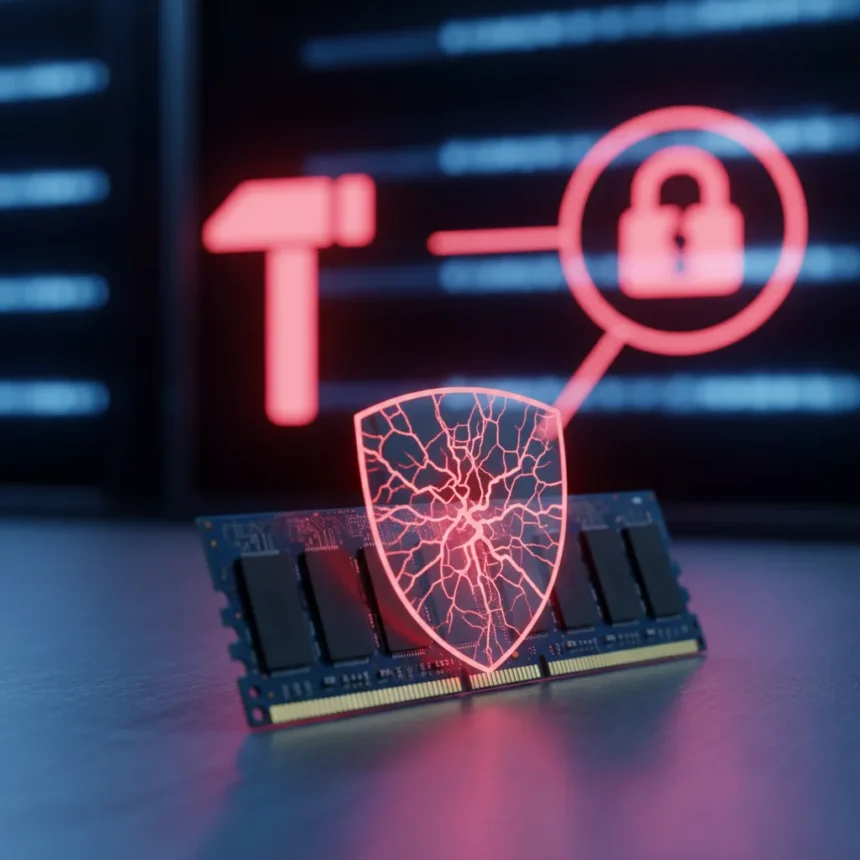
The Rowhammer vulnerability has just exposed a fundamental flaw in how enterprises think about endpoint security. Researchers at ETH Zürich’s COMSEC lab have demonstrated that their Blacksmith fuzzing technique bypasses Target Row Refresh (TRR) protections on 100% of tested DDR4 DRAM modules, shattering vendor claims about memory safety.
Key Takeaways
- Blacksmith bypasses TRR mitigations on all 40 tested PC-DDR4 modules, compared to TRRespass’s 31% success rate.
- Rowhammer exploits electrical charge manipulation to flip bits in adjacent memory rows through repeated access patterns.
- Traditional 3-5 year PC refresh cycles are financially obsolete given persistent firmware and memory vulnerabilities.
- DDR5’s refresh management architecture may reduce Rowhammer risks compared to DDR4’s TRR approach.
- ECC DRAM makes exploitation harder but remains insufficient as a complete defense mechanism.
What is the Rowhammer vulnerability and why does it matter now?
Rowhammer vulnerability refers to a class of attacks that manipulate electrical charge in DRAM by repeatedly accessing one row of transistors, causing bit flips in adjacent rows. The significance lies in timing: as enterprises scale AI workloads and memory demand surges, the discovery that Blacksmith defeats every tested DDR4 protection mechanism undermines the assumption that hardware isolation alone secures endpoints. COMSEC researchers concluded that vendor protections create a false sense of security, leaving systems more vulnerable than previously assumed.
The attack works by hammering specific memory addresses at precise intervals, forcing the electrical charge that represents stored bits to leak into neighboring rows. Once bit flips occur in unintended memory regions, attackers can escalate privileges, break encryption, or extract sensitive data. What makes Blacksmith different from prior Rowhammer techniques is its success rate: where the same team’s earlier TRRespass method triggered bit flips on 31% of tested devices, Blacksmith achieved 100% success across all 40 tested modules over a 256 MB contiguous memory area.
Why endpoint refresh cycles are broken
Enterprise IT has relied on a predictable hardware lifecycle: replace endpoints every 3-5 years, assume newer hardware has better protections, move on. The Rowhammer vulnerability breaks this assumption entirely. If all current DDR4 modules are exploitable regardless of when they were manufactured, then simply aging out older machines does not eliminate risk—it merely delays it. A PC purchased today with DDR4 will remain vulnerable throughout its entire lifecycle, even as newer systems arrive.


This forces a reckoning. IT teams cannot patch Rowhammer the way they patch software vulnerabilities. The flaw exists at the hardware level, in the physical properties of DRAM itself. Replacing DDR4 with DDR5 is the only mitigation path, but that requires wholesale hardware refresh—not in 3-5 years, but urgently, across entire fleets. The financial and logistical burden of accelerated replacement contradicts the cost assumptions that drove endpoint budgets for the past decade.
DDR5 refresh management versus DDR4 TRR
The architectural difference between DDR4 and DDR5 memory protection is significant. DDR4 relies on Target Row Refresh, a technique that attempts to identify and refresh rows at risk of bit flips. Blacksmith’s success proves TRR is insufficient—attackers can craft access patterns that TRR cannot detect or prevent. DDR5 replaces this with a refresh management system that operates differently, potentially reducing the window for Rowhammer exploitation.



However, DDR5 adoption is not instantaneous. Memory demand currently outpaces supply, and many enterprises have only begun transitioning to DDR5 systems. Legacy DDR4 infrastructure will persist for years. ECC DRAM, which adds error-correcting code to detect and fix bit flips, makes Rowhammer harder to exploit but does not eliminate it—attackers can still flip bits; they simply need more attempts or more precision to avoid detection.
The broader endpoint security reckoning
Rowhammer vulnerability exposes a structural problem in how enterprises approach endpoint security: over-reliance on periodic hardware replacement and assumptions about vendor protections. When memory vendors claim their protections work, IT teams assume the claim is validated. When refresh cycles are set at 3-5 years, teams assume that timeline is adequate. Rowhammer proves both assumptions wrong simultaneously.
The vulnerability also highlights the challenge of firmware-level threats. Unlike software vulnerabilities that vendors patch regularly, hardware flaws require replacement. This shifts endpoint security from a software-patching model to a hardware-replacement model—a far more expensive and disruptive approach. IT teams must now evaluate whether current endpoints remain trustworthy, whether accelerated replacement is justified, and how to budget for unexpected hardware lifecycles driven by security rather than performance obsolescence.
Can ECC DRAM fully protect against Rowhammer?
ECC DRAM makes Rowhammer exploitation significantly harder by detecting and correcting single-bit errors. However, it is not a complete defense. Attackers can still trigger bit flips; they simply need to craft more sophisticated patterns or accept lower reliability. ECC adds overhead and cost, and not all systems support it. For endpoints without ECC, Rowhammer remains fully exploitable.



When will DDR5 adoption eliminate this risk?
DDR5’s refresh management architecture may reduce Rowhammer risk, but widespread adoption depends on memory availability and enterprise replacement cycles. Given current memory demand surges, full DDR5 migration across enterprise fleets will take years. In the interim, DDR4 systems remain vulnerable, forcing IT teams to make difficult choices about accelerated replacement, ECC upgrades, or accepting elevated risk.
The Rowhammer vulnerability is not a temporary crisis that will resolve itself through normal hardware replacement cycles. It is a permanent feature of DDR4 architecture that requires active, immediate response. Enterprises that assume their current endpoint refresh strategy remains adequate are betting on luck, not security. The time to rethink endpoint lifecycle management is not in 3-5 years—it is now.
Edited by the All Things Geek team.
Source: TechRadar