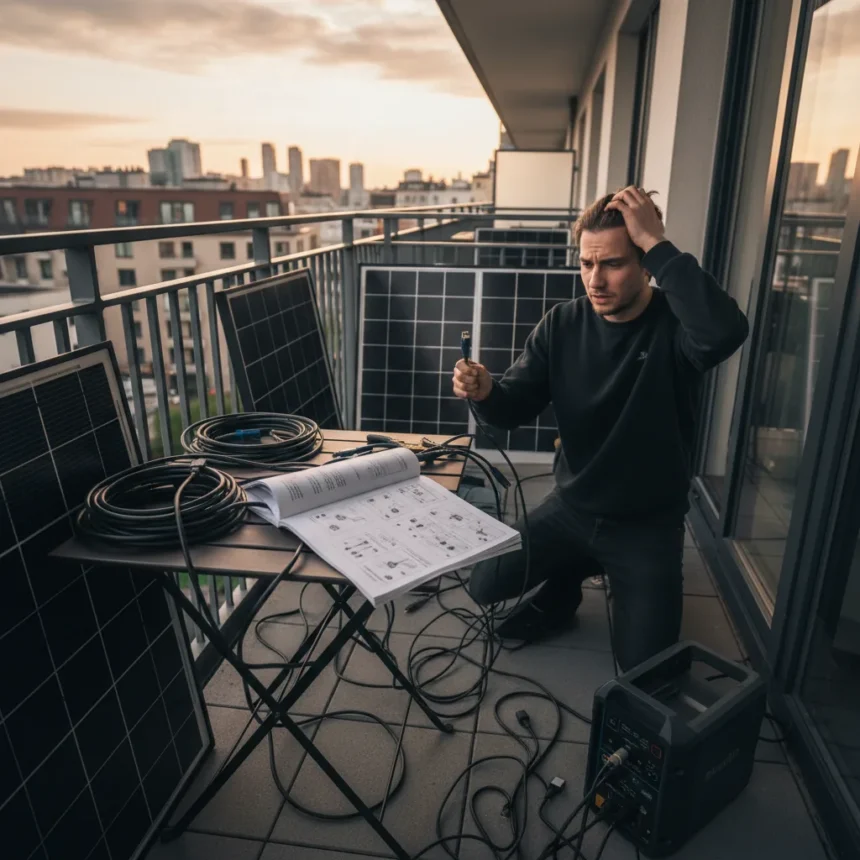
Bluetti’s plug-and-play home solar promise sounds ideal: snap together a few modules, plug into your balcony, and generate your own power without permits or electricians. The company launched the Balco series at a Paris event, claiming to finally solve residential solar’s biggest barrier—installation complexity. After examining the system at launch, the reality is more complicated than the marketing suggests.
Key Takeaways
- Bluetti launched Balco 260 and Balco 500 systems designed for balcony solar with minimal setup complexity.
- Balco 260 outputs up to 2,300 W; Balco 500 reaches 3,680 W maximum with 4,300 W solar capture capability.
- Both systems expand modularly—Balco 260 scales to 15 kWh storage and 14.4 kW solar input across 6 units.
- Balco Transfer Hub enables grid-tied operation with portable power stations via smart controls.
- Plug-and-play claim masks real complexity: grid compliance, mounting, and multi-unit coordination remain non-trivial.
What Bluetti Actually Announced
Bluetti unveiled two core products in the Balco series: the Balco 260 and Balco 500, both marketed as modular, expandable systems for residential solar generation. The Balco 260 delivers up to 2,300 W total output by combining battery storage with grid input and can expand from a single unit to six units, scaling storage capacity to 15 kWh and solar input to 14.4 kW. The Balco 500 operates at higher voltage—a 70-140 V MPPT design—capturing up to 4,300 W of solar input and delivering 3,680 W maximum output, with expandability from 5 kWh to 30 kWh across multiple units. The Balco Transfer Hub functions as a smart grid-tied controller, enabling users to build compliant balcony solar systems using portable power stations and coordinating power distribution via Bluetti’s Space feature.
The systems integrate with external platforms including Shelly, Everhome, Google Home, Amazon Alexa, and Home Assistant, positioning them as part of a broader smart-home ecosystem. Bluetti frames this as a distributed energy network—units can operate independently or in coordination throughout a home, theoretically allowing users to scale solar generation across multiple rooms or outdoor spaces without central installation overhead.
The Plug-and-Play Claim Versus Reality
Here’s where Bluetti’s marketing diverges from practical installation. Calling any balcony solar system truly plug-and-play glosses over genuine complexity. Grid-tied systems require compliance with local electrical codes and, in many regions, formal approval before connection. Mounting hardware must secure panels to railings or walls without damaging structures or violating rental agreements. Multi-unit coordination—especially with the Balco 500’s high-voltage MPPT design—demands understanding of voltage matching, cable sizing, and proper grounding. A user unfamiliar with electrical systems will need professional guidance, negating the plug-and-play convenience claim.

The Balco Transfer Hub addresses some of this by automating grid-tied switching and power routing, but automation does not eliminate the need for initial setup validation. Bluetti’s claim of simplicity works only if you ignore the installation prerequisites and assume users have basic electrical literacy. For the average homeowner, plug-and-play is misleading.
Expandability and Distributed Energy Network
The modular architecture is genuinely useful. Scaling the Balco 260 from 2,300 W to 15 kWh storage and 14.4 kW solar input across six units allows homeowners to add capacity incrementally—useful if budget or space constraints prevent a full installation upfront. The Balco 500’s ability to expand from 5 kWh to 30 kWh offers more ambitious users a path toward serious household solar generation. Coordinating these units via Bluetti Space, which manages power distribution across independent modules, theoretically lets users power different devices from different units or pool generation for high-demand appliances.



In practice, this distributed approach trades simplicity for flexibility. Managing six independent units requires understanding load balancing, priority settings, and when to draw from storage versus grid input. Bluetti’s ecosystem integration helps—Google Home and Alexa support means voice control and automation—but the underlying complexity remains. This is not a system you set and forget.
Pricing, Availability, and the Missing Details
Bluetti has not announced pricing or exact rollout dates for the Balco series. The company indicated availability through official Bluetti channels and selected partners, but without concrete pricing, the value proposition is impossible to assess. Is the Balco 260 competing with budget balcony systems at a few hundred dollars, or premium integrated solutions at thousands? That gap determines whether simplicity justifies cost.
Availability timing also matters. If the Balco series launches in Q2 2025, early adopters will be guinea pigs for real-world grid compliance and performance data. If delays stretch into later quarters, competitors may capture market share with their own simplified offerings. Bluetti’s silence on these details suggests the company is still navigating regulatory approval across different regions—another hint that plug-and-play is aspirational rather than actual.
Should You Wait for Bluetti Balco?
The Balco series addresses a real problem: residential solar installation is complex, expensive, and inaccessible to renters and homeowners without deep pockets or electrical knowledge. Bluetti’s modular approach and smart-home integration are steps toward that goal. But the plug-and-play framing overstates what the system delivers. Grid compliance, mounting, and multi-unit coordination remain non-trivial barriers. The Balco series lowers the barrier compared to traditional rooftop solar, but it does not eliminate it.



Wait for independent installation reviews and real-world performance data before committing. Bluetti’s marketing is optimistic; real-world experience will reveal whether the system lives up to the simplicity promise. Until then, treat plug-and-play as a marketing claim, not a guarantee.
Is the Balco series truly plug-and-play?
No. While Balco systems require less setup than traditional rooftop solar, grid compliance, mounting, and multi-unit coordination demand technical knowledge or professional assistance. The term plug-and-play is marketing shorthand for simplified installation, not literally no-effort setup.
How much does the Balco 260 cost?
Bluetti has not announced pricing for the Balco 260 or Balco 500. The company indicated rollout through official channels and partners, but specific costs remain undisclosed as of the Paris launch event.
Can you expand the Balco 500 to 30 kWh?
Yes. The Balco 500 is designed to scale from an initial 5 kWh capacity to a maximum of 30 kWh by connecting multiple units, allowing incremental expansion as budget and space permit.
Bluetti’s Balco series represents genuine progress toward accessible home solar, but the company’s plug-and-play messaging sets unrealistic expectations. The systems simplify balcony solar compared to rooftop alternatives, but they do not eliminate the technical and regulatory complexity that makes residential solar challenging. Expect to invest time in setup, research local codes, and likely hire professional help for grid connection. If Bluetti delivers transparent pricing and clear installation guidance, the Balco series could become a viable entry point for solar-curious homeowners. For now, the gap between promise and reality remains too wide to recommend sight unseen.
Edited by the All Things Geek team.
Source: TechRadar