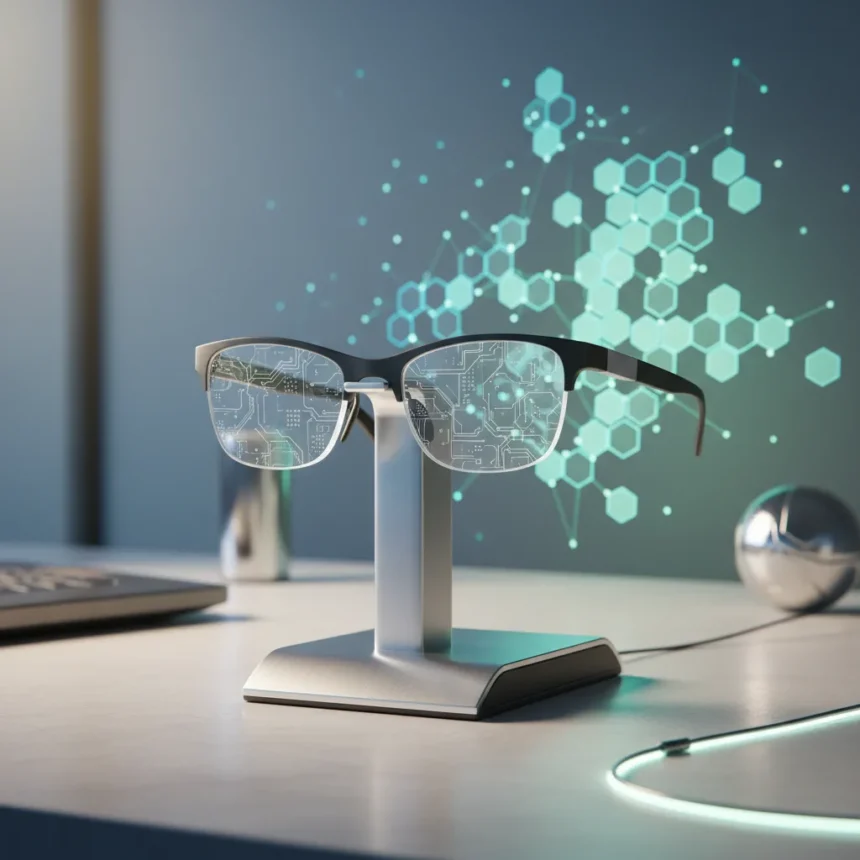
Mosaic’s perception chip represents a fundamental rethinking of how smart glasses should process the world around them. Rather than offloading spatial intelligence to a GPU or cloud processor, the Mosaic perception chip handles real-time environmental understanding directly on the eyewear itself, potentially eliminating the need for bulky batteries or external compute packs that have plagued smart glasses for years.
Key Takeaways
- Mosaic’s perception chip enables real-time spatial intelligence without requiring a dedicated GPU
- The chip is designed to fit into slim, Aviator-style frames without adding significant bulk
- Real-time environmental awareness could work without draining a traditional battery
- The approach challenges the current assumption that spatial computing demands heavy-duty processors
- This breakthrough could reshape how smart glasses balance power, size, and capability
Why Mosaic’s Perception Chip Changes the Smart Glasses Game
The smart glasses industry has been stuck on a fundamental problem: spatial intelligence—the ability to understand your surroundings, recognize objects, map environments, and process visual context—traditionally requires serious computational horsepower. That horsepower has meant either strapping a GPU to your face or sending data to the cloud, both approaches that conflict with the lightweight, everyday-wear form factor that consumers actually want.
Mosaic’s perception chip breaks this trade-off by building spatial processing directly into the silicon. Instead of treating the glasses as a camera that needs external brains, the Mosaic perception chip makes the eyewear itself intelligent. This is not just a performance tweak—it is a different architecture entirely. The chip processes visual input on-device, in real time, without the latency of cloud processing or the power drain of a discrete GPU running continuously.
The implications are immediate and practical. Slim Aviator-style frames could genuinely become smart glasses without requiring you to wear a battery pack the size of a phone or endure multi-hour charging cycles. Real-time environmental awareness—recognizing faces, understanding scenes, tracking movement—becomes possible at the wrist-worn or pocket-sized power budgets that actual consumers will tolerate.


How Mosaic Perception Chip Compares to Current Smart Glasses Approaches
Today’s smart glasses ecosystem relies on one of two compromises. Premium offerings like Meta’s Ray-Ban smart glasses use modest onboard processors paired with cloud connectivity, which means latency and privacy trade-offs. Heavier spatial computing platforms like Microsoft HoloLens require tethered batteries or external compute units, making them impractical for all-day wear. The Mosaic perception chip sidesteps both constraints by handling spatial tasks locally without the power overhead of a full GPU.
This architectural difference matters because it addresses the core problem that has kept smart glasses from becoming a mainstream device category. Consumers rejected Google Glass and early Snapchat Spectacles not because the concept was wrong, but because the execution demanded compromises on battery life, bulk, or capability. A perception chip that delivers real-time spatial understanding without any of those compromises is a genuine departure from the status quo.



The Real-Time Advantage: Why It Matters Now
Real-time processing is not a marketing buzzword here—it is the difference between a device that feels responsive and one that feels sluggish. Cloud-based vision processing introduces latency that makes object recognition and scene understanding feel delayed. On-device processing with the Mosaic perception chip eliminates that lag, meaning spatial features respond instantly to what the wearer is looking at.
This real-time capability also sidesteps privacy concerns that plague cloud-connected smart glasses. If environmental processing happens locally on the chip, image data does not need to leave the device. That is a significant advantage in markets where data residency and privacy regulation are tightening, and it is a trust factor that could accelerate consumer adoption.
What This Means for the Smart Glasses Industry
If the Mosaic perception chip delivers on its architectural promise, it could catalyze a shift in how the entire industry approaches wearable spatial computing. Companies building smart glasses would no longer face the choice between slim form factors and capable software—they could have both. That opens the door to mainstream smart glasses that do not require you to accept compromises on weight, battery life, or aesthetics.
The broader implication is that spatial intelligence is moving from the cloud and the data center back to the edge. This mirrors a larger trend in AI and vision processing, where on-device computation is becoming the preference for latency-sensitive, privacy-critical applications. The Mosaic perception chip is a specific instantiation of that shift, tailored for the unique constraints of eyewear.


Can Mosaic’s Chip Actually Deliver on the Hype?
The headline promise—that Aviator-style glasses can become smart glasses without bulky batteries—depends entirely on whether the Mosaic perception chip can handle the full range of spatial tasks consumers expect. Real-time object recognition, scene mapping, and environmental understanding are computationally demanding. A chip small enough to fit in slim frames will have power and thermal constraints that a desktop GPU does not face.
The article frames this as a breakthrough, but the proof is in the performance. If the chip can deliver spatial intelligence that matches or exceeds what cloud-connected glasses provide, while consuming power measured in milliwatts rather than watts, then Mosaic has genuinely solved a category-defining problem. If it is a compromise—faster than cloud but less capable than GPU-based systems—then it is an incremental step, not a revolution.
When Will Mosaic Perception Chip Smart Glasses Actually Ship?
The research brief does not specify a launch date or availability window for consumer smart glasses using the Mosaic perception chip. The article presents the chip as a conceptual breakthrough and a potential future direction for the industry, rather than a product you can order today. Smart glasses development timelines are notoriously long—from chip design through eyewear integration to regulatory approval and manufacturing ramp can take years.
Which Eyewear Brands Will Use the Mosaic Perception Chip?
The research brief does not name any eyewear manufacturers, brands, or partners that have committed to integrating the Mosaic perception chip. The article focuses on the chip itself and its architectural advantages rather than specific product announcements. Industry partnerships in smart glasses are often announced separately from chip releases, so confirmed partners may not be public yet.
Is the Mosaic Perception Chip Actually Better Than a GPU for Smart Glasses?
The Mosaic perception chip is not universally better than a GPU—it is purpose-built for a different constraint set. A discrete GPU offers more raw processing power but requires more power, more space, and more cooling than a slim smart glasses form factor allows. The Mosaic perception chip trades some peak performance for efficiency and form factor, which is the right trade-off for eyewear. For stationary spatial computing tasks, a GPU might still be superior. For wearable, real-time, privacy-sensitive applications, the Mosaic perception chip’s architecture is a better fit.
The Mosaic perception chip represents a genuine architectural shift in how smart glasses could handle spatial intelligence. If it delivers on its promise of real-time environmental awareness in slim frames without battery bloat, it could finally unlock the smart glasses form factor that consumers have been waiting for. The industry has tried the cloud-connected approach and the tethered-GPU approach—the Mosaic perception chip suggests a third path that might actually work.
Edited by the All Things Geek team.
Source: TechRadar