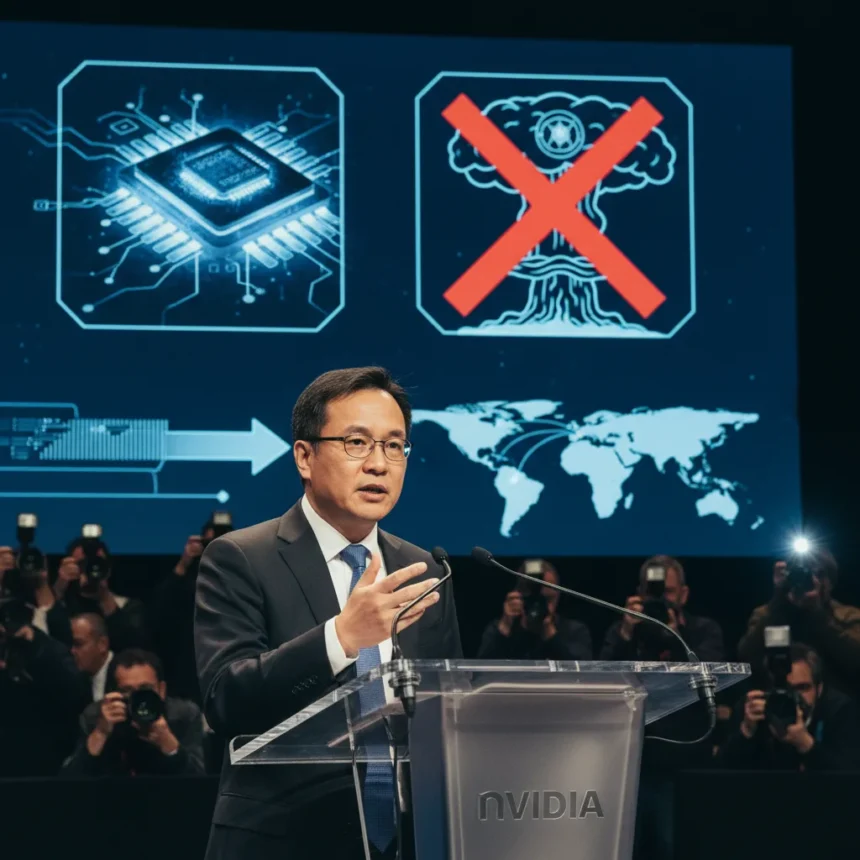
GPU export restrictions have become one of the most contentious policy debates in tech, and Nvidia CEO Jensen Huang just threw a grenade into the middle of it. Huang rejected the comparison of advanced AI chips to nuclear weapons, calling the analogy lunacy and arguing that governments should permit sales to adversarial countries rather than treating chip exports like weapons proliferation.
Key Takeaways
- Jensen Huang called comparing AI GPUs to nuclear weapons “lunacy” and rejected the analogy outright.
- Huang argues China already possesses sufficient computing power to be a major AI player regardless of export restrictions.
- The U.S. approved sales of Nvidia’s H-200 chips to China with a 25% government fee attached.
- Dario Amodei’s comparison framed selling chips to China as equivalent to selling nukes to North Korea.
- Huang contends that “victimising” China or treating it as an “enemy” is strategically flawed.
The Analogy That Sparked the Pushback
Anthropic CEO Dario Amodei made the provocative claim that selling advanced AI chips to China is analogous to selling nuclear weapons to North Korea. That framing has become central to the national-security argument for restricting GPU exports. Huang’s response was blunt: the comparison is lunacy. He rejected the entire premise that AI chips and nuclear weapons occupy the same category of geopolitical risk, arguing that the analogy fundamentally misunderstands both the technology and the market dynamics at play.
The stakes of this debate are enormous. Nvidia’s access to the Chinese market represents billions in potential revenue, and export restrictions directly threaten that opportunity. But Huang’s objection goes beyond business self-interest—he is making a strategic claim about the futility of the restrictions themselves.
Why Huang Says GPU Export Restrictions Fail
Huang’s core argument is straightforward: China already has the computing power and chip development capability to remain a major force in AI. Restricting GPU exports to China, in his view, does not prevent Chinese AI advancement—it merely slows it and creates resentment. Treating China as an “enemy” through export controls is the wrong strategy, Huang contends, because it assumes that denying access to specific products can fundamentally alter competitive dynamics.


This reasoning challenges the foundational logic of U.S. export control policy. If Huang is correct that China’s AI capabilities are already sufficient and that further restrictions merely delay rather than prevent progress, then the restrictions become a symbolic gesture rather than a practical security measure. The comparison to nuclear weapons, by contrast, assumes that controlling access to specific materials or technology can meaningfully constrain an adversary’s capabilities in ways that matter for national security.
The difference is critical. Nuclear weapons require specific fissile materials that are genuinely scarce and controlled. Advanced AI chips are computational tools that can be replicated, redesigned, and substituted. China can manufacture chips domestically, acquire them through third parties, or develop alternative architectures. GPU export restrictions, under this logic, are like trying to prevent someone from running fast by restricting shoe sales—the fundamental capability remains.



The Policy Reality: Approved Sales with a Fee
The practical situation underscores Huang’s point. The U.S. government approved sales of Nvidia’s H-200 chips to China, but imposed a 25% government fee on those transactions. This is not an outright ban—it is a compromise that allows sales while extracting a tax. The fact that such approval exists suggests the government itself does not treat GPU exports with the same absolute prohibition it applies to actual weapons or weapons-grade materials.
This middle ground reveals the incoherence in the “nuclear weapons” framing. If GPUs truly were equivalent to nukes, there would be no approved sales at any price. The fee structure indicates the government views GPU exports as a commercial activity with security concerns—not as weapons proliferation. Huang’s criticism gains force from this contradiction.
China as a Counterpoint to Restriction Logic
Huang’s assertion that China already possesses sufficient AI computing power is the crux of his argument against GPU export restrictions. If true, it demolishes the case for treating chip sales as a meaningful security lever. China’s domestic chip manufacturing capacity, combined with access to alternative suppliers and its own R&D efforts, means that restricting Nvidia’s exports does not prevent Chinese AI development—it merely redirects purchasing decisions and accelerates domestic alternatives.
This framing shifts the debate from “Can we stop China from getting advanced chips?” to “Is restricting exports worth the diplomatic and economic cost when China will find alternatives anyway?” The second question is far more difficult for policymakers to answer with confidence.


Why This Matters Beyond Nvidia
Huang’s pushback is significant because it challenges the entire intellectual framework underlying U.S. AI export policy. If the nuclear weapons analogy is wrong—if GPUs are fundamentally different from weapons in ways that matter for policy—then the restrictions may be based on faulty reasoning. Tech executives, policymakers, and security analysts are now forced to articulate why GPU exports deserve the same treatment as weapons controls, or admit that the comparison is indeed flawed.
The debate also exposes a tension in how democracies approach technological competition with authoritarian states. Restricting exports feels like action, but if those restrictions do not meaningfully alter the competitive landscape, they may simply damage relationships and trade while failing to achieve their stated objective.
Does Jensen Huang have a point about China’s AI capabilities?
Huang argues that China already possesses sufficient computing power and chip development expertise to remain competitive in AI regardless of U.S. export restrictions. While the research brief does not provide detailed technical evidence for this claim, it reflects a broader industry consensus that China’s AI sector is mature enough to develop alternatives or source chips through third parties if direct purchases from Nvidia become unavailable.
Why did the U.S. approve H-200 sales to China with a fee?
The 25% government fee on approved H-200 sales to China represents a compromise between outright restriction and unrestricted commerce. It allows Nvidia to access the Chinese market while generating revenue for the U.S. government and maintaining the appearance of export control. The fee structure itself suggests policymakers do not view GPU exports as equivalent to weapons proliferation.
Is the nuclear weapons analogy actually used in policy discussions?
Yes. Dario Amodei’s comparison of selling chips to China with selling nuclear weapons to North Korea became part of the public debate over GPU export restrictions. Huang’s criticism of this analogy is a direct response to its use in framing the policy case for restricting sales.
Huang’s challenge to the GPU-to-nukes analogy exposes a fundamental disagreement about how technology policy should treat advanced chips. If he is right that the comparison is flawed, then the entire export restriction framework needs rethinking. If he is wrong, then the restrictions are justified but face a credibility problem because the government itself approved sales to China—undermining the absolute prohibition the weapons analogy would demand. Either way, the debate is far from settled.
Edited by the All Things Geek team.
Source: Tom's Hardware