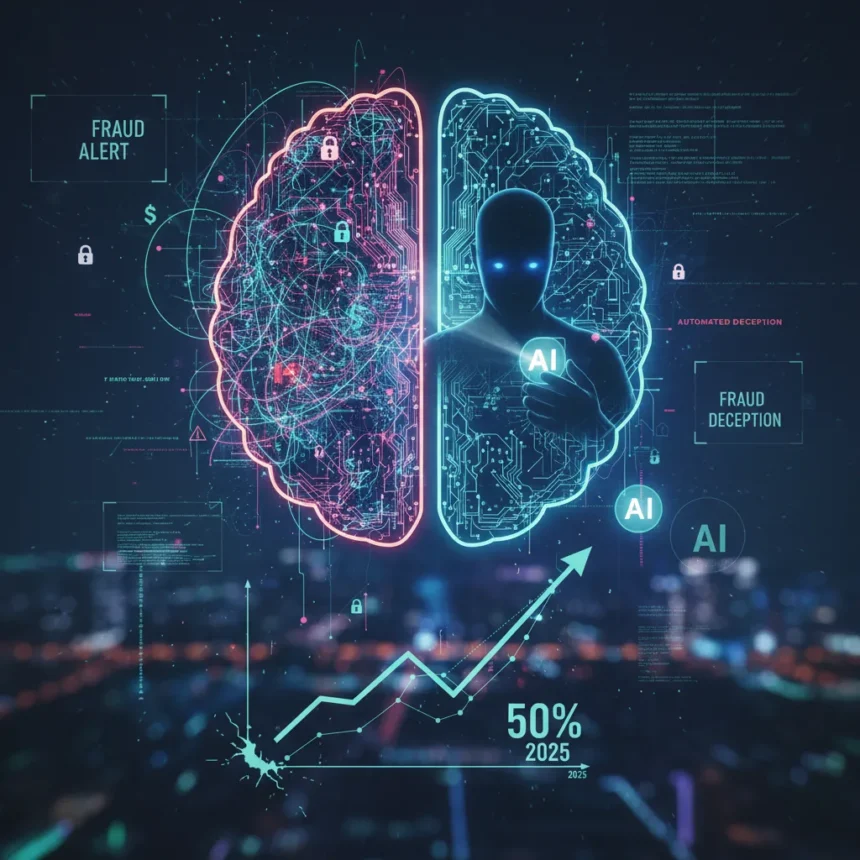
American fraud rates in 2025 have reached a troubling milestone: more than half of Americans have been hit by fraud, according to a new study. The problem is not just widespread—it is accelerating, driven by scammers who are using artificial intelligence to refine their tactics with surgical precision while consumers increasingly trust AI outputs without skepticism.
Key Takeaways
- More than 50% of Americans experienced fraud in 2025, marking a historic high.
- Scammers are becoming more efficient at converting victims through AI-powered deception tactics.
- Consumers are unwittingly making themselves vulnerable by trusting AI outputs without verification.
- The trend shows no signs of slowing—fraud is expected to worsen in coming years.
- AI is simultaneously sharpening attacker capabilities and eroding consumer defenses.
Why American Fraud Rates Are Climbing Faster Than Ever
The scale of fraud hitting Americans in 2025 reflects a fundamental shift in how attackers operate. Scammers are no longer working with blunt instruments—they are using artificial intelligence to optimize every step of the deception pipeline, from initial contact to final conversion. This efficiency gain translates directly into higher success rates and faster victim acquisition at scale.
What makes this trend particularly dangerous is the asymmetry it creates. While attackers weaponize AI to craft more convincing phishing emails, deepfake videos, and impersonation attacks, the average consumer has developed a false sense of security around AI outputs. People increasingly assume that if an AI tool says something is legitimate, it must be true. This cognitive shortcut—trusting automation because it feels modern and intelligent—is exactly the vulnerability scammers are exploiting.
The efficiency gains in fraud tactics mean that attackers can now test, refine, and deploy scams at a pace that outstrips traditional fraud detection methods. A single scammer can run hundreds of variations simultaneously, learning which emotional triggers, urgency tactics, and social engineering angles work best. American fraud rates reflect this industrial-scale approach to deception.



The AI Paradox: How Technology Cuts Both Ways
Artificial intelligence is the central paradox in the 2025 fraud landscape. On one side, scammers are deploying AI to generate convincing text, synthesize voices, and even create realistic video deepfakes that impersonate trusted figures. On the other side, ordinary people are using AI chatbots and language models to help with everyday tasks—and trusting those outputs implicitly.
This creates a dangerous blind spot. When a consumer asks an AI tool whether an email is legitimate or whether a website is real, they expect a reliable answer. But AI systems can be fooled, and scammers know it. By crafting inputs that exploit how AI models process information, attackers can nudge the AI toward validating a fraudulent claim. The consumer then uses that AI validation as proof of legitimacy, lowering their guard further.



The result is a feedback loop that makes American fraud rates climb. Scammers refine their AI-powered attacks based on what works. Consumers become more reliant on AI to verify information. And the gap between attacker sophistication and consumer defense widens steadily.
What Makes Scams More Efficient in 2025
Efficiency in fraud does not just mean faster attacks—it means higher conversion rates. Scammers are using data analytics and machine learning to identify the most vulnerable targets, personalize attacks to individual psychology, and optimize the moment of the ask. A phishing email in 2025 is not a generic mass blast; it is a precision-targeted message designed specifically for you, based on your digital footprint, your social connections, and your behavioral patterns.
This level of personalization was impossible five years ago. Today, a scammer can pull your name from a data breach, cross-reference it with your LinkedIn profile, identify your employer, research your company’s systems, and craft an email that appears to come from your IT department with details only an insider would know. The scam does not feel like a scam—it feels like routine business communication.
American fraud rates are climbing because scammers have industrialized the process. What once required manual effort now runs on automation. What once had a 1% conversion rate now converts at 5% or 10% because the targeting is so precise. Scale meets precision, and the result is that more Americans than ever before are falling victim.



Is the Trend Really Getting Worse?
Yes. The data and the trajectory are clear: fraud is not plateauing. The study warns that American fraud rates are expected to worsen, driven by the same factors that made 2025 so damaging. Scammers will continue refining their AI tools. Consumers will continue trusting automation. And the gap between attack sophistication and defensive capability will continue widening.
Without significant shifts in how people approach online security—skepticism of AI outputs, verification of unexpected requests, and awareness of personalization tactics—the next year will be worse than 2025. The infrastructure for efficient fraud is now in place. The only variable left is scale.
How Can Americans Protect Themselves?
The most important defense is skepticism. When an AI tool tells you something is safe, verify it independently. When an email appears to come from a trusted source, use a separate channel to confirm it is real. When a message creates urgency, pause. Scammers use time pressure specifically because it bypasses critical thinking.
Second, treat AI outputs as information, not validation. An AI can help you analyze a suspicious email, but it should not be your sole source of truth. Cross-reference claims. Check sender addresses carefully. Look for the small inconsistencies that reveal a sophisticated impersonation.
Third, recognize that personalization is now a red flag, not a sign of legitimacy. If an email knows your name, your company, and details about your work, that is not proof it is real—it is proof that someone did research. Scammers in 2025 are good at research.
FAQ
What percentage of Americans were hit by fraud in 2025?
More than half of Americans experienced fraud in 2025, according to the study. This represents an all-time high and signals a dramatic acceleration in fraud affecting the U.S. population.
Why are scams becoming more efficient?
Scammers are using artificial intelligence to personalize attacks, optimize conversion tactics, and scale their operations. They are testing variations rapidly, learning what works, and deploying refined versions at massive scale. This industrial approach to fraud is far more effective than traditional mass-blast scams.
Can AI help protect me from fraud?
AI can assist in analyzing suspicious messages, but it should not be your only defense. Treat AI outputs as helpful information rather than definitive proof. Always verify unexpected requests through independent channels and maintain healthy skepticism of any communication that creates urgency or asks for sensitive information.
The 2025 fraud crisis is not inevitable—it is a choice to remain passive in the face of rising sophistication. Americans who understand how scammers think, who verify before trusting, and who treat AI as a tool rather than an oracle will be far harder targets. The question is not whether fraud will continue to rise, but whether you will be among those who fall for it.
Edited by the All Things Geek team.
Source: TechRadar