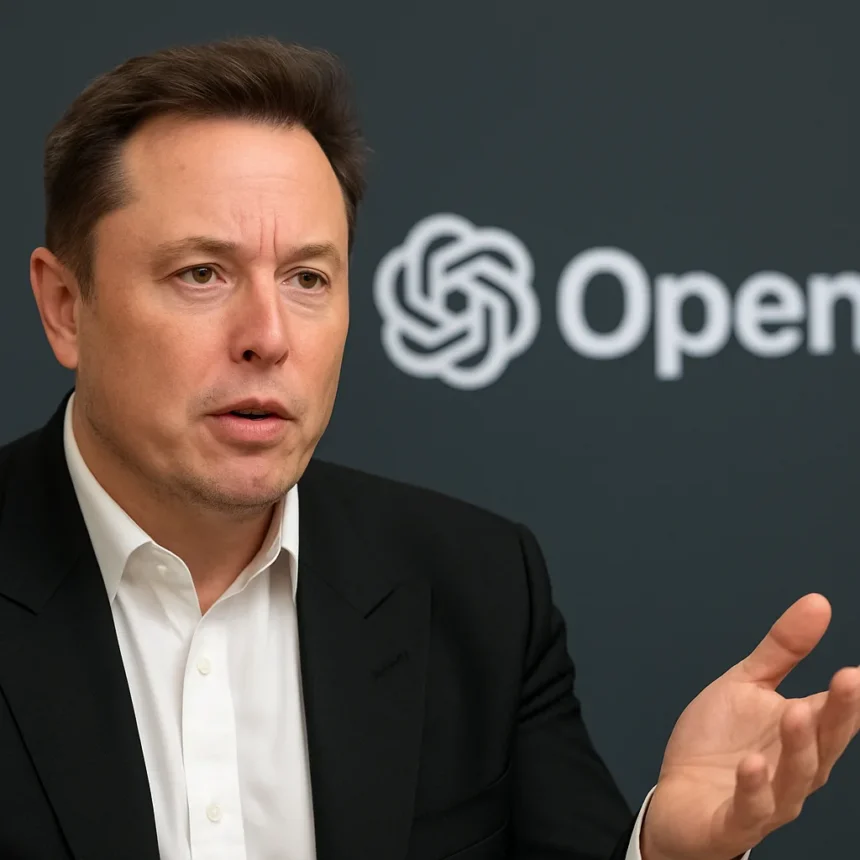
The OpenAI lawsuit is now one of the most revealing courtroom dramas in tech history. Elon Musk is suing his former co-founders Sam Altman and Greg Brockman, alleging they betrayed the company’s original nonprofit mission by pivoting to a for-profit model. In testimony that turned sharply personal, Musk declared: “Without me, OpenAI wouldn’t exist. I came up with the name!” — a claim that his own 2018 emails make considerably harder to defend.
Key Takeaways
- Musk is suing Altman and Brockman for allegedly breaching OpenAI’s original nonprofit mission by transitioning to a for-profit structure.
- Musk testified he contributed $38 million in direct funding to OpenAI, plus his reputation and the idea for the company’s name.
- A 2018 email from Musk to Brockman and Ilya Sutskever shows him threatening to cut funding entirely amid a power struggle.
- OpenAI’s attorney challenged Musk directly on whether he contributed anywhere near a billion dollars — Musk did not say yes.
- Musk also attempted to hire OpenAI researchers for his other companies during the same period he claims to have been the company’s essential backer.
What Elon Musk Actually Claims in the OpenAI Lawsuit
Musk’s core argument is that OpenAI was built on a nonprofit promise — and that Altman and Brockman broke it. In testimony, Musk quantified his direct monetary contribution at $38 million, but insisted that figure understates his real role. He argued he also contributed his reputation and the name “OpenAI” itself, telling the court: “I contributed my reputation! These things have value!”
He also covered rent for OpenAI at the Pioneer Building in San Francisco — the same building that housed his company Neuralink. When pressed on whether that arrangement was genuinely altruistic, Musk’s response was candid to the point of undermining his own argument: “I would have sublet it!” That single line captures the tension running through his entire testimony — a man simultaneously claiming indispensability and admitting he had alternatives.
The 2018 Email That Changes Everything
The most damaging moment in the OpenAI lawsuit testimony wasn’t a question from opposing counsel — it was Musk’s own words from 2018. In an email to Brockman and Ilya Sutskever, Musk wrote: “Guys, I’ve had enough. This is the final straw. Either go do something on your own or continue with OpenAI as a nonprofit. I will no longer fund OpenAI until you have made a firm commitment to stay or I’m just being a fool who is essentially providing free funding for you to create a startup. Discussions are over.”



That email doesn’t read like the correspondence of a visionary founder committed to a mission. It reads like a frustrated investor threatening to walk. Musk himself used the word “fool” to describe his position — and that framing came back in testimony, where he admitted he felt like “a fool” for funding OpenAI. It’s hard to claim you were the indispensable architect of a company while simultaneously describing yourself as someone being taken advantage of.
The email also reveals that Musk was engaged in a power struggle with the co-founders at the same time he was attempting to hire OpenAI researchers for his other companies. That detail matters legally: it suggests his grievances were at least partly about control, not purely about protecting a nonprofit ideal.



Did the OpenAI Lawsuit Cross-Examination Land?
OpenAI attorney Savitt pressed Musk with a question that cut to the heart of the credibility problem: “Did you contribute anywhere near a billion dollars to OpenAI? Yes or no?” Musk’s answer, by any reading of the transcript, was not yes. His $38 million figure, while not trivial, sits well below the threshold the question implied — and the framing of the cross-examination was clearly designed to establish that Musk’s financial stake was more limited than his rhetorical stake.
This is where the lawsuit gets genuinely complicated. Musk’s legal argument rests on the idea that OpenAI betrayed its founding mission. That argument doesn’t necessarily require him to have been the biggest donor. But his courtroom behaviour — the emphatic declarations, the claims about naming the company — suggests he wants credit that the evidence only partially supports. Reputation and naming rights are real contributions. They’re also conveniently unquantifiable ones.
Is Musk’s lawsuit against OpenAI likely to succeed?
The legal question turns on whether OpenAI’s for-profit transition violated the commitments made to its early backers and the public. Musk’s personal credibility as a witness is a separate matter, but courts weigh both. His 2018 email — which he wrote himself — establishes that he was willing to abandon OpenAI over a funding dispute, which complicates any argument that he was a selfless steward of its mission.
What does this trial mean for the future of AI governance?
Whatever the verdict, the OpenAI lawsuit has already done something significant: it has forced a public reckoning with how AI companies are governed and who they answer to. OpenAI began as a nonprofit with an explicit mission to benefit humanity. Its transition to a structure that can attract and reward investors represents a shift that Musk, whatever his motivations, is right to call out as a meaningful change. The question is whether a courtroom is the right place to resolve it — and whether Musk is the right person to make that argument.


The broader tension here isn’t unique to OpenAI. Every major AI lab faces pressure to commercialise fast enough to fund the compute costs that frontier research demands. Altman‘s bet is that a for-profit structure is the only way to stay competitive. Musk’s counter-bet — building his own AI company, xAI — suggests he agrees with that logic in practice, even as he challenges it in court.
The OpenAI lawsuit, stripped of its personal drama, is really a dispute about whether the promises made at a company’s founding can survive contact with the economics of the industry it helped create. That question doesn’t have a clean answer — in court or anywhere else.
Edited by the All Things Geek team.
Source: TechRadar