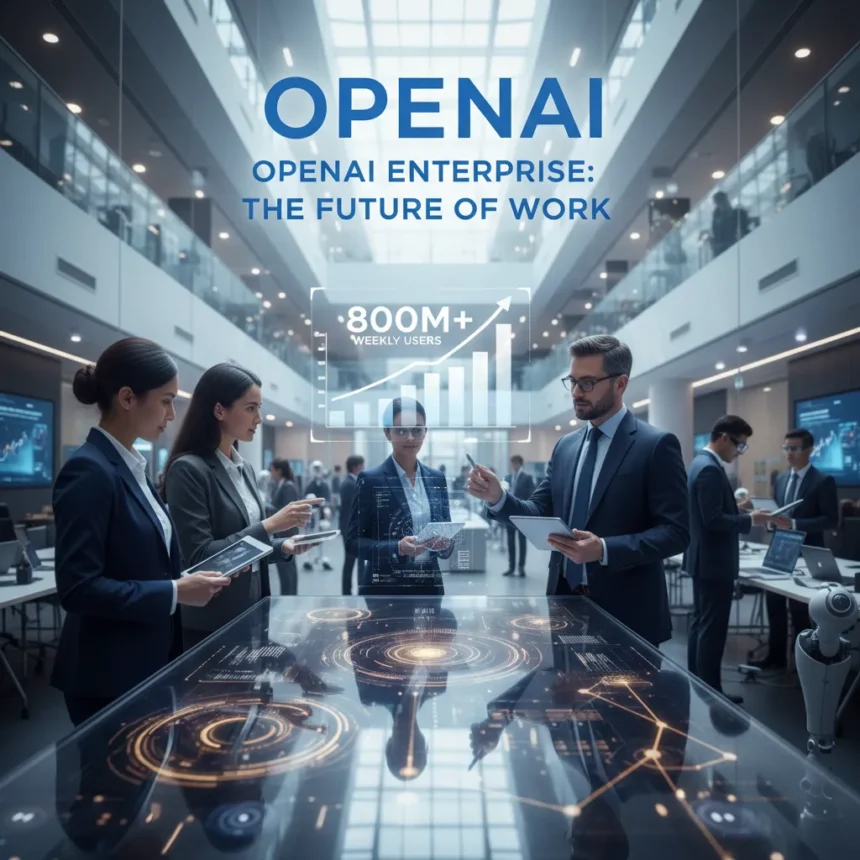
Workplace AI adoption represents the biggest opportunity for OpenAI’s next phase of growth, according to the company’s enterprise leadership. With over 800 million people relying on OpenAI’s tools every week, the company is betting that consumer familiarity with ChatGPT will translate into deeper organizational integration and business transformation.
Key Takeaways
- OpenAI sees workplace AI adoption as its largest growth opportunity for the next phase of business expansion.
- Over 800 million people use OpenAI tools weekly, with five million paying business customers already in place.
- The company emphasizes a “tops down, bottoms up” strategy combining leadership buy-in with employee-wide AI literacy.
- Apps in ChatGPT will let enterprises build custom interfaces directly within ChatGPT, meeting users where they already are.
- Companies risk failure if they launch ambitious AI projects without training workers to use AI effectively.
Why Enterprise AI Adoption Matters More Than You Think
OpenAI’s enterprise strategy hinges on a simple insight: most workers already use ChatGPT in their personal lives and expect the same ease of use and intelligence at work. This consumer-to-enterprise bridge is where the company sees its biggest opportunity. Rather than selling AI as an unfamiliar tool that requires new workflows, OpenAI is positioning itself as the natural extension of what employees already know and trust. The challenge isn’t convincing people that AI works—it’s removing friction from adoption at scale.
The scale is already substantial. Five million paying business customers are using OpenAI’s enterprise offerings, a figure that underscores how quickly workplace AI adoption is accelerating. But raw user numbers tell only half the story. OpenAI’s leadership argues that real enterprise transformation requires more than software access—it demands cultural change and systematic training. Companies that skip the training phase risk expensive failures, even with the best tools in place.
The “Tops Down, Bottoms Up” Framework for Workplace AI Adoption
OpenAI advocates a two-pronged approach to workplace AI adoption that combines executive-level transformation with grassroots employee engagement. The “tops down” element means leadership must commit to AI-driven business change and allocate resources accordingly. The “bottoms up” piece ensures workers across the organization understand how to use AI effectively in their daily roles. Without both, adoption stalls.



This framework addresses a real problem OpenAI sees in the field. According to OpenAI enterprise leadership, companies often duplicate infrastructure work rather than focusing on differentiated value. “What we see when we work with enterprises is that we’ll go into five different companies, and they’re all building the same scaffolding for their applications to work, rather than spending time working on the thing that will really differentiate for their business.” The implication is clear: businesses waste resources on generic AI implementation when they should be investing in competitive advantage. Workplace AI adoption, done correctly, should free teams to focus on what makes them unique.
The training component cannot be overstated. OpenAI’s leadership warns that ambitious AI transformation projects often fail without corresponding investment in employee AI literacy. “It can be tempting to have a big, ambitious, transformational project that totally transforms the way your business works—but if you don’t pair that with building AI literacy among your employees, then you could often fail.” This is not a minor caveat. It suggests that the limiting factor in enterprise AI adoption is not the technology itself, but organizational readiness.



Apps in ChatGPT: Meeting Users Where They Are
A major product direction for OpenAI’s enterprise push is Apps in ChatGPT, which would allow businesses to build custom user interfaces and workflows directly within ChatGPT. This approach eliminates a common friction point: employees already use ChatGPT daily, so building enterprise applications inside it reduces the need for separate tools and logins. The strategy reflects OpenAI’s philosophy of meeting users where they already are rather than forcing them to adopt new platforms.
This creates what OpenAI describes as “a whole new opportunity for businesses” by embedding custom enterprise tools into the interface millions of workers already know. Instead of rolling out yet another software platform that requires training, integration, and change management, companies can build their workflows inside an application their employees already use and trust. The potential productivity gains are significant, but so is the strategic advantage: OpenAI positions itself as the operating system for work itself, not just a tool within existing systems.
The Competitive Landscape and OpenAI’s Positioning
OpenAI’s enterprise strategy differs fundamentally from a pure software licensing model. Rather than selling point solutions or isolated AI features, the company is building an ecosystem where enterprises can create, deploy, and scale AI applications. This positions OpenAI not just as a vendor but as a platform for builders—startups and global enterprises alike. The company’s goal is to become “the best place for builders to actually come and build their applications using GenAI.”
This ecosystem approach gives OpenAI advantages over vendors offering narrower AI capabilities. By providing both the foundational model (ChatGPT) and the infrastructure for building on top of it (Apps in ChatGPT), OpenAI creates switching costs and deepens customer relationships. Competitors offering standalone AI tools or point solutions lack this integrated advantage. Workplace AI adoption, in OpenAI’s view, is not about selling more licenses—it is about becoming indispensable to how work gets done.



Internal Focus Amid External Noise
OpenAI’s enterprise leadership emphasized that despite external commentary and speculation about the company’s direction, internal focus remains sharp. “I think the main thing is to not get distracted by a lot of the noise that’s happening on the outside—lots of people have lots to say about what they think OpenAI is doing, and actually inside, it’s remarkable how calm and focused the atmosphere is, because we have a mission, we know what it is, we know what it’s going to take to get to the next step.” This statement suggests OpenAI is executing a long-term strategy without being derailed by short-term criticism or market chatter.
The company’s confidence in its enterprise direction extends into 2026 and beyond. OpenAI’s leadership expressed gratitude to current customers and excitement about future developments, signaling that enterprise AI adoption is not a temporary focus but a core pillar of the company’s evolution. The framing of workplace AI adoption as an “operating system for work” suggests OpenAI is thinking in terms of foundational infrastructure, not incremental feature additions.
What Does This Mean for Businesses?
For organizations considering AI investment, OpenAI’s enterprise push carries clear implications. First, workplace AI adoption requires more than buying software—it demands training, cultural alignment, and executive commitment. Second, the most successful implementations will likely focus on differentiated business value, not generic infrastructure. Third, as tools like Apps in ChatGPT mature, the competitive advantage will shift toward companies that integrate AI deeply into their workflows rather than treating it as a separate function.
The five million paying business customers already using OpenAI’s enterprise offerings represent early adopters who have navigated these challenges. For the majority of businesses still evaluating AI, the message is clear: start with employee literacy, align leadership and frontline teams, and focus on problems that matter to your business.
Is workplace AI adoption really the biggest opportunity for OpenAI?
OpenAI’s enterprise leadership identifies workplace AI adoption as the company’s largest growth opportunity because it combines existing consumer familiarity with ChatGPT, a massive addressable market of enterprises, and the potential to embed AI into the core operating system of work itself. Unlike consumer AI, which is largely saturated, enterprise adoption is still in its early stages and offers room for significant expansion.
What is the difference between “tops down” and “bottoms up” workplace AI adoption?
“Tops down” refers to executive-led transformation where leadership commits resources and strategy to AI implementation. “Bottoms up” means building AI literacy across the entire workforce so employees can use AI effectively in their daily roles. Both are necessary—leadership buy-in without employee training leads to failed implementations, while employee enthusiasm without executive support fails to scale.
How does Apps in ChatGPT change workplace AI adoption?
Apps in ChatGPT allows enterprises to build custom workflows and interfaces directly within the ChatGPT platform, eliminating the need for separate tools and training on new software. By meeting users where they already are, it removes friction from adoption and positions ChatGPT as the central hub for business operations rather than just an AI assistant.
OpenAI’s enterprise strategy reflects a fundamental shift in how AI companies think about growth. Rather than competing on model performance alone, OpenAI is building an ecosystem where workplace AI adoption becomes inevitable—not through force, but through integration into the tools and workflows people already use. For businesses watching this space, the message is clear: AI adoption is no longer optional, but success requires more than software. It requires strategy, training, and genuine commitment to transformation.
Edited by the All Things Geek team.
Source: TechRadar