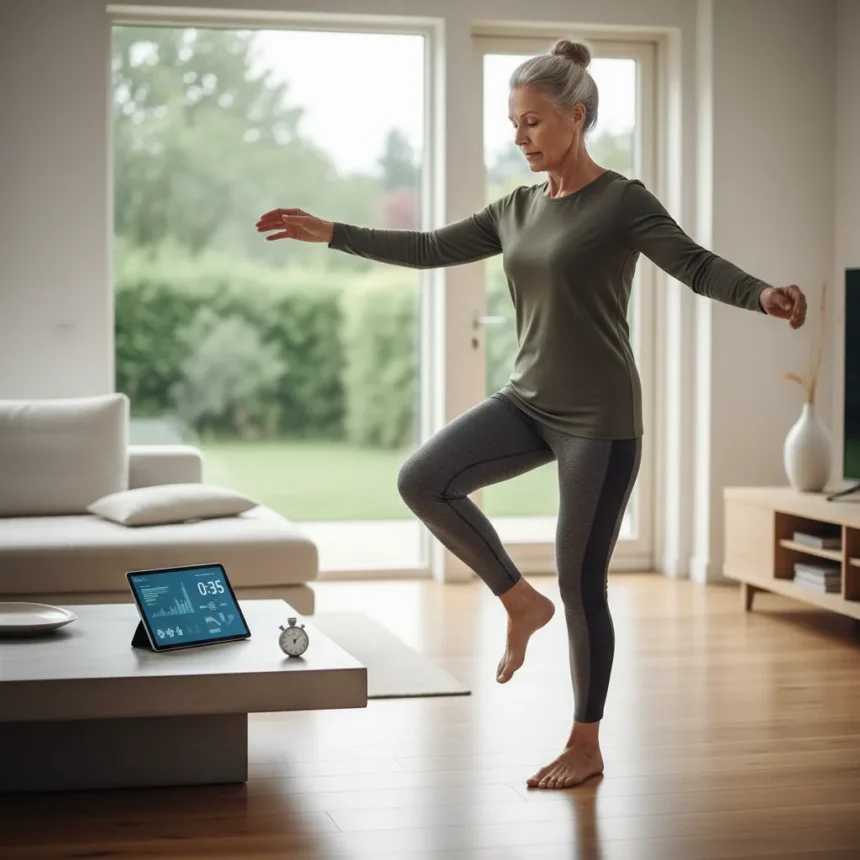
The single-leg balance test is one of the best ways to assess your fall risk as you age, according to personal trainers who work with seniors. Standing on one leg for a set duration challenges your balance and stability in ways that directly reflect your vulnerability to falls. Most people can perform this test almost anywhere, without equipment or special preparation, making it an accessible self-check that takes less than a minute.
Key Takeaways
- Single-leg balance test measures fall risk by challenging stability and proprioception.
- Lack of lower-body strength and poor balance are two major fall-risk factors.
- The test requires no equipment and can be done at home safely.
- Balance training combined with strength work reduces fall risk significantly.
- Certified personal trainers can guide proper form for beginners.
Why Fall Risk Matters as You Get Older
Falls are not random accidents—they result from specific, measurable weaknesses. Two major fall-risk factors are lack of lower-body strength and poor balance. As you age, both decline naturally unless you actively maintain them. The single-leg balance test isolates balance and stability, making it a practical way to gauge where you stand before a fall happens.
Standing on one leg forces your body to recruit stabilizer muscles, engage your core, and maintain proprioception—your sense of where your body is in space. This is exactly what your body must do to catch itself during a stumble. If you cannot hold a single-leg stance for a meaningful duration, your body lacks the neuromuscular control to prevent a fall in real life. The test is not a medical diagnosis, but it is a red flag worth taking seriously.
How to Perform the Single-Leg Balance Test
The test is straightforward. Stand on one leg, keeping your other leg slightly bent and lifted off the ground. Maintain an upright posture, focus your eyes on a fixed point ahead, and hold the position for as long as you can. Note how long you lasted. Repeat on the other leg. The goal is not perfection—it is a baseline measure of your current balance capacity.

No equipment is needed to start. You do not need a gym, weights, or special clothing. Simply find a safe space where you can fall without hitting furniture or walls. If you are new to exercise or have balance concerns, consider working with a certified personal trainer to learn proper form and ensure you are performing the test safely. A trainer can also assess whether an underlying condition—such as inner ear dysfunction or neurological changes—might be affecting your balance.
Age-Based Expectations and What They Mean
Different age groups have different baseline balance capacities. Younger older adults typically hold a single-leg stance longer than those in their 80s or 90s. The research brief does not provide the exact hold-time targets by age group, but the principle is clear: if you are significantly below the expected range for your age, balance training should become a priority.



A poor result does not mean you are doomed to fall. It means you have identified a correctable weakness. Balance is trainable at any age. Unlike some physical capacities that decline irreversibly, balance improves quickly with practice—often within weeks of consistent training. This is why the single-leg balance test is so valuable: it motivates action before a fall occurs.
Building Balance and Strength to Reduce Fall Risk
The single-leg balance test identifies the problem. Exercise solves it. Balance training and lower-body strength work address the two major fall-risk factors directly. Start with bodyweight exercises—single-leg stands, heel-to-toe walking, and controlled lunges—to build foundational stability.
As your balance and strength improve, you can progress by adding adjustable dumbbells to increase resistance. Dumbbells are optional for beginners, but they accelerate progress once you have mastered basic form. A purposeful exercise routine that combines balance challenges with strength training can meaningfully reduce your fall risk and restore confidence in daily movement.
Is the single-leg balance test accurate for predicting falls?
The single-leg balance test is one indicator of fall risk, not a complete medical assessment. It measures balance and stability, which are two key factors in fall prevention. However, falls result from multiple causes—medication side effects, vision changes, home hazards, and neurological conditions can all play a role. The test is most useful as a motivator for training, not as a diagnostic tool.



Can you improve your single-leg balance test results?
Yes. Balance improves quickly with practice. Consistent training—even 10 to 15 minutes daily—can yield noticeable improvements within weeks. Start with bodyweight exercises and progress to weighted variations as your stability increases. A certified personal trainer can design a program tailored to your current level and goals.
What should I do if I fail the single-leg balance test?
A poor result is a call to action, not a cause for alarm. Begin a balance and strength training program immediately. Focus on controlled, low-impact exercises that challenge stability without causing injury. If you have never exercised before or have balance concerns, work with a certified personal trainer to ensure proper form and safety. Within weeks of consistent practice, you should see measurable improvement.
The single-leg balance test is a simple tool that gives you real insight into your fall risk. It costs nothing, requires no equipment, and takes less than a minute. If your result concerns you, the solution is equally simple: a purposeful training routine that builds balance and strength. Falls are preventable. Test yourself today, then take action to stay stable, independent, and safe as you age.
Edited by the All Things Geek team.
Source: Tom's Guide