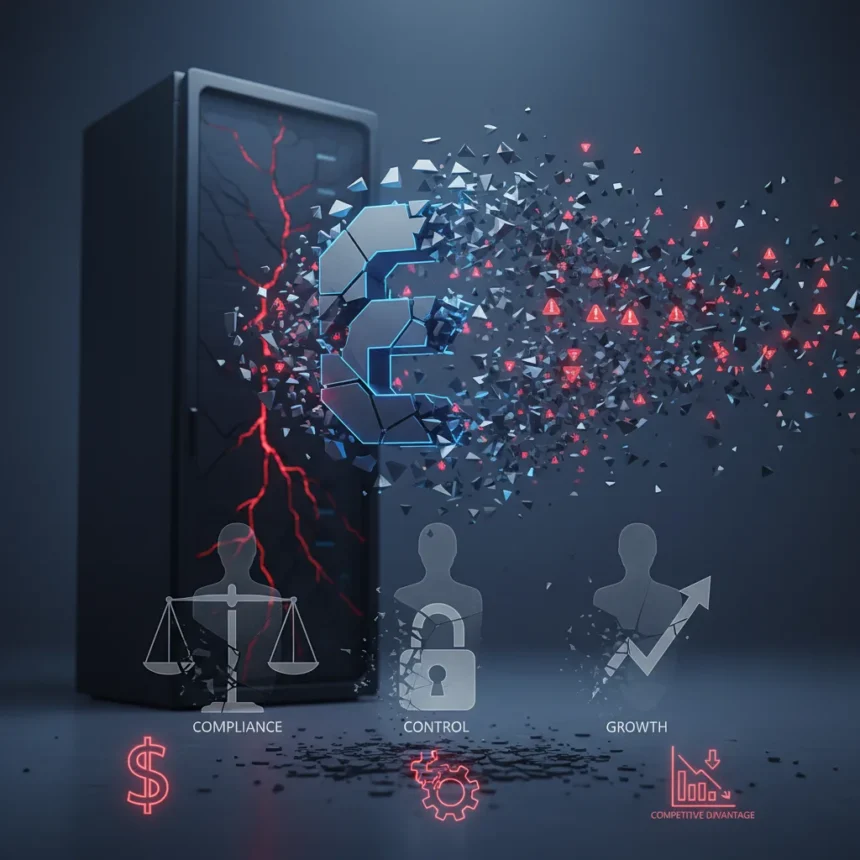
Fragmented entity data is quietly eroding enterprise stability. While organizations obsess over visible systems—cloud infrastructure, security platforms, analytics dashboards—a hidden operational layer sits beneath, silently undermining five critical business functions: compliance, control, automation, resilience, and growth. This is not a technical problem buried in IT budgets. It is a business risk that directly threatens regulatory standing, operational continuity, and competitive position.
Key Takeaways
- Fragmented entity data creates hidden vulnerabilities across compliance, control, automation, resilience, and growth.
- Data fragmentation leads to regulatory fines, operational failures, and weakened governance.
- Enterprises often focus on visible systems while ignoring the underlying data layer that determines whether those systems actually work.
- Compliance failures stemming from poor data quality can result in lawsuits and significant financial penalties.
- Addressing fragmented data is essential for operational continuity and scaling growth.
Why enterprises are missing the fragmented entity data problem
Most organizations have built robust outer layers of technology. They invest heavily in cybersecurity tools, cloud platforms, and automation frameworks. Yet beneath these visible systems lies a fragmented data landscape that few executives fully understand or monitor. Fragmented entity data refers to organizational information—customer records, supplier details, operational assets, regulatory documentation—scattered across disconnected systems, databases, and legacy platforms without a unified structure or governance model.
The danger is that fragmented data does not announce itself as a crisis. Systems continue to run. Dashboards still populate with metrics. But the underlying data quality deteriorates silently, creating cascading failures that only surface when compliance audits fail, automation workflows stall, or a security incident exposes the full extent of the mess. By then, the damage is already done. Organizations discover they cannot trace data lineage, cannot verify data accuracy, and cannot respond quickly to regulatory demands or operational emergencies.
This hidden layer becomes particularly damaging because it operates outside the visibility of most governance frameworks. A company may have a Chief Data Officer and a data strategy, yet still lack visibility into how entity data flows, where it fragments, and which systems depend on its accuracy. The result is a false sense of control—leadership believes the organization has data governance when, in fact, critical operational data remains fragmented and unmanaged.

The five ways fragmented entity data destroys business value
Fragmented entity data undermines business performance across five interconnected dimensions. First, compliance becomes nearly impossible. Regulators demand accurate, traceable records. When entity data is scattered across systems, audit trails break down, data cannot be produced on demand, and organizations struggle to prove they meet regulatory standards. The cost is severe: regulatory fines, legal liability, and reputational damage.
Second, control collapses. Management cannot effectively govern what they cannot see. Fragmented data means no single source of truth for critical information. Decisions are made on incomplete or contradictory data. Risk assessments miss blind spots. Operational leaders lack the visibility needed to steer the organization confidently. Third, automation stalls. Modern enterprise automation—robotic process automation, workflow orchestration, AI-driven decision-making—all depend on clean, unified data. Fragmented data breaks these pipelines. Automation initiatives fail or deliver inconsistent results, wasting investment and frustrating teams.



Fourth, resilience weakens. When data is fragmented, disaster recovery becomes chaotic. An outage, breach, or data corruption in one system cascades unpredictably because dependencies are unclear. Business continuity plans fail because they were built on assumptions about data availability that no longer hold. Fifth, growth stalls. Scaling operations, entering new markets, launching new products—all require reliable operational data. Fragmented data makes scaling risky and expensive. Integration projects take longer. New systems cannot connect cleanly to legacy ones. Innovation slows because teams spend more time reconciling data than building new capabilities.
How fragmented entity data connects to real financial and legal risk
The business case for addressing fragmented entity data is not theoretical. Data failures translate directly into financial and legal consequences. A compliance failure triggered by poor data quality can result in regulatory fines that reach millions of dollars. A data breach that exploits fragmented, unmonitored systems can expose sensitive information and trigger lawsuits. An automation failure caused by bad entity data can halt critical business processes, costing revenue and customer trust.
Organizations that ignore fragmented entity data are essentially betting that they will not be audited, will not be breached, and will not face operational disruption. That is not a sustainable strategy. Regulatory scrutiny is increasing. Cyber threats are intensifying. Operational complexity is growing. Each of these trends makes fragmented data more dangerous, not less. The enterprises that will thrive are those that treat entity data quality and governance as a strategic priority, not an afterthought.
What separates organizations that manage fragmented entity data from those that do not
The difference between enterprises that control their data and those that do not comes down to visibility and governance. Organizations that succeed invest in understanding where their entity data lives, how it flows between systems, and where it fragments. They establish data governance frameworks that assign accountability for data quality. They implement tools and processes to monitor data health continuously, not just during crisis response.



This requires a shift in mindset. Data governance cannot be delegated entirely to IT. It must be a business priority, with executive sponsorship and cross-functional ownership. Finance, legal, operations, and technology must align on what good data quality looks like and what happens when it fails. The organizations pulling ahead are those embedding data quality checks into operational workflows, not treating them as separate audit exercises.
Is fragmented entity data a problem my organization faces?
If your organization uses multiple systems to manage customer, supplier, or operational data; if you have legacy systems running alongside newer cloud platforms; if you struggle to produce complete data quickly during audits; or if different departments maintain separate versions of the same information, you have fragmented entity data. Most enterprises do. The question is not whether you have it, but whether you are aware of it and actively managing it.
What is the first step to addressing fragmented entity data?
Start with a data audit. Map where critical entity data lives across your systems. Identify where it fragments and where dependencies exist. Assign a single owner—ideally someone with executive authority—to lead governance. Then prioritize the highest-risk areas: data that feeds compliance requirements, data that drives critical automation, data that impacts customer or operational decisions. Fix those first. Do not try to solve everything at once.
How does fragmented entity data differ from other data management challenges?
Fragmented entity data is distinct from data security or analytics challenges. A company can have strong cybersecurity and still have fragmented entity data. A company can have sophisticated analytics and still lack governance over operational data. Fragmented entity data is about the foundational accuracy, consistency, and traceability of the information that runs the business. It is the invisible layer that either enables or undermines everything else.
Enterprises cannot afford to ignore fragmented entity data any longer. The cost of ignoring it—in regulatory risk, operational failure, and lost growth—is too high. The organizations that win in the next five years will be those that treat entity data as a strategic asset, not a technical problem. That shift starts now, with visibility, governance, and executive commitment to making data quality non-negotiable.
Edited by the All Things Geek team.
Source: TechRadar