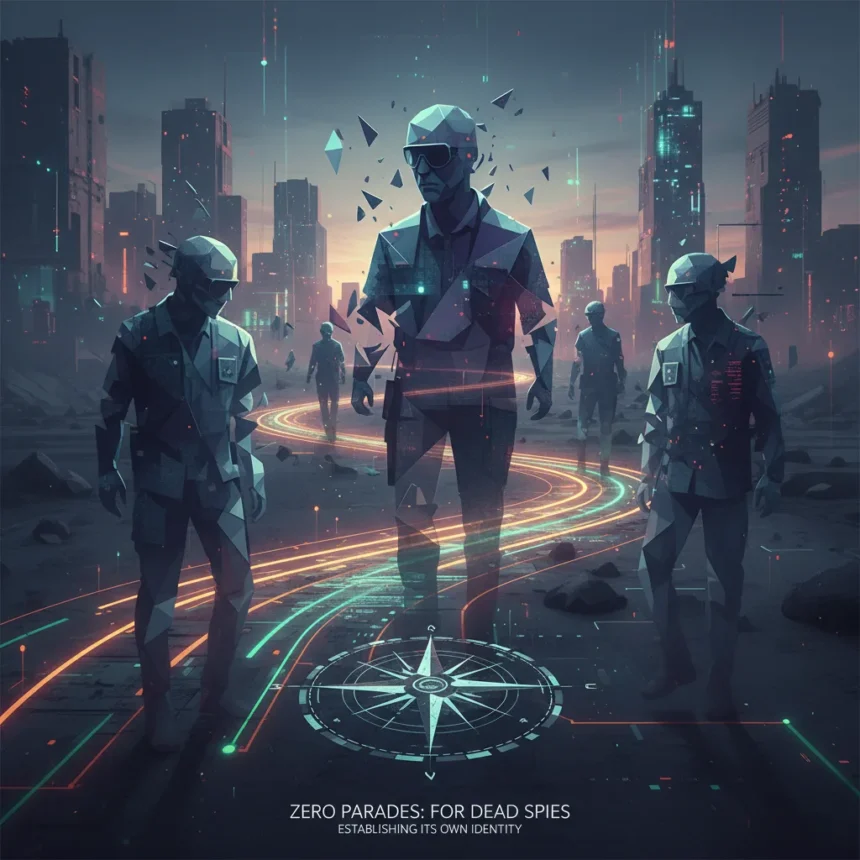
Zero Parades: For Dead Spies is an espionage RPG developed by ZA/UM, the studio behind Disco Elysium, that positions itself as a spiritual successor while refusing to simply retread familiar ground. The game casts you as Hershel Wilk, a burnt-out spy recalled for one last assignment after a catastrophic failure destroyed their reputation. What matters here is not whether Zero Parades: For Dead Spies matches Disco Elysium’s emotional punch—it does something riskier. It asks whether ZA/UM can build an entirely new world using the same architectural principles that made their debut game unforgettable.
Key Takeaways
- Zero Parades: For Dead Spies features a dialogue system built around “failing forward,” where blocked paths lead to new opportunities.
- The game includes skill checks, choice-based consequences, and complex vertical dialogue trees mirroring Disco Elysium’s structure.
- A free Steam Next Fest demo offered two full quests, side activities, and open exploration.
- Players choose from three distinct character archetypes that shape Hershel Wilk’s abilities and dialogue options.
- The art direction and dense writing preserve ZA/UM’s signature style while establishing a distinct espionage identity.
Why Zero Parades: For Dead Spies Matters Right Now
The shadow of Disco Elysium looms large over any ZA/UM project. That game redefined what narrative-heavy RPGs could achieve—dense writing, skill checks that fail forward, and a world where your character’s broken mind was the actual story. Comparisons are inevitable. But Zero Parades: For Dead Spies sidesteps the trap of imitation by anchoring itself in espionage rather than detective noir. Hershel Wilk is not a detective hunting a killer. He is a spy hunting redemption, and that fundamental shift in premise ripples through every system.
The Steam Next Fest demo made this shift tangible. Players could access two full quests, side activities, and open exploration of the starting area, giving a substantive taste of how the game actually plays. This was not a vertical slice—it was a genuine preview that let potential players understand whether ZA/UM’s approach to dialogue and consequence still resonated after Disco Elysium.
The Dialogue System That Makes Zero Parades: For Dead Spies Distinctive
Zero Parades: For Dead Spies uses a dialogue system built around “failing forward,” a phrase ZA/UM has emphasized repeatedly. The principle is simple but powerful: every door closed is an open opportunity to go through the window instead. In practical terms, this means failed skill checks do not lock you out of content—they redirect you toward different paths with their own consequences and rewards. You pass a skill check to get someone to open up and improve your abilities with the experience you receive. You fail, and the conversation branches in a new direction entirely. Neither outcome is a dead end.


This architecture mirrors Disco Elysium’s design but applies it to espionage work rather than detective investigation. The choices you make affect everything: the loyalty of your friends, the paths you can take, and the fragility of your mind. In a spy narrative, that fragility takes on new weight. A detective’s fractured psyche is tragic. A spy’s fractured psyche is operational liability. Zero Parades: For Dead Spies leans into that distinction, making psychological breakdown feel less like a character quirk and more like an active threat to the mission.
Character Archetypes and Replayability
The game offers three distinct character archetypes that shape how Hershel Wilk approaches both dialogue and skill checks. This is not a cosmetic choice. Each archetype likely influences which conversations open naturally and which require skill checks to unlock. In Disco Elysium, your character’s flaws drove the narrative. In Zero Parades: For Dead Spies, your archetype drives your operational approach. A spy trained in deception has different dialogue options than one trained in infiltration, and both differ from one trained in analysis. This structure justifies multiple playthroughs in a way that feels organic to the espionage premise rather than forced.



The art direction echoes Disco Elysium’s hand-drawn aesthetic while establishing its own visual language suited to spy work—sharper angles, colder color palettes, an atmosphere of urban paranoia rather than washed-out melancholy. This is crucial. Spiritual successors often fail because they borrow visual language too directly. Zero Parades: For Dead Spies borrows the technique but applies it to a different emotional register.
How Zero Parades: For Dead Spies Compares to Disco Elysium
The comparison is unavoidable, but it is also reductive. Disco Elysium is a game about a detective who has forgotten who he is, investigating a murder that forces him to remember. Zero Parades: For Dead Spies is a game about a spy who remembers exactly who he is—a failure—and must prove he is something more. Both use skill checks, dialogue trees, and consequence systems. Both feature dense writing and complex character interactions. But the emotional core differs fundamentally. Disco Elysium asks what happens when you lose yourself. Zero Parades: For Dead Spies asks what happens when you cannot escape yourself.
This distinction matters because it means Zero Parades: For Dead Spies is not competing with Disco Elysium for the same emotional real estate. It is building adjacent to it, sharing architectural DNA but inhabiting a different thematic space. That is the safest path for a spiritual successor—acknowledge the template, then deliberately diverge.
What the Demo Revealed About the Full Game
The Steam Next Fest demo ran until March 16, 2026, giving players a substantial window to experience Zero Parades: For Dead Spies before the full release. Two full quests is enough to understand the pacing and dialogue density. Side activities showed how the game handles optional content. Open exploration revealed how much agency players have in moving through the world. From these elements, the full game appears to be structuring itself around player choice and consequence in ways that honor Disco Elysium’s legacy without feeling derivative.


The demo also signaled ZA/UM’s confidence in their design. They were not hiding the game behind a vertical slice or a scripted sequence. They opened the world and let players explore, fail, and discover branching paths. That confidence is justified. The dialogue system works. The consequence structure is clear. The writing maintains the density and character depth that made Disco Elysium remarkable.
Is Zero Parades: For Dead Spies worth playing?
If you loved Disco Elysium for its writing, skill-check structure, and willingness to let you fail forward into new narrative branches, Zero Parades: For Dead Spies is essential. The game preserves what made that design work while building something thematically distinct. If you played Disco Elysium and felt it was overrated, this game will not change your mind—it operates from the same design philosophy. But if you wanted more of what Disco Elysium did, Zero Parades: For Dead Spies delivers that and then establishes its own identity on top.
Can you play the Zero Parades: For Dead Spies demo right now?
The Steam Next Fest demo is available on PC and includes two full quests, side activities, and open exploration. The demo ran until March 16, 2026, so availability depends on when you are reading this. Check Steam directly to confirm whether the demo window is still open or if the full game has launched.
How does the dialogue system in Zero Parades: For Dead Spies differ from Disco Elysium?
Both games use skill checks and branching dialogue, but Zero Parades: For Dead Spies emphasizes “failing forward”—blocked paths redirect rather than dead-end. In practice, this means failed skill checks lead to different conversation branches with their own consequences. The underlying architecture is similar, but the espionage context makes failure feel like operational redirection rather than character limitation.
Zero Parades: For Dead Spies proves that ZA/UM understands what made Disco Elysium work and is confident enough to apply those principles to a completely different world. It is not a sequel masquerading as a spiritual successor. It is a new game built on proven design foundations, and that distinction is what makes it worth your time.
Edited by the All Things Geek team.
Source: TechRadar