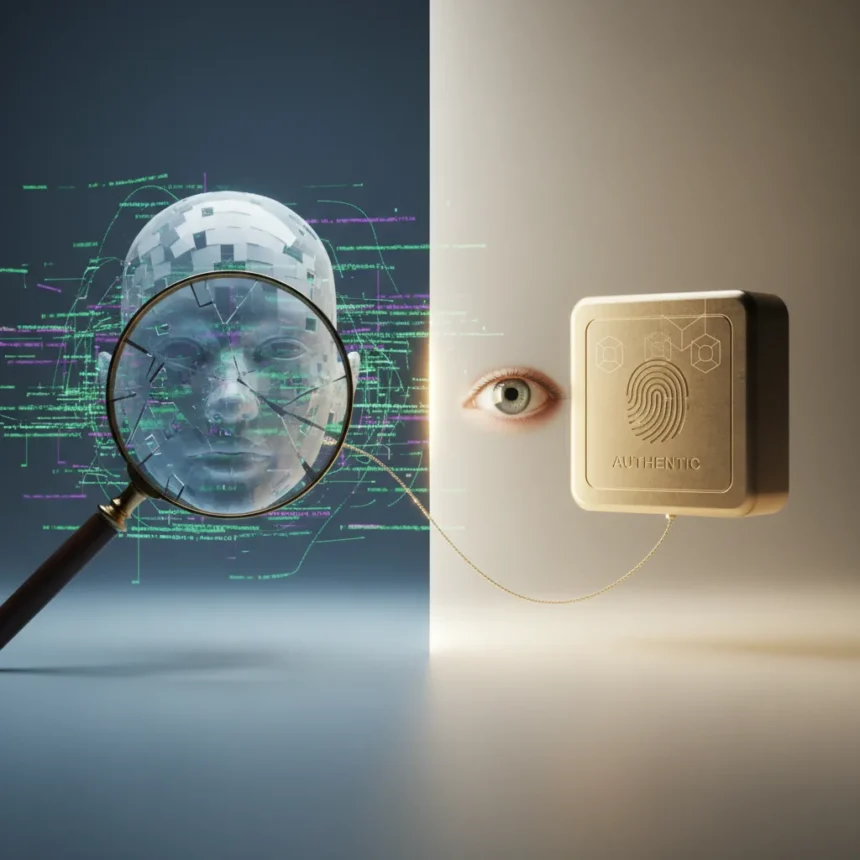
Deepfake verification tools are failing to keep pace with generative AI, and the problem is accelerating. As synthetic media becomes indistinguishable from reality, society faces a crisis not of detection but of trust itself. The shift from spotting the fake to proving the real has become urgent.
Key Takeaways
- Only 34% of people believe they can easily tell AI content from user-generated material.
- Deepfake-related fraud rose 3,000% in 2023, with average losses around $500,000 per incident.
- Detection tools are locked in an arms race with generative AI and cannot keep pace.
- Proof of humanness—verifying genuine identity without storing sensitive biometric data—offers a better approach than detection alone.
- Financial institutions and video platforms face the most severe risks from deepfake impersonation.
Why Deepfake Verification Tools Are Losing Ground
The premise that humans can spot deepfakes is collapsing. Only 34% of people believe it is easy to tell AI content from user-generated material, yet deepfake fraud keeps accelerating. Deepfake-related fraud rose by 3,000% in 2023, with average losses reaching around $500,000 per incident. These numbers reveal the scale of the problem: detection is failing, and the cost of failure is measured in millions.
Deepfake verification tools face a fundamental problem: they are locked in an arms race with generative AI itself. As detection methods improve, so do the AI systems designed to evade them. This dynamic ensures that purely reactive detection approaches will always lag behind the sophistication of synthetic media. The faster detection algorithms evolve, the faster generative models adapt to fool them. This arms race is unwinnable through detection alone.
The threat spans every sector. Scammers deploy deepfaked celebrity endorsements to steal millions through investment schemes on social media. Fraudsters use AI-generated video pleas with the faces of aid workers after natural disasters. Political deepfakes spread rapidly, showing candidates saying things they never said. Financial institutions face especially severe challenges, as impersonation and account takeovers become harder to prevent.



Why Traditional Responses Fall Short
Three traditional approaches dominate the deepfake defense landscape: detection tools, moderation, and Know Your Customer (KYC) checks. None fully solve the problem. Detection tools, as noted, cannot keep pace with generative AI. Moderation at scale is costly and controversial, requiring massive human or automated review infrastructure that struggles with accuracy and cultural context. KYC escalation adds friction for consumers without solving the core difficulty of spotting fakes in real time.
KYC checks carry an additional risk: they often require users to submit sensitive biometric data, such as selfies and document images. This data becomes a target for theft and leakage. Once compromised, user-identifying content can accelerate the ability of AI to impersonate real people, creating a feedback loop where the cure worsens the disease. Storing and sharing sensitive biometric data, even with good intentions, increases the risk profile rather than reducing it.



Proof of Humanness: A Better Approach to Deepfake Verification
If detecting the fake is failing, the smarter approach is proving the real. Proof of humanness means verifying that a genuine person is behind an interaction, without storing or sharing sensitive biometric data. This shifts the burden from detection (spotting what is false) to verification (confirming what is authentic).
The concept is straightforward but powerful. Banks could apply proof-of-human checks when opening accounts or authorizing transactions, ensuring that the person on screen is who they claim to be without collecting permanent biometric records. Video platforms could block deepfake executives from tricking colleagues into wire transfers or disclosing confidential information. Rather than trying to identify synthetic media after it appears, organizations verify authenticity before trust is extended.
This approach addresses the core vulnerability: the moment when a scammer impersonates someone trusted. By confirming genuine identity at the point of interaction—without creating a permanent biometric database that can be breached—organizations reduce both the likelihood of fraud and the collateral damage of data theft. The person being impersonated remains protected, and the organization avoids the liability of storing sensitive identity data.
The Credibility Crisis Beneath the Fraud
Deepfake fraud is not only a financial problem; it is a trust problem. As synthetic media becomes harder to distinguish from reality, the very idea of spotting the fake is collapsing. This cognitive dissonance has consequences beyond individual scams. It erodes confidence in video evidence, audio recordings, and digital interactions themselves. If a video of a CEO authorizing a transaction could be synthetic, how do you know any video is real?



This uncertainty affects the credibility of AI itself. If generative AI is perceived as a tool for mass deception, trust in legitimate AI applications declines. Financial institutions struggle to verify customer identity. Video platforms lose confidence in their ability to moderate authentic content. The problem spreads beyond deepfakes into a broader crisis of digital authenticity. Proof of humanness addresses this by establishing a standard for what authentic interaction looks like, independent of detection technology.
Is deepfake verification technology available now?
Proof of humanness is emerging as a practical approach, but widespread deployment is still developing. Banks and video platforms are beginning to explore identity verification methods that do not rely on storing permanent biometric data. The technology exists, but adoption and standardization remain in early stages.
Can deepfake detection tools ever win the arms race?
Unlikely. Detection tools will continue to improve, but generative AI advances faster. The arms race is asymmetrical—defenders must catch every fake, while attackers need only stay ahead. Shifting focus from detection to verification of authenticity is a more sustainable strategy than trying to out-detect generative AI.
What happens to biometric data collected for KYC checks?
Biometric data collected for identity verification becomes a target for theft. Once leaked, this data can be used to train AI systems to impersonate the original person, accelerating deepfake fraud. This is why proof of humanness avoids storing or sharing sensitive biometric information—it verifies identity without creating a permanent record that can be compromised.
The deepfake crisis is real, but the solution is not better detection. It is better verification. As AI-generated content becomes harder to distinguish, the only reliable path forward is proving that a genuine person stands behind each interaction. Organizations that shift from spotting fakes to confirming authenticity will build trust in an era when trust itself is the scarcest resource.
Edited by the All Things Geek team.
Source: TechRadar