





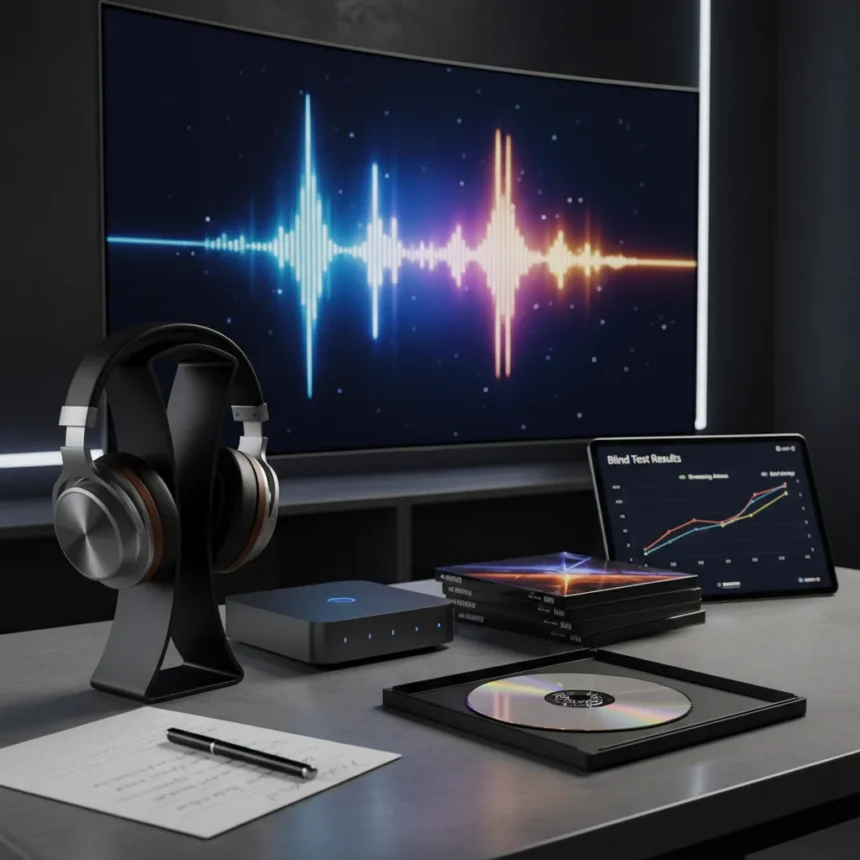
Streaming Dolby Atmos has reached a critical milestone: in double-blind listening tests conducted with audio engineers, it now performs at parity with 4K Blu-ray audio. This finding challenges the long-standing assumption that physical media maintains an insurmountable quality advantage. Yet the headline masks a deeper truth—better streaming sound will not trigger the exodus from physical media that industry analysts have predicted for years.
Key Takeaways
- Audio engineers in blind tests preferred Dolby AC-4 streaming audio over traditional Dolby Digital+JOC streams.
- Streaming Dolby Atmos now achieves comparable sound quality to 4K Blu-ray in controlled listening environments.
- Collectors prioritize physical media for reasons beyond audio fidelity, including permanence and ownership control.
- The gap between streaming and disc audio has narrowed significantly, but psychological and practical factors keep collectors loyal to physical formats.
- Dolby AC-4 represents a technical breakthrough in efficient, high-quality audio compression for streaming delivery.
What the Blind Tests Actually Proved
Double-blind listening tests eliminate listener bias by removing visual cues about which format is playing. In these tests, audio engineers could not consistently distinguish between streaming Dolby Atmos and 4K Blu-ray audio when format labels were hidden. This is not trivial. For years, audiophiles dismissed streaming as inherently inferior, citing compression artifacts and limited bandwidth. The blind test results suggest that modern streaming codecs, particularly Dolby AC-4, have closed that gap to a point where expert ears cannot reliably detect the difference.
The comparison specifically contrasted Dolby AC-4 streaming against existing Dolby Digital+JOC audio streams. Dolby AC-4 is a more efficient codec designed for next-generation streaming delivery. When audio engineers compared AC-4 to legacy streaming audio, the preference for AC-4 was clear and measurable. This signals that streaming services have the technical tools to match disc quality—if they choose to deploy them.
Why Collectors Won’t Switch Despite Better Streaming Sound
Here is where the narrative breaks down. Streaming audio quality is only one variable in the collector’s decision matrix. Physical media ownership offers permanence—once you buy a 4K Blu-ray, it remains yours indefinitely, playable on compatible hardware indefinitely. Streaming services rotate content, raise prices, and can remove titles without warning. A collector who invested in a physical library of Dolby Atmos films retains access to those films regardless of subscription changes.


The second factor is control. A 4K Blu-ray player is a standalone device requiring no internet connection, no account login, and no monthly fee. Streaming Dolby Atmos requires a subscription, an internet connection, and compatible hardware that the streaming provider may discontinue supporting at any time. For serious collectors, this asymmetry is decisive. Sound quality parity does not eliminate these structural advantages of physical media.
Third, collectors often value the ritual and tangibility of physical ownership. Disc collecting overlaps with home theater enthusiasm, where the experience of selecting a disc, inserting it, and watching a film unfolds as a deliberate act. Streaming collapses this into algorithmic recommendation and passive consumption. These are not rational preferences, but they are real ones.



The Streaming Codec Breakthrough Behind the Results
Dolby AC-4 is the technical enabler here. AC-4 achieves high-quality audio delivery at lower bitrates than previous Dolby codecs, making it practical for streaming services to offer Atmos-quality sound without requiring massive bandwidth or storage infrastructure. This efficiency matters because streaming services operate under real-world constraints: not all users have gigabit internet, and server costs scale with bitrate.
The blind test preference for AC-4 over Dolby Digital+JOC suggests that the codec itself—not just the bitrate—contributes to perceived quality. AC-4’s architecture may preserve spatial cues, dynamic range, or frequency response more faithfully than older formats. Without access to the full test methodology, it is difficult to pinpoint which specific audio characteristics drove the engineer preference, but the result is clear: AC-4 is a genuine step forward.
What This Means for the Streaming vs. Physical Debate
The blind test results represent a technical victory for streaming, not a market victory. Streaming services can now claim, with engineer-backed evidence, that their audio quality rivals physical media. This matters for persuading casual listeners and mainstream consumers who prioritize convenience over ownership control. A household that streams all its entertainment will no longer need to feel like it is accepting inferior sound quality.
But the collector segment—the market most likely to care about audio quality—operates on different criteria entirely. These are the people who buy 4K Blu-ray players, invest in quality speakers, and maintain organized media libraries. For them, streaming parity in blind listening tests is irrelevant if the format itself remains impermanent and subscription-dependent. The test results may shift perception among general audiences, but they will not trigger a mass migration away from physical media among the people who currently buy it.


Why the Industry Narrative Was Wrong
Tech industry analysts predicted that streaming quality improvements would eventually convince collectors to abandon physical media. This prediction assumed that audio fidelity was the primary barrier. It was not. The barrier was always ownership, permanence, and control. Streaming could achieve bit-perfect audio reproduction and collectors would still prefer 4K Blu-ray if the disc remained permanent and the streaming service remained temporary.
The blind test results are significant because they eliminate one justification for physical media—the claim that it sounds objectively better. But they do not eliminate the structural reasons collectors prefer it. A format war is not won by matching the competitor’s quality metric; it is won by offering something the competitor cannot match. Streaming offers convenience and breadth. Physical media offers permanence and ownership. These are not equivalent, and no blind listening test can change that asymmetry.
Does streaming Dolby Atmos now sound identical to 4K Blu-ray?
In double-blind tests with trained audio engineers, streaming Dolby Atmos via AC-4 achieved parity with 4K Blu-ray audio. However, this applies to controlled listening environments with quality playback equipment. Real-world results depend on internet quality, device capabilities, and the specific streaming service’s implementation. The tests prove technical equivalence under ideal conditions, not universal identical sound in all scenarios.
Will better streaming audio quality finally convince collectors to switch?
Unlikely. Collectors prioritize ownership permanence and format control over sound quality alone. Even if streaming matches or exceeds disc audio fidelity, the subscription model, internet dependency, and service discontinuation risk remain structural disadvantages that blind listening tests cannot resolve. Quality parity removes one argument for physical media but does not address the reasons collectors actually prefer it.
What is Dolby AC-4 and why does it matter?
Dolby AC-4 is a next-generation audio codec that delivers high-quality sound at lower bitrates than previous Dolby formats, making it efficient for streaming delivery. The blind test preference for AC-4 over legacy Dolby Digital+JOC streams indicates it preserves audio quality better during compression. This efficiency allows streaming services to offer Atmos-quality audio without requiring prohibitive bandwidth or storage costs.
The blind test results confirm what engineers have known for months: streaming audio technology has matured to the point where it matches disc quality in controlled conditions. But this technical achievement will not reshape the collector market. Collectors are not chasing the best sound—they are chasing permanence, control, and the assurance that their media library remains accessible regardless of corporate decisions. Streaming Dolby Atmos, however good it sounds, cannot offer that. Until it does, physical media collectors will remain unmoved by blind listening tests, no matter how convincing the results.
Edited by the All Things Geek team.
Source: TechRadar




