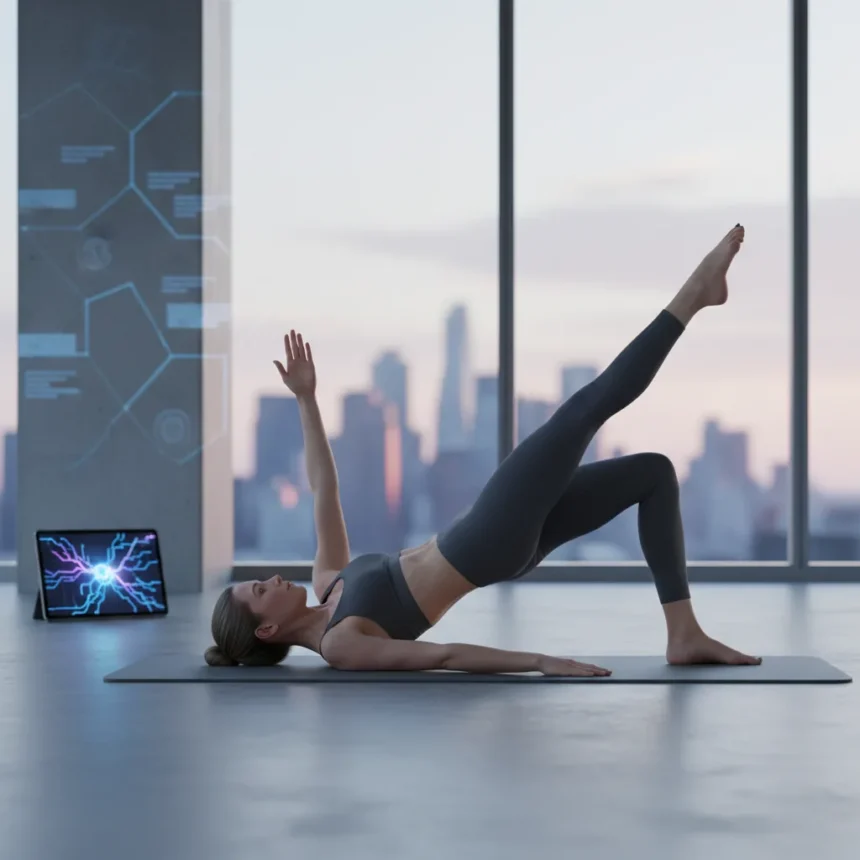
The Pilates dead bug is a deceptively simple core exercise that challenges the conventional wisdom of sit-ups and crunches. Rather than relying on repeated spinal flexion, this move emphasizes control, stability, and coordination—qualities that actually build functional core strength most people need.
Key Takeaways
- The Pilates dead bug prioritizes control and stability over speed and repetition.
- It offers a safer alternative to sit-ups and crunches for core training.
- The exercise requires no equipment and works for most fitness levels.
- Progressions allow you to increase difficulty as your strength improves.
- Real results come from consistent practice with proper form and control.
Why the Pilates dead bug outperforms traditional ab work
Sit-ups and crunches have dominated core training for decades, yet they come with a significant drawback: repeated spinal flexion can strain the neck and lower back, especially when done with poor form. The Pilates dead bug sidesteps this problem entirely. Instead of crunching your spine, you lie on your back and move your limbs in a coordinated pattern that demands deep core engagement without compressing your vertebrae. The result is a move that actually feels easier on your body while delivering stronger, more stable results.
The key difference lies in how these exercises recruit your core muscles. Sit-ups primarily target the rectus abdominis—the surface layer—while largely ignoring the deeper stabilizer muscles that support your spine and posture. The Pilates dead bug, by contrast, forces your entire core system to work together. You cannot rush through the movement. You cannot use momentum. Every repetition demands that your abdominals, obliques, and deep transverse abdominis fire in concert to maintain stability as your limbs move independently of your torso. This is why practitioners report seeing real results in their core strength and control.
How to perform the Pilates dead bug with proper form
Start by lying flat on your back with your knees bent and feet flat on the floor, positioned hip-width apart. Your arms should extend straight up toward the ceiling, perpendicular to your body. Before you move, press your lower back gently into the floor—this is your neutral spine position and the foundation of the entire exercise. Maintain this contact throughout.

From this starting position, slowly extend your right leg straight out, hovering it just above the floor while simultaneously lowering your left arm overhead, also hovering above the floor. The movement should be controlled and deliberate. Return to the starting position, then repeat on the opposite side: left leg extends, right arm lowers. This alternating pattern is the dead bug. Move slowly. Breathe steadily. If your lower back lifts off the floor, you have gone too far—scale back the range of motion until you can maintain that spinal contact throughout the set. Control matters far more than speed or range.
Progressions to challenge your core as you improve
Once you have mastered the basic dead bug with proper form, several progressions will increase the difficulty without requiring any equipment. The simplest progression is to extend both your right arm and right leg simultaneously, then both your left arm and left leg. This removes the alternating pattern and forces your core to stabilize a more asymmetrical load. Move slowly and maintain that lower back contact.



For a greater challenge, try holding the extended position for 2-3 seconds before returning to start. This isometric pause forces your core muscles to sustain tension, building endurance alongside strength. Another effective progression involves adding a slight pulse or micro-movement while your limbs are extended—tiny up-and-down motions that keep your muscles under constant tension. Finally, advanced practitioners can try the dead bug with a stability ball held between their hands or feet, adding an unstable element that demands even greater core control and coordination.
Why control beats speed in core training
The fitness world often equates more reps with better results, but core training is different. A slow, controlled dead bug repetition with perfect form builds far more strength and stability than twenty rushed crunches. This is because slow movement under tension forces your muscles to work harder and longer. When you move fast, momentum takes over, and your muscles actually do less work. Additionally, controlled movement allows you to maintain that critical lower back contact, protecting your spine while maximizing core activation.
The Pilates dead bug proves that simplicity and control trump complexity and speed. You do not need fancy equipment, gym membership, or complicated programming. You need consistency, proper form, and patience. Start with three sets of 8-10 repetitions per side, performed twice per week with at least one rest day between sessions. Focus on moving slowly, breathing steadily, and maintaining spinal stability. After 4-6 weeks of consistent practice, you will notice improvements in core strength, posture, and everyday movement quality that sit-ups and crunches rarely deliver.
Is the Pilates dead bug safe for beginners?
Yes. The Pilates dead bug is one of the safest core exercises available because it eliminates the neck strain and lower back compression associated with sit-ups and crunches. If you are returning from injury, pregnant, or new to exercise, consult a qualified fitness professional or physical therapist before starting any new routine. They can assess your individual needs and confirm that the dead bug is appropriate for you. Start with the basic version and progress only when you can maintain perfect form without lower back discomfort.



How many times per week should I do the Pilates dead bug?
Two to three sessions per week is ideal for most people. This frequency allows your core muscles adequate recovery time while providing enough stimulus to drive strength gains. Each session should include 3-4 sets of 8-12 controlled repetitions per side. Rest at least one full day between dead bug sessions to allow your muscles to recover and adapt.
Can the Pilates dead bug replace sit-ups entirely?
For most people, yes. The dead bug delivers superior core strength, stability, and safety compared to sit-ups and crunches. It addresses the deeper stabilizer muscles that traditional ab exercises ignore, and it does so without spinal compression. If you have specific athletic goals or enjoy variety, combining the dead bug with other core moves like planks or bird dogs is fine—but sit-ups and crunches are not necessary for building a strong, stable core.
The Pilates dead bug represents a shift in how we think about core training. It proves that effective strength building does not require speed, equipment, or the kind of repetitive spinal flexion that leaves your neck and back sore. Instead, it rewards control, consistency, and patience. If you have been grinding away with sit-ups and crunches without seeing real results, the dead bug offers a smarter, safer path to the core strength you actually want.
Edited by the All Things Geek team.
Source: Tom's Guide