







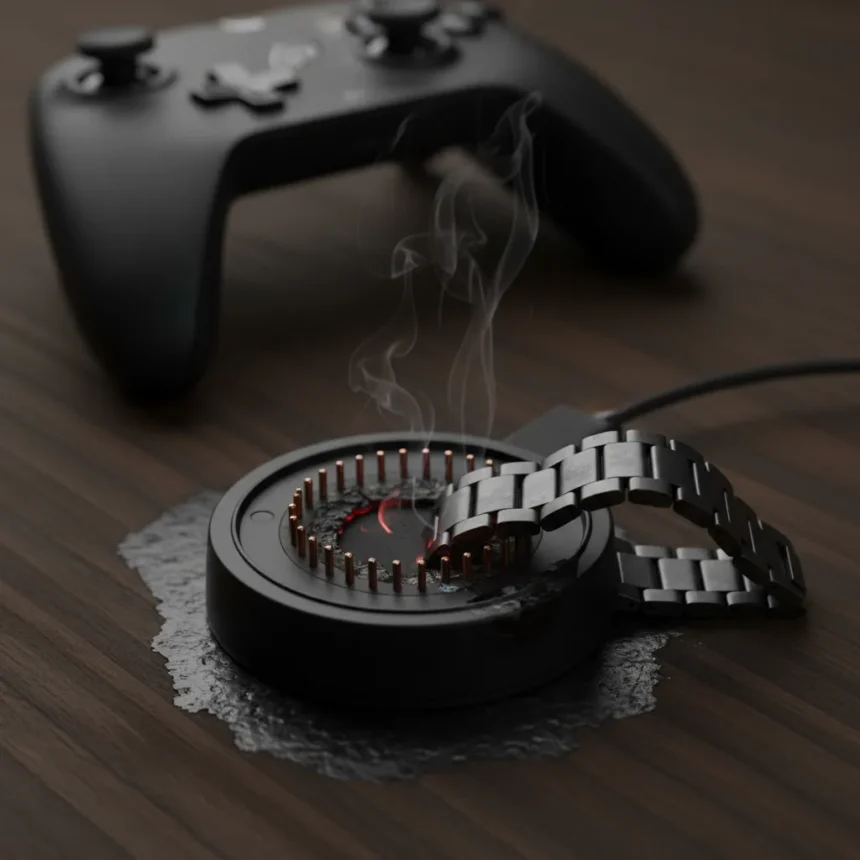
The Steam Controller charging puck is a magnetic wireless charging dock designed by Valve for its handheld gaming device. A recent incident has exposed a serious design vulnerability: the puck’s exposed pogo pins can create dangerous electrical arcs when conductive metal objects make contact, potentially causing fire. A Reddit user discovered this hazard when their Pixel Watch 3 metal wristband touched the puck at precisely the wrong angle, triggering a short circuit that caused the strap to start sizzling.
Key Takeaways
- A Pixel Watch 3 metal band created a short circuit on the Steam Controller puck’s exposed pogo pins, causing the strap to sizzle.
- The puck’s magnetic design attracts metallic objects directly toward its unprotected electrical contacts.
- Valve’s manual warns users to keep metallic objects away from the puck before connecting, but the warning may come too late.
- Both devices survived with only cosmetic damage, but the incident highlights a critical design flaw.
- The exposed-pin architecture differs significantly from contactless wireless charging systems used by competitors.
How the Short Circuit Happened
The incident unfolded when a metal smartwatch wristband made contact with the Steam Controller charging puck’s exposed pogo pins. According to the user’s account, the metal strap touched the puck at an angle that bridged the electrical contacts, creating a direct short circuit. The strap immediately began sizzling as current flowed through it. The user quickly separated the watch from the puck, preventing escalation to a full fire. Both devices sustained only cosmetic damage, but the speed and intensity of the electrical arc raised alarm about what could happen if the contact lasted longer or involved a more flammable material.
The core problem lies in the puck’s design: it uses a magnetic attachment system to hold the Steam Controller in place during charging, but the magnetic field also attracts nearby metal objects—including watch bands, keys, coins, and metal jewelry. Once a conductive object touches the exposed pogo pins, nothing stops current from flowing through it. Valve’s manual does warn users to keep metallic objects away from the charging puck before connecting, stating that magnetic parts may attract metallic items and that users should ensure the wireless adapter and charging puck are free of metallic objects before connecting to reduce the risk of sparks and resulting property damage or possible injury.
Design Flaw: Exposed Pins vs. Safer Alternatives
The Steam Controller charging puck’s exposed pogo pin design is fundamentally different from safer charging architectures used in competing products. Many modern wireless chargers—both magnetic and inductive—use recessed contact points or fully enclosed charging chambers that prevent accidental metal contact. Some systems include current-limiting circuitry that automatically cuts power if a short is detected, a safety feature absent from the puck’s design. The exposed pins on Valve’s charging dock are directly accessible, meaning any conductive object that lands on them at the right angle becomes a potential hazard.
This architectural choice may have been made for simplicity and cost, but it creates a safety liability. Inductive charging systems, like those used in some competitor controllers, eliminate the risk entirely by transmitting power through magnetic induction rather than direct electrical contact. Magnetic charging docks from other manufacturers often include protective covers or angled contact points that make accidental bridging difficult. The Steam Controller puck offers none of these protections, leaving users to rely entirely on manual vigilance—an unrealistic expectation in households with multiple wireless devices.
Safety Concerns and Regulatory Questions
The near-fire incident has sparked discussion about whether the puck’s design complies with electrical safety standards, particularly in the European Union, where regulations around exposed electrical contacts on consumer devices are stricter than in North America. While Valve has not issued a public statement addressing the incident, the company’s own manual acknowledgment of the hazard suggests the risk was known during design. The question now is whether the warning is sufficient, or whether the design itself should be reconsidered.


Fire risk with consumer electronics is taken seriously by regulatory bodies worldwide. An electrical arc hot enough to cause sizzling on a metal strap could ignite nearby flammable materials—paper, fabric, or plastic. The fact that the incident occurred in a home environment, where the puck might sit on a desk near other objects, underscores the real-world danger. Secondary coverage of the incident has raised concerns that the puck may not meet stricter international electrical safety standards for consumer devices. Valve’s silence on the matter has only amplified these concerns.
What Valve Says—and Doesn’t Say
Valve’s official response to the incident remains absent. The company’s manual includes a warning about metallic objects, but that warning places the burden entirely on the user. No recall has been issued, no design change announced, and no statement clarifying whether this is an isolated user error or a broader design vulnerability. This silence is notable given that the incident was widely reported across gaming and tech media, suggesting Valve is aware of the coverage.
The manual’s warning is a legal protection for Valve but offers little comfort to users. Warnings work best when the risk is non-obvious or requires technical knowledge to understand. In this case, most users would not naturally assume that placing a smartwatch near a charging dock could cause a fire. The magnetic attraction actually works against user safety—it draws metal objects toward the hazard rather than away from it. A more proactive approach would involve either redesigning the puck with recessed or protected contacts, adding current-limiting circuitry, or issuing a clear advisory about which devices should never be placed near the charger.
Should You Use the Steam Controller Charging Puck?
If you own a Steam Controller and use the magnetic charging puck, the immediate safeguard is simple: keep all metallic objects away from the dock while charging. Remove smartwatches with metal bands, keep keys and coins off your desk, and avoid placing the puck in areas where metal jewelry or other conductive items might accidentally touch it. The risk is real, but manageable with deliberate precautions.



However, the incident highlights a design philosophy that prioritizes convenience over safety. Valve chose an exposed-pin magnetic system for its simplicity and cost-effectiveness, but that choice created a hazard that users must actively manage. Competitors have demonstrated that wireless charging can be both convenient and safe—inductive systems and recessed contact designs eliminate this risk entirely. Until Valve addresses the design flaw or issues a comprehensive safety advisory, users should treat the charging puck as a device requiring careful handling and environmental awareness.
Could this happen with other devices near the puck?
Yes. Any metal object capable of bridging the pogo pins—metal watch bands, jewelry, coins, keys, or metal phone cases—poses the same risk. The hazard is not specific to the Pixel Watch 3; it is inherent to the puck’s design. Devices with metal components should be kept away from the charger entirely.
Has Valve issued a recall or design fix?
As of the time of reporting, Valve had not issued a recall, design revision, or formal statement addressing the safety concern. The company’s manual warning remains the only official guidance.
What makes the Steam Controller charging puck different from other wireless chargers?
The puck uses exposed pogo pins for direct electrical contact, whereas many competing wireless chargers use inductive charging or recessed contact points that prevent accidental metal bridging. The Steam Controller puck’s design is simpler but less safe.
The Steam Controller charging puck incident is a reminder that hardware design involves trade-offs, and Valve chose convenience over safety. Until the company redesigns the puck or issues a stronger advisory, users must be their own safeguard. The risk is avoidable with awareness, but it should never have existed in the first place.
Edited by the All Things Geek team.
Source: Tom's Hardware




