





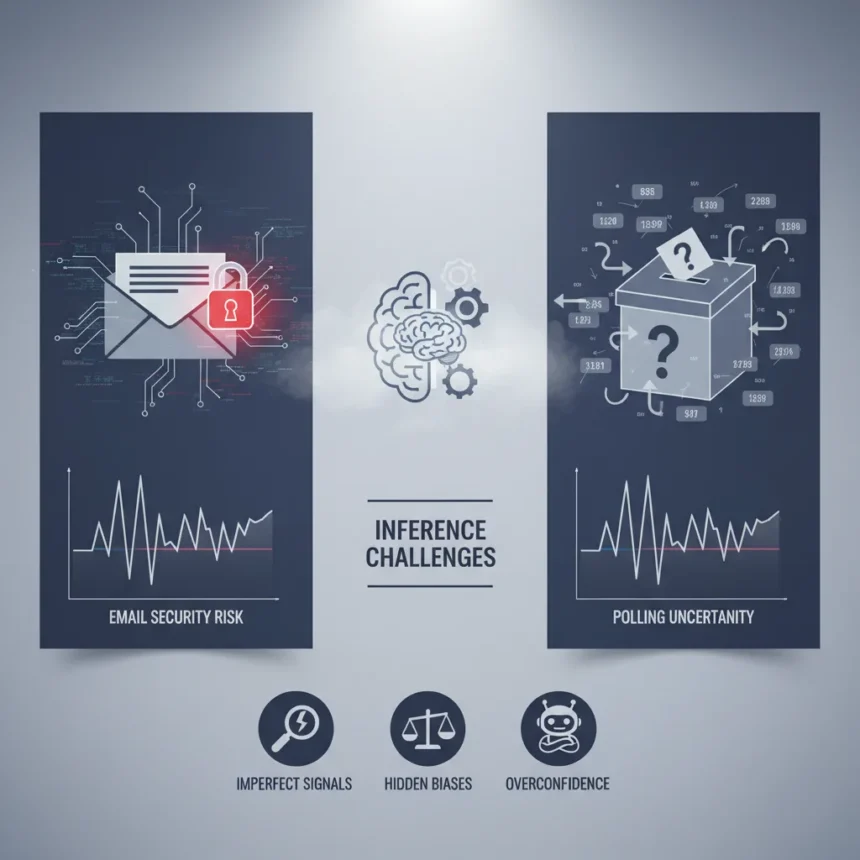
Machine learning email security systems face a fundamental problem that election pollsters know well: they must make predictions based on incomplete, imperfect data. Both domains depend on inference from noisy signals rather than certainty, yet both often project false confidence in their automated decisions.
Key Takeaways
- Election polling and ML-based email security both rely on inference from incomplete signals, not perfect prediction.
- Sampling bias in polling mirrors classification bias in machine learning threat detection systems.
- False positives and false negatives in email security are analogous to polling error margins and systematic bias.
- Automated systems in both domains can mask uncertainty, leading to overconfidence in flawed predictions.
- Human oversight and model calibration are essential to prevent cascading errors in security decisions.
Why Polling Failures Predict Machine Learning Email Security Risks
Election polling fails not because pollsters are incompetent, but because they face an inherent constraint: they must infer population behavior from a sample. The same constraint haunts machine learning-based email security. These systems are trained on historical threat data—a sample—and deployed to catch threats they have never seen. When a polling model misses a population shift, it produces a prediction error. When an email security model misses a new attack pattern, it produces a false negative: a dangerous email reaches the inbox.
The analogy runs deeper than surface comparison. Polling operates on the assumption that past voter behavior predicts future voting. Machine learning email security operates on the assumption that past threat patterns predict future threats. Both assumptions break when the world changes faster than the training data reflects. Both systems then fail silently—the pollster publishes a confident forecast that proves wrong; the security model flags nothing while a novel phishing campaign spreads.
Sampling Bias and Classification Bias: The Hidden Flaw
Pollsters have long known that who you sample shapes what you find. If a poll oversamples one demographic, its results skew. Machine learning email security systems face an analogous problem: classification bias. If the training data overrepresents certain threat types—say, Nigerian prince scams—the model learns to detect those threats efficiently while remaining blind to emerging attack vectors, such as credential-stuffing campaigns targeting a specific industry.



The difference is visibility. A pollster can audit sampling methodology and adjust weights. An email security model buried in production often hides its biases until they cause real damage. A security team may not realize their ML system has learned to ignore threats that look nothing like the training set, just as a polling firm might not realize it has systematically undersampled a key voter segment until election night arrives.
False Positives, False Negatives, and the Confidence Trap
Election polling produces two types of error: it can overestimate one candidate’s support (false positive for that candidate) or underestimate it (false negative). Email security models produce the same errors. A false positive flags a legitimate email as a threat, clogging inboxes with false alarms. A false negative misses a real threat, allowing it through.


The dangerous part is that both systems often hide their uncertainty. A poll reports a single number—say, 52 percent—with a margin of error of plus or minus 3 percent. Many readers ignore the margin and treat 52 as fact. Similarly, an email security model produces a confidence score: this email is 87 percent likely to be spam. Teams then set a threshold—flag anything above 80 percent—and trust the system to work. Neither the poll nor the model explicitly communicates how often it is wrong, or under what conditions it tends to fail.
When Automated Decisions Replace Human Judgment
The real risk emerges when organizations treat automated predictions as gospel. A poll showing a 10-point lead feels decisive; a security model flagging 95 percent of incoming email as threats feels comprehensive. But both can be catastrophically wrong. A polling model trained on 2016 data might have missed the 2020 shifts in suburban voting. An email security model trained on 2023 threat data might be blind to the spear-phishing techniques deployed in 2024.
The solution is not to abandon automation—polls and email filters are still valuable—but to maintain skepticism and human oversight. A pollster who publishes results without discussing methodology, sample size, and potential biases is doing a disservice. A security team that deploys an ML model without understanding its failure modes, testing its performance on novel threats, or maintaining human review of edge cases is gambling with organizational risk.
Building Calibrated, Transparent Models
Good polling organizations publish not just a point estimate but a confidence interval, a discussion of likely sources of error, and caveats about when their model might fail. Email security teams should do the same. A machine learning email security system should be transparent about its false positive rate, its false negative rate, and the types of threats it is most likely to miss. Teams should test the model on threat data it has never seen. They should maintain human analysts who review flagged emails and, critically, who audit the model’s misses.



This is not a call to abandon machine learning. It is a call to deploy it with the same epistemological humility that good polling brings: acknowledge uncertainty, publish confidence bounds, test assumptions, and maintain human judgment as a check on automated decisions. Election polling has taught us that inference from incomplete data is powerful but fallible. Machine learning email security systems would benefit from the same lesson.
Can machine learning email security catch zero-day threats?
No system can catch a threat it has never seen before. Machine learning models are particularly vulnerable to zero-day attacks because they rely on patterns learned from historical data. A zero-day exploit has no history in the training set, so the model has no pattern to match. Hybrid approaches that combine ML detection with rule-based systems and human analysis offer better protection than ML alone.
How do false positives harm email security?
False positives—legitimate emails flagged as threats—create alert fatigue. Security teams become desensitized to alerts, and users stop trusting email filters. This paradoxically weakens security because people ignore warnings or disable filters. A machine learning email security system that flags 30 percent of legitimate email as spam is worse than no filter at all.
What role should humans play in machine learning email security?
Humans should audit the model’s decisions, especially its misses. A security analyst should periodically review emails the model flagged as safe but might have been threats, and emails it flagged as threats but were legitimate. This feedback loop helps recalibrate the model and catches systematic biases before they cause damage. The goal is not to replace human judgment with automation, but to augment it.
Machine learning email security is not a solved problem. Like election polling, it works best when teams understand its limits, test it rigorously, and maintain skepticism about its predictions. Organizations that treat their ML security models as infallible oracles will eventually face a threat their model was blind to. Those that treat them as powerful but imperfect tools, and pair them with human oversight, stand a better chance of catching what slips through.
Edited by the All Things Geek team.
Source: TechRadar




