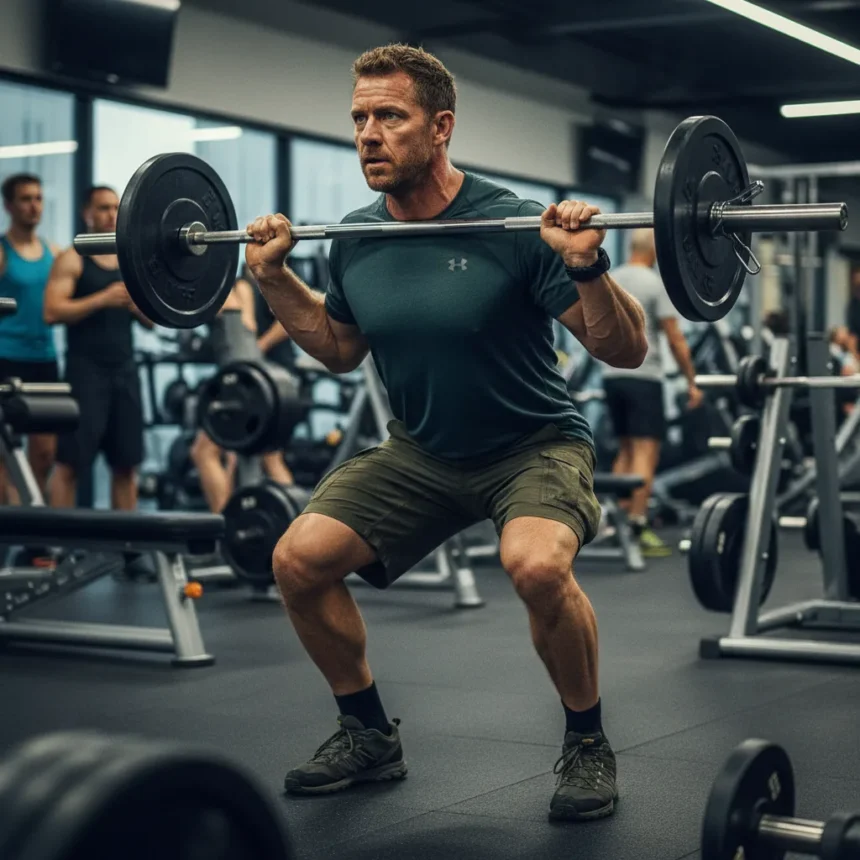
Bear Grylls’ full-body strength workout strips away the noise. At 51, the adventurer is pitching a plan built on economy of movement: six exercises, three days a week, designed to build strength and muscle without the endless repetition most gym routines demand.
Key Takeaways
- Bear Grylls designed a three-day full-body strength workout using just six moves.
- The routine combines squats, presses, pull-ups, and rows for complete muscle engagement.
- The focus is on efficiency and simplicity over complex programming.
- The workout targets strength and muscle building without excessive volume.
- This approach appeals to busy adults seeking results in minimal time.
Why Six Moves Matter for Full-Body Strength
The full-body strength workout concept rests on a simple principle: compound movements do the heavy lifting. Squats, presses, pull-ups, and rows each recruit multiple muscle groups simultaneously. You hit your legs, chest, back, and shoulders in one session rather than isolating individual muscles across five separate exercises. That efficiency is the entire pitch.
Most commercial gym routines bloat with isolation work—cable flyes, leg curls, lateral raises—movements that feel productive but steal time from what actually builds strength. Grylls’ approach cuts those out. Six moves across three days means you’re in and out, not grinding through hour-long sessions. For anyone over 40 juggling work and life, that simplicity has real appeal.
The Full-Body Strength Workout Structure
The plan spans three days per week, rotating through the same six-move framework. Each session targets your entire body by stacking compound movements that work in sequence. Squats load your legs and core. Presses develop upper body push strength. Pull-ups and rows build back thickness and pulling power. The combination ensures no muscle group is neglected.

This approach differs fundamentally from split routines that dedicate entire days to single body parts. A Monday chest day, Wednesday back day, Friday leg day structure allows more volume per muscle but requires more frequency and time. Grylls’ full-body strength workout compresses everything into three sessions, making it accessible for people who can’t commit to five gym days weekly.
Who Benefits From This Full-Body Strength Workout
The routine targets adults seeking strength gains without complexity. If you’re tired of guessing whether your program is optimal, this cuts through that paralysis. Six moves is memorable. Three days is sustainable. You’re not tracking dozens of exercises or wondering if you should add a fourth day.



Busy professionals, parents, and anyone returning to training after time away will find the simplicity appealing. You don’t need a detailed periodization plan or a spreadsheet tracking microcycles. Show up three times a week, do the six moves, and focus on getting stronger at each one. That’s the entire system.
Full-Body Strength Workout vs. Traditional Split Training
Traditional bodybuilding splits dedicate separate days to chest, back, legs, and shoulders. This allows higher volume per muscle and longer rest between sessions hitting the same area. But it demands more gym days and more total time. A full-body strength workout hits everything in one session, recovering the same muscles only after 48 hours. For strength development specifically, research and coaching consensus suggest that frequency and intensity matter more than volume per session.
The trade-off is real. Split routines may produce slightly more muscle size over time due to higher volume, but they demand more commitment. Grylls’ full-body strength workout prioritizes adherence and strength over theoretical maximum hypertrophy. If you’ll actually do three days consistently but would skip a fourth or fifth day, the full-body approach wins.
Safety Considerations for Full-Body Strength Training
Before starting any strength program, especially one involving pull-ups and heavy presses, consult a qualified fitness professional if you are a beginner, returning from injury, or have existing joint concerns. Form on compound movements matters enormously—poor squat mechanics or sloppy pressing can lead to chronic issues. Consider working with a coach for at least a few sessions to establish proper technique.



Start conservatively with weights. You should be able to complete all reps with control and maintain neutral spine positioning throughout. If you cannot do a pull-up, use an assisted machine or resistance bands initially. Progressive overload—gradually increasing weight or reps—builds strength safely. Rushing into heavy loads with poor form is the fastest way to injury.
Frequently Asked Questions
What makes a full-body strength workout more efficient than split routines?
A full-body strength workout hits all major muscle groups in one session, allowing you to recover each muscle group within 48 hours before training it again. This higher frequency combined with lower volume per session often produces faster strength gains. Split routines require more total gym days to achieve similar frequency, making them less time-efficient for busy people.
Can beginners use Bear Grylls’ full-body strength workout approach?
The structure—six compound moves, three days per week—works for beginners, but exercise selection and load matter. A beginner should use lighter weights, focus on movement quality, and potentially modify pull-ups with assistance. Working with a coach initially ensures proper form before progressing to heavier loads.
How long does a full-body strength workout session typically take?
With six compound moves and adequate rest between sets, a full-body strength workout session generally takes 45 to 60 minutes. Rest periods depend on intensity—heavy strength work needs more recovery between sets than moderate hypertrophy training. The actual time varies based on your strength level and how much weight you’re lifting.
Grylls’ full-body strength workout succeeds because it respects your time while demanding real effort. Six moves, three days, no nonsense. That’s not a marketing angle—it’s the entire philosophy. If you’ve been lost in elaborate program design or spinning your wheels with endless isolation exercises, this approach cuts through the clutter and delivers what actually works: consistent training on compound movements. The simplicity is the feature, not a limitation.
Where to Buy
30 Amazon customer reviews | £62.90
Edited by the All Things Geek team.
Source: T3