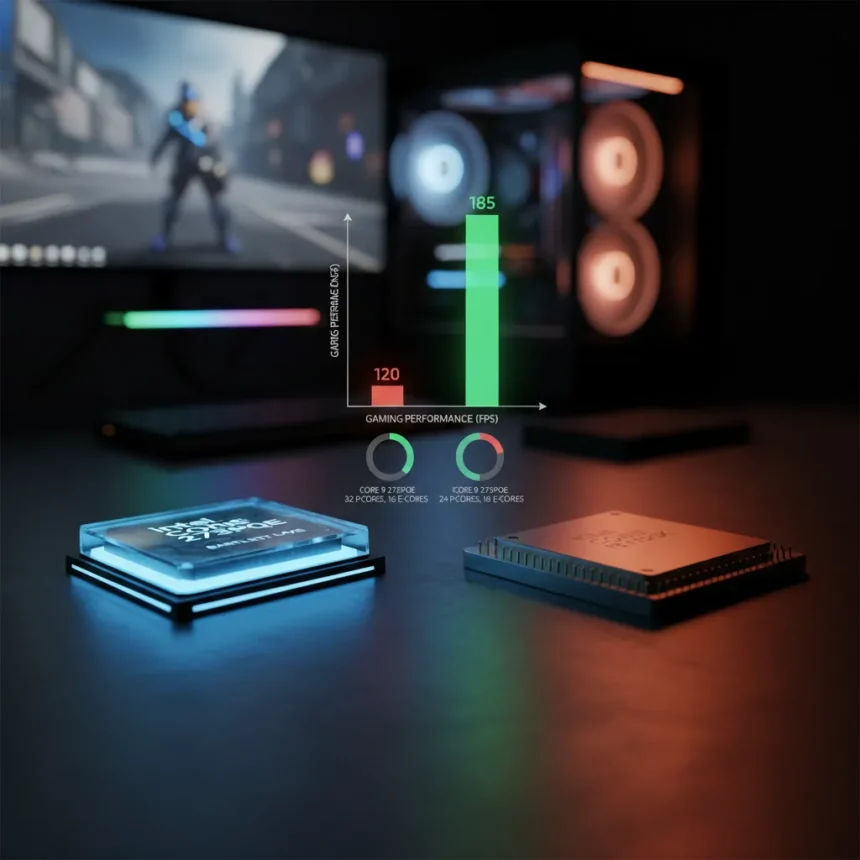
Intel’s Core 9 273PQE gaming performance lags behind the four-year-old Core i9-13900K despite packing 50% more P-cores, according to benchmarks from German tech outlet PC Games Hardware. The comparison exposes a hard truth about modern CPU design: raw core counts don’t automatically translate to gaming dominance.
Key Takeaways
- The Core 9 273PQE has 50% more P-cores than the Core i9-13900K but underperforms in gaming tests
- PC Games Hardware’s testing shows the older i9-13900K maintains an edge in gaming workloads
- Core count alone does not determine gaming CPU performance
- Bartlett Lake is Intel’s new flagship architecture competing in the high-end processor market
- The comparison includes modern mainstream processors alongside the older Intel flagship
Why the Core 9 273PQE Gaming Performance Disappoints
The Core 9 273PQE gaming performance gap reveals a fundamental design mismatch. Intel’s Bartlett Lake flagship prioritizes raw P-core count over the architectural refinements that made the i9-13900K such a strong gaming chip. More cores sound impressive in marketing materials, but they mean nothing if clock speeds, cache efficiency, or instruction-per-cycle performance can’t keep pace with older silicon.
Gaming workloads don’t scale linearly with core count. A four-year-old architecture optimized for gaming still outpaces a newer design that trades gaming performance for other metrics. This suggests Intel may have made architectural compromises in Bartlett Lake that benefit workloads like rendering or compilation but hurt frame rates in modern titles.
PC Games Hardware’s testing methodology compared the Core 9 273PQE against both the i9-13900K and modern mainstream processors, creating a comprehensive picture of where the new flagship sits in the performance hierarchy. The results were unambiguous: despite its core count advantage, the newer chip couldn’t dethrone a processor released four years prior.


Core Count vs. Real-World Gaming Performance
The Core 9 273PQE gaming performance problem highlights why enthusiasts shouldn’t chase core counts blindly. A CPU with 50% more P-cores should dominate gaming benchmarks in theory. In practice, the i9-13900K’s architecture, clock speeds, and cache design proved more important than sheer core volume. This mismatch between spec sheets and actual gaming results is exactly what separates marketing hype from engineering reality.
Bartlett Lake appears to have been designed with different priorities in mind. If the Core 9 273PQE gaming performance trails older mainstream competition, Intel either sacrificed gaming optimization for multi-threaded workloads or made power and thermal trade-offs that hurt clock speeds. Without access to detailed specifications, the exact reason remains unclear, but the benchmark results don’t lie.



What This Means for Intel’s Flagship Strategy
The Core 9 273PQE gaming performance loss is a strategic problem for Intel. Flagship CPUs carry prestige pricing and must excel across the board, not just in niche workloads. When a four-year-old chip beats your new flagship in gaming, marketing teams have a problem. Enthusiasts and content creators—the audience that buys flagship processors—care about gaming performance as a proxy for overall responsiveness and system feel.
Intel positioned Bartlett Lake as its answer to modern competition, but the Core 9 273PQE gaming performance results suggest the company may have miscalculated market priorities. A processor that dominates in rendering farms but stutters in gaming is a poor flagship choice for the consumer market, even if it excels in server and workstation environments.
How the Core 9 273PQE Compares to Mainstream Competition
PC Games Hardware’s testing included modern mainstream processors alongside the flagship comparison. The Core 9 273PQE gaming performance against these mid-range chips remains unclear from the available data, but the fact that a four-year-old flagship outperforms the new flagship suggests the new Bartlett Lake processor struggles across gaming workloads broadly. If the i9-13900K beats it, mainstream CPUs likely do too.
This creates an awkward positioning problem. The Core 9 273PQE can’t claim gaming crown. It can’t claim gaming dominance over older flagships. For workstation and server buyers, raw P-core count might matter more, but those markets don’t drive consumer perception of Intel’s flagship prowess.



Does Core Count Matter for Gaming?
The Core 9 273PQE gaming performance comparison answers this question definitively: not as much as other factors. Modern games typically use four to eight cores effectively. Beyond that, clock speed, cache hierarchy, and instruction efficiency matter far more than additional cores. The i9-13900K’s architecture, refined over generations, still extracts better gaming performance from fewer cores than Bartlett Lake’s design.
This doesn’t mean core count is irrelevant. Multi-threaded workloads, streaming, and content creation benefit from more cores. But for gaming specifically, the Core 9 273PQE gaming performance loss proves that Intel’s approach to Bartlett Lake prioritized other workloads at gaming’s expense.
What Happens Next for Intel’s Flagship Lineup?
The Core 9 273PQE gaming performance failure signals that Intel needs to recalibrate its flagship strategy. If the company intends to compete in consumer markets, gaming performance can’t be an afterthought. Bartlett Lake as a concept may work fine for data centers and workstations, but as a consumer flagship, the Core 9 273PQE appears to have missed the mark.
Intel has released Bartlett Lake as a new flagship architecture, but the benchmarks from PC Games Hardware suggest the market may not receive it as such. Gaming remains a key performance benchmark for consumer CPU perception, and losing to a processor four years old is a messaging disaster.
FAQ
Why does the Core 9 273PQE gaming performance lag despite having more cores?
Gaming performance depends on clock speed, cache efficiency, and per-core performance—not just core count. The i9-13900K’s older but optimized architecture extracts better gaming performance from fewer cores than Bartlett Lake’s design. Intel appears to have made architectural trade-offs that favor multi-threaded workloads over gaming.
Is the Core i9-13900K still a good gaming CPU?
According to PC Games Hardware’s testing, the i9-13900K outperforms Intel’s new Bartlett Lake flagship in gaming, making it a strong choice for gamers seeking proven performance. A four-year-old processor beating newer competition indicates the i9-13900K remains competitive for gaming workloads.
Should I buy the Core 9 273PQE for gaming?
Based on the Core 9 273PQE gaming performance results from PC Games Hardware, the newer flagship does not deliver gaming advantages over the older i9-13900K. If gaming is your primary use case, the i9-13900K or modern mainstream processors may offer better value and performance.
Intel’s Bartlett Lake flagship stumbles where it matters most for consumer perception: gaming. The Core 9 273PQE gaming performance loss to a four-year-old processor is a wake-up call that core counts alone don’t win markets. Enthusiasts and gamers will remember this benchmark result longer than any marketing claim about P-core counts.
Edited by the All Things Geek team.
Source: Tom's Hardware