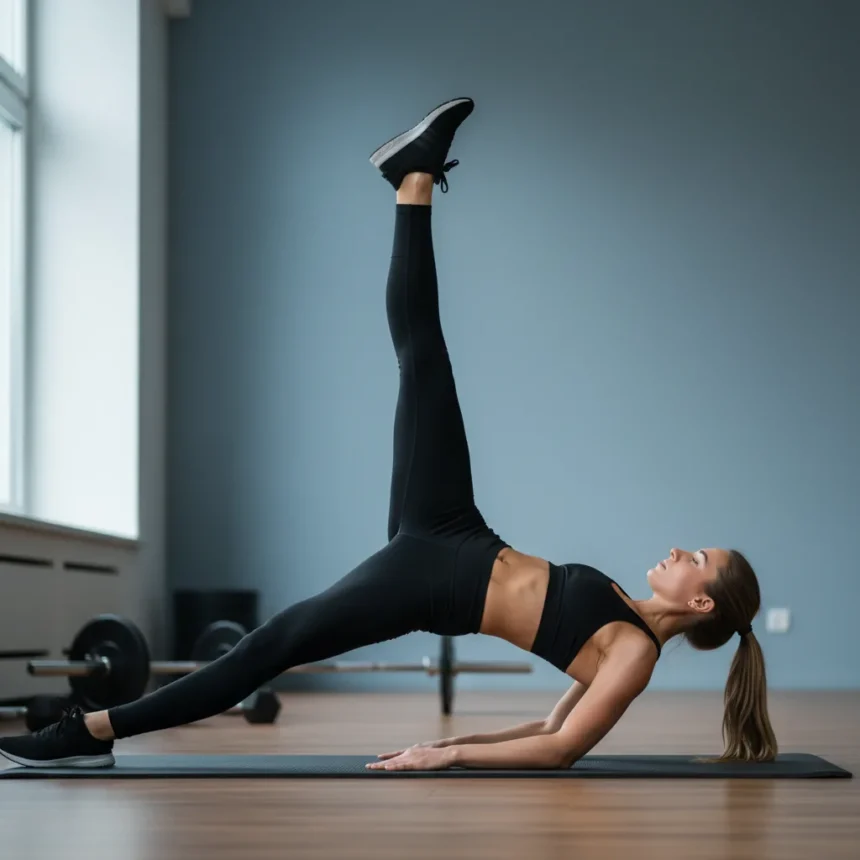
The single-leg glute bridge is gaining recognition as a superior alternative to squats for building both glute size and strength. Unlike bilateral movements that distribute load across both legs, this unilateral variation forces each glute to work independently, creating greater activation and forcing the stabilizer muscles to engage more intensely. The result is a more shapely backside and a super-strong lower body without the joint stress of heavy barbell squats.
Key Takeaways
- Single-leg glute bridge targets glutes more directly than traditional squats.
- Unilateral training forces each glute to work independently for balanced development.
- The exercise builds both aesthetic and functional strength simultaneously.
- No equipment needed—bodyweight is sufficient for significant glute activation.
- This move complements rather than completely replaces compound leg exercises.
Why the Single-Leg Glute Bridge Outperforms Squats
Squats have dominated glute-training conversations for decades, but they distribute load across the entire lower body—quads, hamstrings, glutes, and stabilizers all share the workload. The single-leg glute bridge isolates the glutes with surgical precision. By lifting one leg off the ground and driving through a single hip, you eliminate the ability to compensate with your stronger side, forcing both glutes to develop symmetrically. This asymmetrical loading pattern also demands greater core stability and proprioceptive control, turning a simple bridge into a full posterior-chain challenge.
The mechanical advantage of the bridge position itself matters too. Your torso remains supported on the ground, reducing spinal compression compared to loaded squats. This is particularly valuable for lifters managing lower back issues or those seeking glute development without the cumulative joint stress of heavy barbell training. The bridge also allows you to achieve full hip extension—the endpoint where glute contraction peaks—without the forward knee travel that squats demand.
Building Both Aesthetics and Performance
The single-leg glute bridge delivers on two fronts that matter to different training goals. For those chasing visual glute development, the unilateral demand creates greater time under tension per glute. Each rep forces the working glute to stabilize the entire upper body while extending the hip, creating the kind of sustained contraction that drives hypertrophy. The aesthetic result is a more defined, lifted backside without the bulk that heavy squat programming can add to the quadriceps.

From a performance standpoint, single-leg bridge strength translates directly to athletic power and injury resilience. Hip extension strength—the exact movement pattern trained here—is foundational for sprinting, jumping, and explosive movements. Building unilateral strength also corrects imbalances that bilateral exercises mask. If your right glute is significantly weaker than your left, a squat will still feel balanced because both legs work together. A single-leg glute bridge exposes and corrects that deficit immediately, improving overall movement quality and reducing injury risk.
How Single-Leg Glute Bridge Compares to Squats
Squats remain a valuable compound movement for overall lower body development, but they are not the only path to glute growth. The single-leg glute bridge excels where squats fall short: isolation, unilateral balance, and glute-specific activation. A squat recruits your entire lower body in a coordinated pattern—useful for building total-body strength but less efficient if your goal is maximal glute development. The bridge, by contrast, demands glute dominance from rep one.



That said, the two exercises serve different purposes. Squats build systemic strength, teach movement coordination, and develop the stabilizers around the knee and ankle. Single-leg glute bridges prioritize posterior-chain isolation and unilateral control. The ideal approach combines both: use squats for overall lower body strength and power, and layer in single-leg glute bridges for targeted glute hypertrophy and symmetry correction. This pairing delivers the aesthetic and functional benefits of each without the drawbacks of relying on either alone.
Progression and Practical Application
The beauty of the single-leg glute bridge is its scalability. Beginners can start with the two-leg version to master the hip extension pattern, then progress to single-leg work. From there, variations include adding a pause at the top for time-under-tension, elevating your upper back on a bench or step to increase range of motion, or adding external load via a barbell across your hips or a dumbbell held at your chest. Advanced lifters can perform explosive single-leg bridges, single-leg hip thrusts from a bench, or banded variations for accommodating resistance.
The exercise requires no equipment beyond a mat and your bodyweight, making it accessible for home training or gym settings. Perform it 2–3 times per week as part of a lower body routine, aiming for 8–12 reps per leg with controlled tempo. The single-leg glute bridge fits smoothly into leg day after compound movements like squats or deadlifts, or as a dedicated glute-focused session when paired with other posterior-chain exercises.
Is the single-leg glute bridge better than squats?
Not necessarily better overall, but more effective for isolated glute development. Squats build total lower body strength; single-leg glute bridges maximize glute-specific growth and correct imbalances. Use both for optimal results.



How many reps should I do for single-leg glute bridge?
Aim for 8–12 reps per leg with controlled tempo and a pause at the top. Perform 2–3 sets, 2–3 times per week. Adjust reps based on your goal: higher reps for endurance, moderate reps with added weight for hypertrophy.
Can I do single-leg glute bridge every day?
Daily training is possible if you keep intensity moderate, but 2–3 times per week allows adequate recovery for glute hypertrophy. Overtraining without sufficient rest reduces gains and increases injury risk.
The single-leg glute bridge is not a replacement for squats—it is a precision tool that squats cannot replicate. If your goal is a stronger, more defined backside with bulletproof unilateral strength, this move deserves a permanent spot in your training arsenal. Squats built the foundation; the single-leg glute bridge builds the masterpiece.
Edited by the All Things Geek team.
Source: Tom's Guide