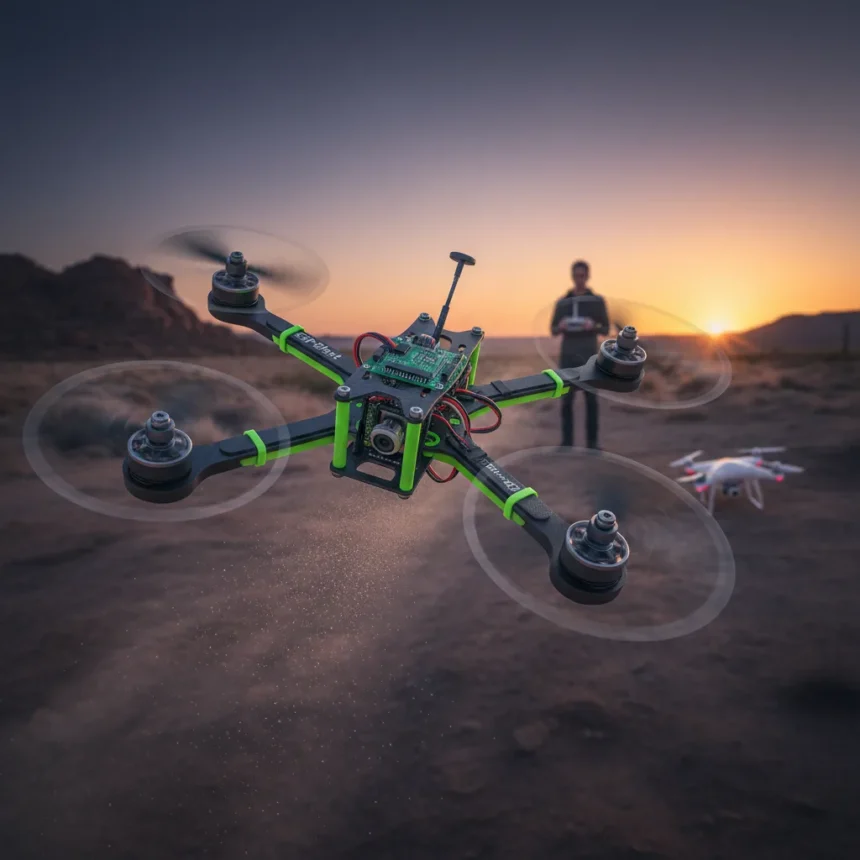
The ESP-Blast DIY drone costs $155 to build and reaches 67mph—a speed that challenges the assumption that fast, capable drones require thousand-dollar price tags or proprietary hardware. YouTuber Max Imagination designed and documented the entire build process, proving that a five-dollar microcontroller and open-source design can compete with commercial options on performance.
Key Takeaways
- ESP-Blast DIY drone costs $155 total, with an ESP32 microcontroller at just $5
- Measured top speed of 67 mph (over 108 km/h) achieved through iterative testing and tuning
- 3D-printed PETG airframe weighs only 136 grams—lighter than a deck of cards
- Flight time approximately 5 minutes on a 450 mAh battery
- Fully open-source with free 3D models, tutorials, and video instructions from Max Imagination
What makes a DIY drone costs $155 realistic
The ESP-Blast achieves its aggressive price point by replacing expensive proprietary flight controllers with an ESP32 microcontroller, the same chip found in smart home devices and IoT appliances. This architectural choice shifts the value proposition: instead of paying for brand-name hardware, builders pay for design knowledge and assembly skill. The complete bill of materials includes electronic speed controllers, a barometer, GPS unit, sensors, radio gear, propellers, and a 450 mAh battery—everything needed for autonomous flight.
Max Imagination’s decision to use 3D printing for the airframe further reduces costs. The frame prints in PETG material on an Elegoo Neptune 4 Plus printer, creating a structure that weighs just 136 grams while maintaining rigidity for high-speed flight. This approach democratizes drone design: anyone with access to a 3D printer (or a local makerspace) can fabricate the airframe, then source standard off-the-shelf electronics from global suppliers.
Speed and performance of the DIY drone costs $155
The 67 mph top speed emerges from careful tuning rather than exotic hardware. Max Imagination documented the iterative testing process, including crashes and repairs, showing that reaching this velocity requires balancing motor power, propeller selection, and flight controller responsiveness. The five-minute flight time reflects the energy demands of high-speed flight on a modest battery capacity—a trade-off inherent to ultralight designs.

For context, the speed record in RC quadcopter racing sits at 411 mph, held through specialized, unlimited-budget builds. Max Imagination consulted Benjamin Bigg, a prominent figure in the speed-racing community, to validate the ESP-Blast’s engineering. This collaboration positioned the DIY drone not as a toy, but as a legitimate entry point into a competitive hobby that traditionally requires thousands in investment.
Open-source design and accessibility
The ESP-Blast’s true innovation lies in its transparency. Max Imagination published full 3D models, assembly tutorials, and video documentation on YouTube, eliminating gatekeeping. Builders can download the files immediately, source components from standard electronics retailers, and replicate the design without proprietary software or locked-down hardware. This contrasts sharply with commercial drones, where firmware updates, spare parts, and repair restrictions create ongoing dependencies.



The project contains no corporate sponsors, grants, or defense contracts—it is purely DIY passion work. This independence matters for credibility. Max Imagination built the ESP-Blast to answer a single question: how fast can you go when the budget ceiling is $155? The answer, demonstrated through video flight testing, shifts expectations about what budget-conscious builders can achieve.
Why this matters for the broader drone market
The ESP-Blast does not replace commercial drones like DJI models for consumer photography or casual flying. It targets a different audience: hobbyists willing to solder, debug, and iterate. The project proves that knowledge and design skill matter more than hardware cost in high-performance applications. A $155 DIY drone reaching 67 mph exposes the markup premium on commercial flight controllers and the value of open-source communities in driving innovation.
For potential builders, the barrier is not money—it is time and technical comfort. Assembling the ESP-Blast requires soldering skills, familiarity with microcontroller programming, and patience through test-and-crash cycles. The five-minute flight time also demands proximity to a flying field and acceptance of rapid battery depletion. These constraints make it unsuitable for beginners, despite its low cost.
Is the DIY drone costs $155 actually buildable?
Yes, the ESP-Blast is fully buildable using the open-source files and tutorials provided by Max Imagination on YouTube. All components are commercially available from standard electronics suppliers, and the 3D-printed frame can be fabricated on consumer-grade printers or through mail-order services. The total cost of $155 assumes purchasing individual components; bulk orders or regional pricing variations may shift the final figure slightly, but the design targets this price point specifically.



How does the ESP-Blast compare to commercial racing drones?
Commercial FPV racing drones typically cost between $300 and $800 for ready-to-fly kits, with professional builds exceeding $1,500. The ESP-Blast undercuts this by an order of magnitude while maintaining competitive speed for recreational flight. However, commercial options offer refined ergonomics, proven reliability, and manufacturer support—advantages that cost money. The ESP-Blast trades these conveniences for transparency and learning value.
What happens after you build the DIY drone costs $155?
After assembly and tuning, the ESP-Blast enters the flight-test phase documented in Max Imagination’s video. Early iterations crashed repeatedly, providing data for design refinement. Successful flights confirmed the 67 mph speed measurement and validated the structural integrity of the 3D-printed frame. Builders replicating the design should expect similar iteration cycles—the project is reproducible, but not plug-and-play.
The ESP-Blast demonstrates that expensive hardware is not a prerequisite for high-performance drones. By combining an inexpensive microcontroller, smart design, and open-source transparency, Max Imagination created a blueprint for budget-conscious builders seeking speed and learning. The real cost of entry is technical skill and willingness to embrace the DIY ethos, not dollars.
Edited by the All Things Geek team.
Source: TechRadar