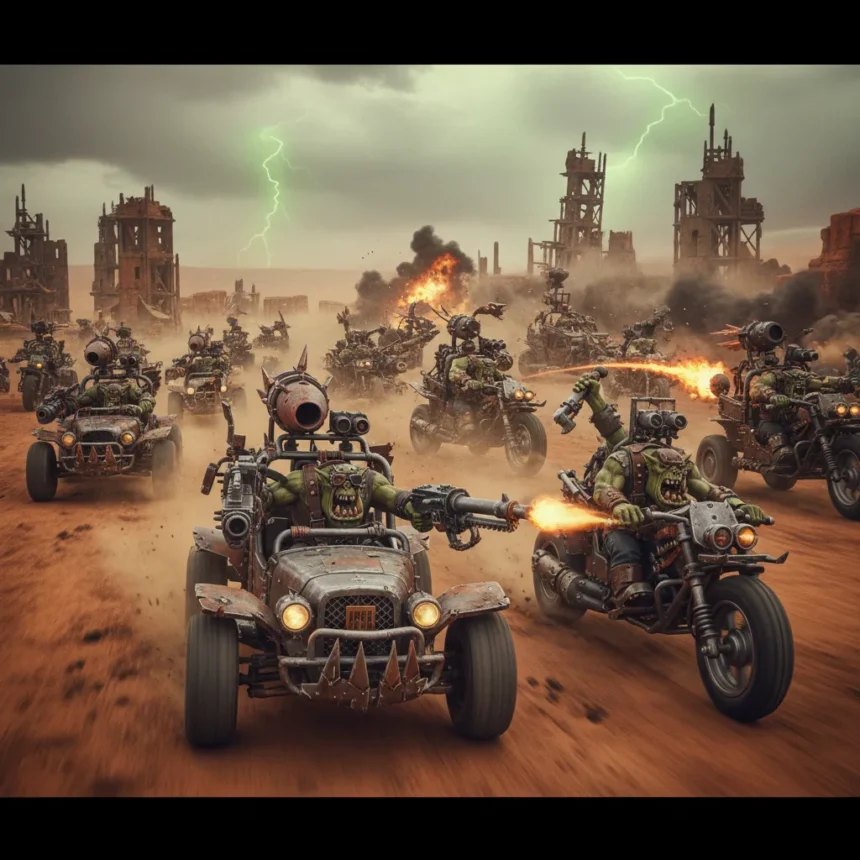
Warhammer 40,000: Speed Freeks is a vehicular combat game set in the Warhammer 40,000 universe, centered on speed-obsessed Orks who live for grease, metal, fire, and going fast. This is not a racing sim. This is Twisted Metal transplanted into the 41st Millennium, where the only rule is chaos and the only victory condition is your opponent’s explosion.
Key Takeaways
- Speed Freeks blends vehicular combat with conquest-style gameplay and racing objectives
- Kill Konvoy mode pits two teams of eight players in a Stompa escort race
- Players choose from class-based vehicles with unique abilities and roles
- Matches support up to 16 players in team-based competitive gameplay
- Built on Unreal Engine 5 and designed as the ultimate Ork gaming fantasy
What Makes Warhammer 40,000: Speed Freeks Stand Out
Forget everything you know about Forza. Warhammer 40,000: Speed Freeks is not about lap times or apex precision. Instead, it borrows the anarchic energy of Twisted Metal and the explosive absurdity of Mad Max’s vehicular mayhem, then wraps it all in Ork culture. The game’s core premise is simple: Orks love speed, and they will destroy anything in their path to achieve it. Players build their own vehicles and win through a mix of strategy and brute force, creating a chaotic blend where a perfectly timed bomb throw matters as much as vehicle positioning.
The genius here is that Speed Freeks does not pretend to be something it is not. It leans into the ridiculous. Orks are not subtle creatures, and neither is this game. Every explosion is exaggerated, every vehicle is cobbled together from scrap metal and spite, and every match devolves into organized mayhem. That tonal clarity—embracing absurdity rather than fighting it—is what separates this from generic vehicle combat games.
Kill Konvoy: The Standout Game Mode
Kill Konvoy, showcased at the Warhammer Skulls Showcase 2024, exemplifies what makes Speed Freeks compelling. Two teams of eight players compete to escort a giant Ork mech called a Stompa across the battlefield to the finish line first. The twist: every player is both a protector and a saboteur. Your team can throw bombs at the enemy Stompa to slow its progress, speed up your own Stompa, or simply destroy enemy players to protect the convoy. It is a mode that rewards both teamwork and individual aggression, which sounds contradictory until you realize that in the Ork universe, those are not mutually exclusive.


This mode crystallizes what separates Speed Freeks from traditional racing games. There is no pretense of fair competition or technical skill hierarchies. A lucky bomb hit counts as much as a perfectly executed maneuver. A well-coordinated team ambush is as valid as a solo rampage. That democratic approach to victory—where brute force, strategy, and chaos all have equal weight—is authentically Ork.
Class-Based Vehicle Combat and Progression
The game uses a class-based system where players choose from vehicle types with unique abilities and roles. Coverage describes killer, tank, and support vehicles, each filling different battlefield roles. This is where strategy enters the equation. A team cannot win with eight killer vehicles; they need balance. Tank vehicles absorb damage. Support vehicles enhance team performance. Killer vehicles deal damage. Players must coordinate loadouts before each match, adding a layer of tactical decision-making that elevates Speed Freeks beyond simple vehicle brawling.



The alpha gameplay loop blended conquest and racing mechanics, requiring players to capture points before racing to the finish line. This hybrid structure prevents matches from becoming pure vehicle demolition derbies. Teams must think about positioning, point control, and timing, not just who has the biggest gun. It is a design choice that respects player agency while maintaining the chaotic Ork spirit.
How Speed Freeks Compares to Twisted Metal and Other Combat Games
Twisted Metal pioneered vehicular combat as a competitive sport. Speed Freeks takes that formula and infuses it with Warhammer 40,000’s grimdark humor and Ork culture. Where Twisted Metal emphasizes dark fantasy and driver backstories, Speed Freeks leans into pure vehicular destruction without narrative pretense. Both games share the core appeal: vehicles are weapons, the arena is a playground, and victory goes to whoever causes the most controlled chaos.
The game also draws inspiration from Mad Max’s vehicular combat sequences, though Speed Freeks amplifies the absurdity to a level that makes Mad Max look restrained. Every vehicle is more ridiculous, every explosion is more theatrical, and the stakes are purely about Ork honor and speed, not survival or resource scarcity. That tonal difference matters. It allows Speed Freeks to embrace destruction without the weight of narrative justification.
Ork Culture as Game Design
What makes Warhammer 40,000: Speed Freeks work is that Ork culture is inherently suited to vehicular combat gameplay. Orks believe that bigger, faster, and louder is better. They do not plan; they attack. They do not strategize in the traditional sense; they respond to chaos with more chaos. This cultural framework gives the game permission to be unbalanced, unpredictable, and absurd. Players are not roleplaying as soldiers or racers; they are embodying Ork philosophy through gameplay.

The developers describe it as the ultimate Warhammer 40,000 Ork gaming fantasy. That claim holds weight. Most Warhammer 40K games focus on the grim darkness, the endless war, the suffering. Speed Freeks focuses on the joy—the pure, unhinged joy of speed and destruction that defines Ork culture. It is a refreshingly honest take on what Orks actually want.
Should You Play Warhammer 40,000: Speed Freeks?
If you loved Twisted Metal, enjoyed the vehicular chaos of Wreckfest, or simply want a game that does not take itself seriously, Speed Freeks is worth your time. It is not a traditional racing game, not a pure combat simulator, and definitely not a strategy game, even though it contains elements of all three. It is a vehicle for Ork chaos, and that is exactly what it should be.
The game’s appeal lies in its specificity. It does not try to be everything to everyone. It commits to a singular vision: Orks racing, bombing, and destroying each other in the 41st Millennium. That clarity of purpose is rare in modern gaming.
Is Warhammer 40,000: Speed Freeks free-to-play?
The game was announced as free-to-play and PC-exclusive, with an alpha playtest available on Steam. However, availability and pricing models may have changed since the initial announcement, so check the current Steam store page for the most up-to-date information on cost and platform availability.
What is Kill Konvoy mode in Speed Freeks?
Kill Konvoy is a competitive mode where two teams of eight players escort a giant Ork Stompa mech across the battlefield to the finish line. Teams can throw bombs at enemy Stompas, speed up their own, or eliminate enemy players to protect their convoy. It combines racing, combat, and teamwork into a single chaotic objective.
How many players can play Warhammer 40,000: Speed Freeks at once?
Matches support up to 16 players in team-based gameplay, typically organized as two teams competing against each other. The exact team structure varies by game mode, but Kill Konvoy specifically features two teams of eight players each.
Warhammer 40,000: Speed Freeks succeeds because it understands what Orks are and builds a game around that identity. It is not trying to out-Forza Forza or out-Metal Twisted Metal. It is creating something uniquely Ork: chaotic, loud, fast, and utterly committed to destruction as entertainment. That focus is its greatest strength.
Edited by the All Things Geek team.
Source: Windows Central