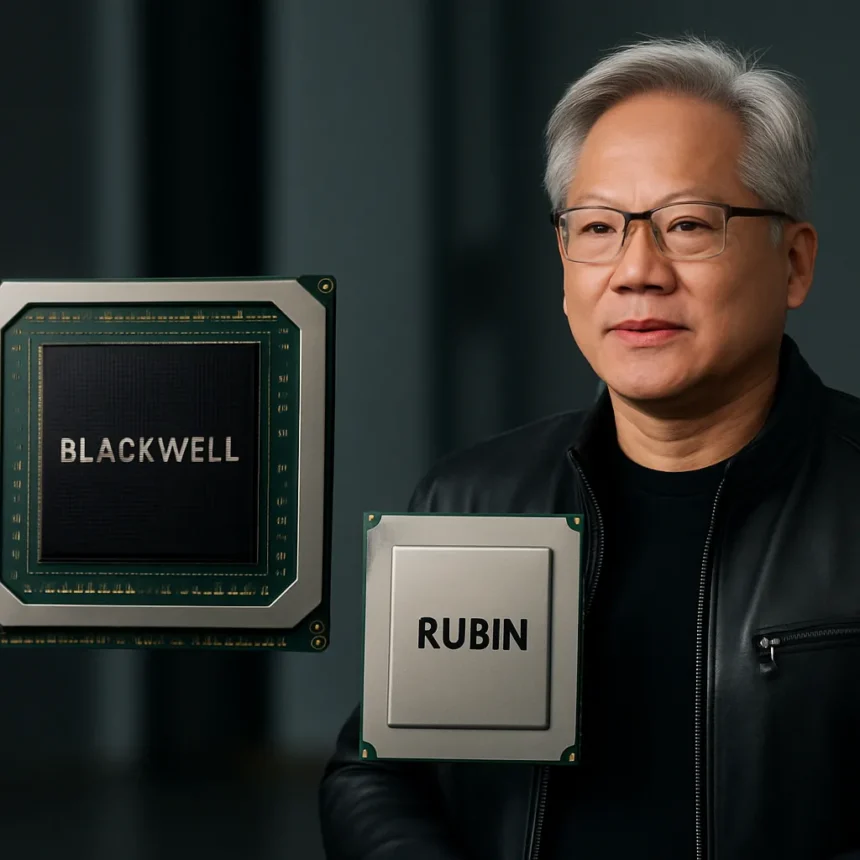
Nvidia Blackwell Rubin chips are positioned to generate at least $1 trillion in revenue, according to CEO Jensen Huang, as the company reveals its next-generation Vera CPU and server infrastructure. This forecast arrives amid record earnings and marks a decisive moment for Nvidia’s control over the AI infrastructure market—a position that rivals and investors alike are watching carefully.
TL;DR: Jensen Huang predicts $1 trillion revenue from Blackwell and Rubin chips while announcing the Vera CPU with large-scale shipments beginning in H2 2026. Blackwell achieves 10x inference efficiency gains and volume production is ramping globally.
Blackwell dominates inference at scale
Blackwell is described as the “king of inference,” delivering a 10x reduction in the computational cost of generating each token compared to previous generations. This efficiency matters because inference—the process of running trained AI models to generate outputs—represents the bulk of real-world AI workloads and operational costs for cloud providers and enterprises. When a language model produces text, that generation consumes power and compute resources; cutting those costs by an order of magnitude changes the economics of running AI at scale.
Nvidia’s Blackwell platform, built on TSMC’s 4NP process with a chiplet design requiring liquid cooling, has achieved volume production with the first U.S.-manufactured wafer produced at TSMC’s Arizona facility. The platform is now shipping worldwide, with all Blackwell GPUs in the cloud already sold out. This supply constraint underscores demand intensity: cloud providers cannot acquire Nvidia hardware fast enough to meet customer requests for AI services.


Jensen Huang emphasized the market momentum in a recent interview: “Sales are off the charts for Blackwell. Nvidia GPUs in the cloud are sold out. We have lots of Blackwells coming and a bunch of Vera Rubins coming. Business is very, very strong”. The supply chain supporting this ramp includes partnerships with TSMC, SK Hynix, Micron, Samsung, Foxconn, Quanta, and Wistron, positioning Nvidia to sustain production at unprecedented scale.
Vera Rubin arrives with million-GPU ambitions
The Vera Rubin GPU, Nvidia’s successor to Blackwell, will begin large-scale shipments in the second half of 2026. This next-generation platform features a dual-die design with over 330 billion transistors and a 3.6 TB/s NVLink 6 interconnect, architected for what Nvidia calls the “Million-GPU Era”—unified data centers where thousands of GPUs operate in concert as a single computational fabric.



Rubin maintains the 10x AI token processing cost reduction achieved by Blackwell, with major cloud providers including AWS, Google, and Azure slated to deploy the platform. This multi-cloud strategy is critical: it prevents any single cloud provider from gaining exclusive access to the next generation of Nvidia hardware, while simultaneously expanding Nvidia’s addressable market across competing infrastructure ecosystems. By 2026, enterprises will choose between cloud providers partly on the basis of which has secured Vera Rubin capacity first.
The architecture shift toward unified data centers reflects a fundamental change in how AI infrastructure operates. Rather than isolated GPU clusters, the Million-GPU Era envisions seamless orchestration across massive deployments, with NVLink 6 providing the interconnect bandwidth to make this practical. This design philosophy directly addresses the scaling challenges that enterprises face when training and running inference on models with trillions of parameters.
Record financials and the trillion-dollar question
Nvidia’s recent earnings demonstrate explosive growth underpinning Huang’s confidence in the $1 trillion forecast. The company reported quarterly data center revenue of $51.2 billion with 66% year-over-year growth, while full fiscal year 2026 revenue reached a record $216 billion. Gross margins remain exceptionally strong at 73-75%, providing the financial cushion to invest in supply chain partnerships and manufacturing capacity.
However, the $1 trillion prediction carries promotional weight. Huang frames it as inevitable—”In the new AI world, computing power equals revenue,” he stated, arguing that companies will not stop investing in AI infrastructure because generated tokens directly translate into customer benefits. This logic assumes sustained demand growth and competitive moats that remain unproven. Some investors have expressed skepticism: SoftBank and Peter Thiel dumped Nvidia shares, signaling doubts about growth sustainability. The trillion-dollar forecast, while grounded in current momentum, is ultimately a CEO’s bet on the future, not a guarantee.



Competition and ecosystem lock-in
Nvidia’s dominance faces emerging challenges from rivals offering cheaper, more power-efficient alternatives. The deployment of Rubin across AWS, Google, and Azure serves partly as a counter to these competitive pressures, ensuring that Nvidia hardware remains central to major cloud infrastructure investments. Meta’s recent chip deal with Nvidia further extends the company’s revenue visibility by securing a major hyperscaler’s commitment to Nvidia GPUs.
The broader ecosystem strategy reveals Nvidia’s understanding that AI infrastructure is not purely about raw performance. Partnerships matter: Intel is collaborating with Nvidia on custom data-center and PC products featuring NVLink, while Uber is deploying Nvidia’s DRIVE AGX Hyperion 10 platform for Level-4 autonomous mobility networks planned to include 100,000 vehicles by 2027. These partnerships lock customers into the Nvidia ecosystem and create switching costs that protect market share even as competitors emerge.
Is Nvidia’s $1 trillion prediction realistic?
The forecast depends on sustained AI infrastructure spending and continued market share dominance. Current data supports the near-term case: Blackwell is sold out, production is ramping, and major cloud providers are committing to Rubin deployments. But $1 trillion in cumulative revenue from two product lines over several years assumes no major disruption—no breakthrough in competitor efficiency, no slowdown in enterprise AI spending, and no shift toward alternative architectures.
Huang’s statement that “computing power is revenue” reflects a belief that AI workloads will expand faster than hardware costs decline. If inference becomes cheaper and more efficient than Nvidia expects, demand growth could plateau. Conversely, if AI adoption accelerates beyond current projections, the $1 trillion target may prove conservative. The forecast is credible given Nvidia’s current position, but it is not inevitable.
What does the Vera CPU add beyond Blackwell?
The Vera CPU (also referred to as Vera Rubin GPU in product documentation) brings architectural improvements centered on unified data center orchestration and token processing efficiency. The dual-die design with 330+ billion transistors and NVLink 6 interconnect enables tighter coupling between GPUs in massive clusters, reducing latency and improving throughput for distributed inference workloads.
When will Vera Rubin chips be available?
Large-scale shipments of Vera Rubin chips are planned for the second half of 2026, following volume production and customer qualification. This timeline gives cloud providers and enterprises roughly 12 months to prepare infrastructure and workload migration strategies.
How does Blackwell’s 10x inference improvement compare to competitors?
Blackwell’s 10x reduction in token generation cost represents a significant efficiency gain over Nvidia’s previous generation, measured by throughput per megawatt in real-world inference benchmarks. Competitors offering cheaper alternatives have not yet matched this combination of performance and power efficiency at scale, though the competitive landscape is rapidly evolving.
Nvidia’s $1 trillion revenue forecast from Blackwell and Rubin chips reflects both the company’s current market dominance and its bet that AI infrastructure spending will accelerate for years to come. The technical achievements are real—10x inference efficiency, volume production, global shipping—but the financial prediction depends on sustained demand and competitive moats that rivals will inevitably challenge. For enterprises and cloud providers, the immediate takeaway is clear: Nvidia hardware will remain the default choice for AI infrastructure through 2026 and beyond, making decisions about Blackwell and Rubin deployments critical to competitive positioning.
Edited by the All Things Geek team.
Source: TechRadar