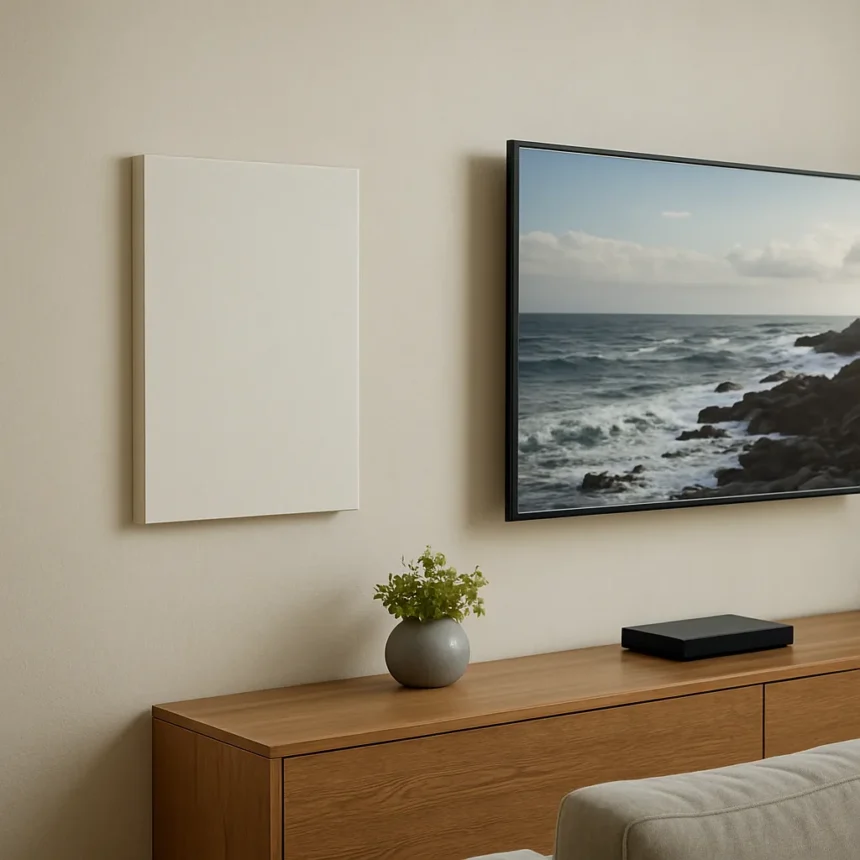
Invisible speakers have always been the compromise solution: you get clean walls and hidden audio, but you sacrifice the sound quality that traditional speaker cabinets deliver. Two new invisible speakers from Stealth Acoustics just demolished that assumption. After hearing the LineaRadiance LRAD-430 and LRX-83 at a recent event, the skepticism evaporates the moment the music starts playing.
TL;DR: Stealth Acoustics’ new invisible speakers deliver shockingly detailed, full-range sound suitable for both hi-fi listening and home theater, with wide dispersion that works across wall and ceiling placement. The LRAD-430 handles everything from bombastic electronic music to intimate vocals without compromise.
What invisible speakers actually are
Invisible speakers are in-wall or in-ceiling models finished over with plaster, drywall compound, or paint, making them architecturally seamless. Unlike traditional speakers that sit as discrete objects in a room, invisible speakers vanish into the wall itself. The concept trades visibility for integration, but historically, that integration came at a sonic cost.
Stealth Acoustics challenges this trade-off with designs engineered specifically for plaster-over installation. The LRAD-430 is a three-way, full-range speaker with integrated backbox, frequency response from 35 Hz to 20 kHz, and 170-degree vertical and horizontal dispersion. It uses two 8-inch low-frequency drivers, a 1-1/8-inch neodymium mid driver, and a 1-inch neodymium high-frequency driver. The LRX-83, their other reviewed model, takes a different approach with a patented combination of transducers and traditional cone woofers, optional backbox for bass response down to 40 Hz, and two protection circuits.



How invisible speakers sound in real rooms
The LRAD-430 delivers what reviewers call shockingly good, full-range sound from a truly invisible speaker. High frequencies are detailed and articulate without the harshness that plaster-over designs sometimes introduce. The speaker excels with bombastic content—electronic producers like The Crystal Method and Daft Punk hit hard—but doesn’t sacrifice refinement with vocal-heavy material. Norah Jones, Diana Krall, and Rebecca Pidgeon sound natural and present, not thin or recessed.
The LRX-83 performs similarly across genres and handles high volumes without strain, though ceiling placement does reduce imaging compared to wall mounting—a physical limitation of placement rather than a design flaw. Both speakers benefit from their ultra-wide dispersion, which suits them for distributed music playback across multiple channels in home theater or as front-wall left/right arrays in hi-fi systems.



One reviewer summed it up this way: it isn’t long before you stop thinking of these as invisible speakers performing some magic trick and just start thinking of them as speakers. That shift in perception is the real victory.
Invisible speakers vs. traditional alternatives
Sonance’s Invisible Series offers a competing approach, using Motion Flex Technology with wave-flex drive units for highs and air-flex woofers for lows, with frequency response up to 30 kHz and 170-degree dispersion. European brands like Nakymatone represent the ultra-premium invisible market, and Gray Sound offers smaller models with coaxial tweeters paired to subwoofers.
What separates Stealth Acoustics is the emphasis on full-range performance without requiring a separate subwoofer in most applications. The LRAD-430’s dual 8-inch woofers and the LRX-83’s optional backbox for 40 Hz bass extension mean you get genuine low-end reproduction, not just midrange and treble. This matters for hi-fi listeners who want music to breathe and home theater enthusiasts who expect impact from action sequences.
The installation reality
Invisible speakers require professional installation with precision drywall finishing—typically a skim coat of joint compound that must be applied and sanded to match surrounding walls without affecting acoustic performance. This is not a weekend DIY project. The plaster finish is part of the acoustic design, and sloppy finishing will compromise sound. Stealth Acoustics products are made in America and were showcased at CEDIA Expo 2024, signaling serious industry backing.



The trade-off is real: you spend more on installation and finish work than you would with a traditional speaker, but you gain a living space that doesn’t revolve around audio equipment. For design-conscious listeners and home theater enthusiasts who refuse to sacrifice aesthetics, that trade-off is worth it.
Should you choose invisible speakers?
Invisible speakers make sense if you value architectural cleanliness more than traditional speaker placement flexibility. They work best in dedicated listening rooms, home theaters, or multi-room audio systems where you can optimize placement and finishing. They are less ideal for rooms where you might rearrange furniture or where wall damage from future renovations is likely.
Can invisible speakers match traditional speakers in sound quality?
The LRAD-430 and LRX-83 prove that yes, they can—at least for most listeners. High-frequency detail in the LRAD-430 is detailed and clear, though not identical to premium tweeters like the SVS Ultra Evolution’s diamond-coated design. For the vast majority of music and film content, the difference is imperceptible. What matters more is the full-range reproduction and dispersion these speakers deliver.
What’s the difference between the LRAD-430 and LRX-83?
The LRAD-430 emphasizes wide dispersion and integrated backbox design for seamless installation, while the LRX-83 uses a patented transducer combination and optional backbox for flexibility. Both are strong performers; the choice depends on your room layout and whether you want the backbox integrated or optional.
Invisible speakers are no longer a compromise. Stealth Acoustics has proven that plaster-over design can deliver the sound quality that justifies the aesthetic payoff. If you are building a new room or renovating and want audio that disappears into the walls, these speakers deserve serious consideration.
Where to Buy
Steve Jobs: A Biographic Portrait
Edited by the All Things Geek team.
Source: TechRadar