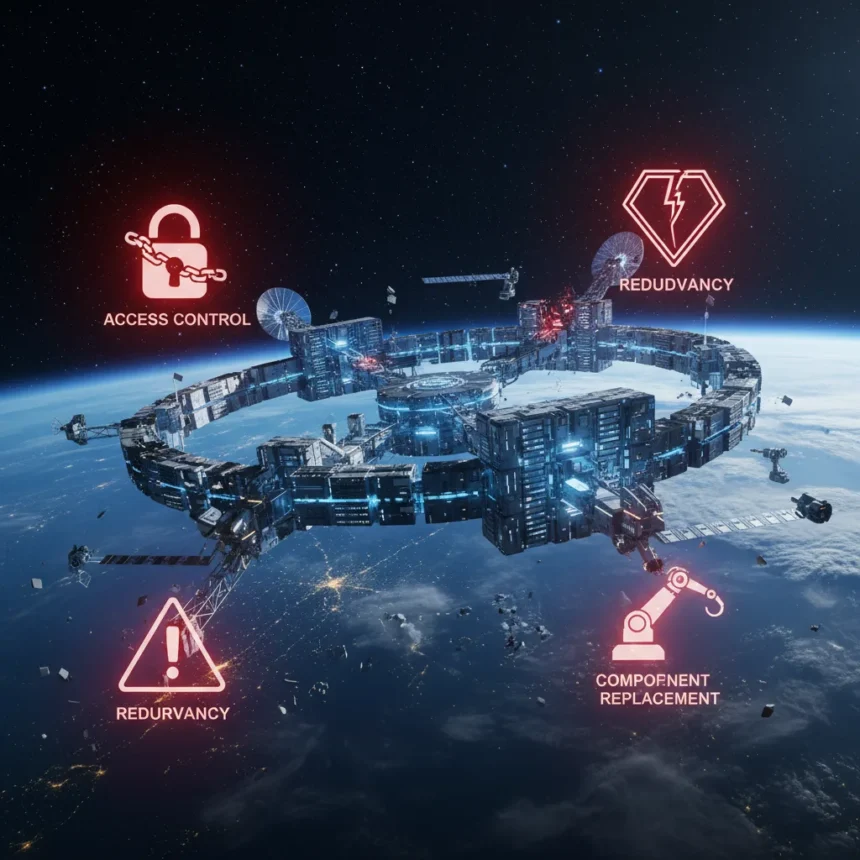
Orbital AI infrastructure represents one of the industry’s most ambitious—and potentially risky—frontiers. As hyperscalers explore moving compute into low Earth orbit, a fundamental operational reality emerges: the assumptions that govern terrestrial data center reliability collapse the moment infrastructure leaves the ground.
Key Takeaways
- Orbital data centers face three critical challenges: layered access control, physical redundancy, and rapid component replacement.
- Cooling in orbit is fundamentally harder because convection is unavailable and sunlight creates extreme temperature swings.
- Failed components in space cannot be quickly swapped, potentially turning hardware failures into months-long outages.
- Cosmic rays and micrometeorites add environmental hazards absent from terrestrial facilities.
- Traditional data center operations assume physical accessibility and rapid logistics—neither exists in orbit.
Why orbital AI infrastructure creates unprecedented operational risk
Terrestrial data centers depend on four foundational pillars: reliable power, redundant networking, environmental control, and physical security. Engineers have spent decades perfecting these systems on Earth. In orbit, every single assumption breaks. The moment infrastructure moves to orbit, the expectation of rapid physical access—the backbone of modern data center operations—disappears entirely.
Consider a failed server in a traditional facility. A technician walks to the rack, removes the dead unit, installs a replacement, and the system is operational again within hours. In orbit, that same failure becomes a cascading problem. You cannot send a repair crew on short notice. You cannot dispatch a replacement component next-day. You cannot even physically inspect the damage without launching a mission.
The cooling challenge that makes orbital AI infrastructure fundamentally different
Heat rejection is the first bottleneck. Terrestrial data centers rely on convection—hot air rises, cool air sinks, fans move air through equipment. In the vacuum of space, convection does not exist. The only mechanism for rejecting heat is radiation, which requires enormous radiative surface area to dissipate the thermal load from high-density compute.



Sunlight compounds the problem. In orbit, thermal swings between sunlit and shaded sides of a spacecraft can be extreme. A server exposed to direct solar radiation experiences temperatures far beyond what terrestrial cooling systems were designed to handle. Add the challenge of maintaining stable operating temperatures across thousands of processors, and the engineering becomes exponentially harder than anything solved on Earth.
Access control, redundancy, and component replacement in orbital AI infrastructure
Three operational challenges stand out. First, layered access control becomes nearly impossible to enforce. On Earth, you control physical access through security doors, badge readers, and surveillance. In orbit, you control access through the spacecraft itself—and if that access point fails, you have no backup entry mechanism.



Second, physical redundancy requires either launching duplicate systems or accepting single points of failure. Terrestrial data centers spread critical components across multiple racks, buildings, and geographic regions. Orbital systems cannot easily distribute redundancy across multiple launches without multiplying costs exponentially.
Third, rapid component replacement becomes a logistical nightmare. Data centers generate significant electronic waste because hardware is frequently replaced, often every 2–5 years. In orbit, you cannot simply discard a failed unit and install a new one. Every replacement component must be launched separately, transported through the vacuum, and installed by astronauts or robots. What takes minutes on Earth takes months in space.
Environmental hazards unique to orbital AI infrastructure
Terrestrial data centers face power outages, network failures, and cooling breakdowns. Orbital systems face those same risks plus cosmic rays and micrometeorites. Cosmic radiation can corrupt data, degrade solar panels, and damage sensitive electronics. Micrometeorites—tiny debris traveling at orbital velocities—can puncture spacecraft hulls and disable external systems.
These hazards are not theoretical. They are documented engineering constraints that every space mission must account for. A single micrometeorite strike on a critical cooling line could disable an entire orbital facility, and there is no way to repair it remotely.



How orbital AI infrastructure compares to terrestrial data centers
Terrestrial facilities already consume enormous amounts of electricity—a single AI data center can draw as much power as 100,000 households. Moving that workload to orbit does not reduce power consumption; it adds the overhead of launching fuel, maintaining orbital mechanics, and powering life support systems for any crewed maintenance.
The comparison reveals why orbital compute makes sense only for specific use cases: processing that cannot tolerate terrestrial latency, experiments that require microgravity, or applications where the unique advantages of space outweigh the operational complexity. General-purpose AI training and inference—the workloads that drive hyperscaler infrastructure decisions—do not fit that profile.
Is orbital AI infrastructure viable for commercial deployment?
The honest answer is not yet. Hyperscalers are exploring the concept, and research projects like Hewlett Packard Enterprise’s Spaceborne Computer-2 have demonstrated that computing hardware can function in space. But demonstration is not the same as operational reliability at scale. Until engineers solve the access control, redundancy, and component replacement challenges, orbital AI infrastructure remains a high-risk experiment rather than a production platform.
What would make orbital AI infrastructure operationally feasible?
Three breakthroughs would be necessary. First, fully autonomous systems that can diagnose and repair failures without human intervention. Second, on-orbit manufacturing or spare parts depots so replacements do not require launches from Earth. Third, thermal management systems that can handle extreme temperature swings without massive radiative panels. None of these exist at scale today.
Why are hyperscalers considering orbital AI infrastructure if it is so risky?
The appeal is latency reduction for edge computing and the possibility of processing data closer to satellites and space-based sensors. For specific applications—real-time Earth observation, autonomous vehicle coordination, or distributed AI inference—the latency advantage might justify the operational complexity. For general-purpose compute, terrestrial data centers remain far more practical.
The lesson is clear: moving infrastructure to orbit is not a problem of engineering capability—humans have launched and maintained space stations for decades. It is a problem of operational economics. Until the cost and complexity of orbital maintenance drops dramatically, the three critical challenges of access control, redundancy, and component replacement will keep orbital AI infrastructure grounded in the realm of research rather than commercial reality.
Edited by the All Things Geek team.
Source: TechRadar