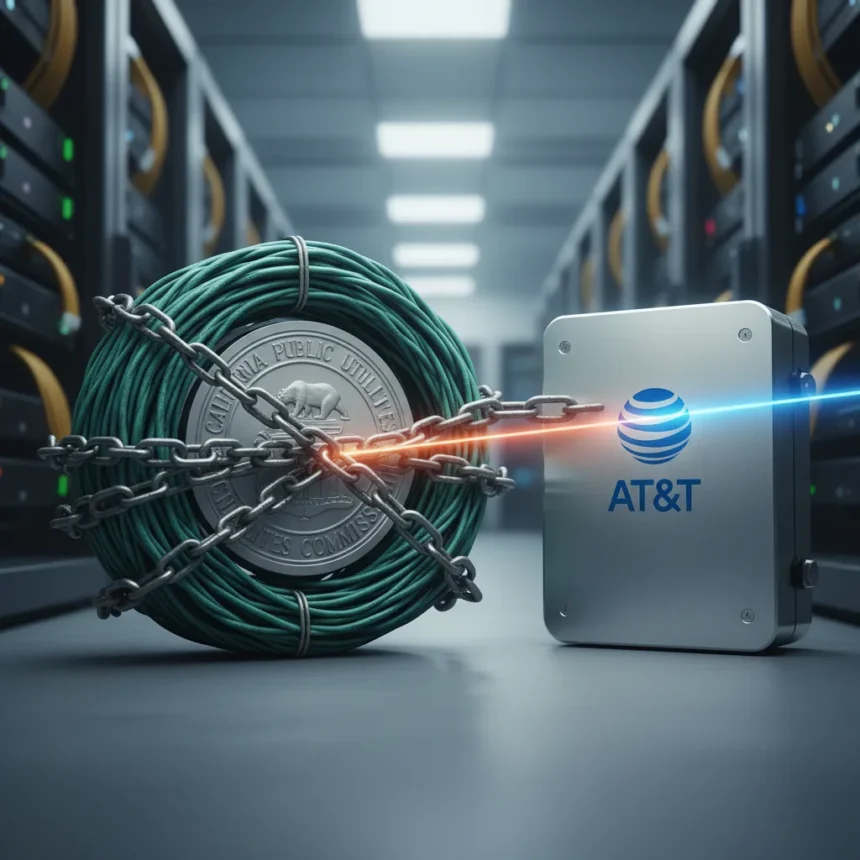
AT&T has escalated its battle with California regulators by filing a federal lawsuit in the Southern District of California, challenging the state’s requirement to maintain its legacy copper network maintenance infrastructure for traditional landline service. The telecommunications giant argues that California’s Public Utilities Commission (CPUC) is forcing it to operate an outdated, expensive system that serves a shrinking customer base while draining billions annually.
Key Takeaways
- AT&T filed federal litigation against California’s CPUC over mandatory legacy copper network maintenance requirements
- The company claims it spends at least $1 billion annually to maintain copper infrastructure in California
- Nearly 200,000 California customers still rely on copper-based landlines, dial-up, or DSL connections
- AT&T says copper lines now reach only about 3% of households in its California territory
- The company also petitioned the FCC to discontinue service for 184,000 residential and 15,000 business customers
The Economics of Copper: Why AT&T Wants Out
AT&T’s core argument rests on a simple economic reality: the legacy copper network maintenance burden has become unsustainable. The company spends at least $1 billion annually to keep its copper infrastructure operational in California, yet this vast investment now serves only about 3% of households in its service territory. That mismatch between cost and coverage sits at the heart of the dispute.
The copper network was built decades ago when landlines reached nearly every home. Today, wireless service and fiber-based broadband have displaced traditional phone lines for the vast majority of customers. Nearly 200,000 Californians still depend on copper-based infrastructure for landline phone service, dial-up connections, or DSL, but that represents a fraction of the state’s population. AT&T argues this small remaining user base does not justify the ongoing operational expense, especially when modern alternatives exist.
Beyond cost, AT&T points to operational vulnerabilities. The company claims California experienced approximately 2,000 outages tied to copper theft this year alone. Copper theft has become a persistent problem for telecom operators, as thieves strip wiring from infrastructure to sell the metal. These thefts disrupt service for the remaining customers who depend on it and force AT&T to invest in repairs and security measures.


What California Regulators Want to Protect
California’s approach reflects a different priority: ensuring that residents who lack access to modern broadband alternatives retain some form of reliable communication. The CPUC’s legacy copper network maintenance rules require AT&T to keep the system operational, which means the company cannot simply shut down infrastructure even if it becomes unprofitable.
This regulatory stance protects a specific population: rural and underserved communities where fiber deployment remains limited and wireless coverage may be spotty. For these areas, copper-based DSL or landline service represents a critical lifeline. Regulators worry that allowing AT&T to retire the network would leave thousands of Californians without any reliable communication option.



The tension reflects a broader challenge in telecom policy. Regulators must balance the financial burden on carriers against the connectivity needs of customers in less profitable areas. AT&T’s lawsuit forces California to defend its position in federal court, where the company argues that the state’s rules are preempted by federal telecommunications law.
AT&T’s Broader Push to Retire Copper
The California lawsuit is part of a wider AT&T strategy to accelerate copper retirement across the United States. The company has also filed petitions with the Federal Communications Commission (FCC) seeking approval to discontinue copper-based service for 184,000 residential customers and 15,000 business customers in California. These FCC petitions represent a parallel track: if federal regulators approve the discontinuances, AT&T could shut down copper service even if California’s CPUC objects.
AT&T’s dual approach—suing California while petitioning the FCC—reflects the complexity of telecom regulation in the United States. State regulators set rules for intrastate service, while the FCC oversees interstate communications and can preempt state requirements in certain circumstances. By pursuing both paths simultaneously, AT&T is betting that either federal courts or the FCC will side with the company’s argument that legacy copper network maintenance is economically untenable.
What This Means for Copper-Dependent Customers
For the nearly 200,000 Californians who rely on copper infrastructure, this lawsuit creates uncertainty. If AT&T prevails, the company could begin retiring the network, forcing customers to migrate to alternatives. For many, this would mean switching to wireless service or pursuing fiber or cable broadband if available. For others in truly underserved areas, the options may be limited.



The lawsuit also highlights a gap in broadband policy. California has invested in fiber deployment and broadband expansion programs, but these efforts take time and money. In the interim, some residents have no choice but to depend on aging copper infrastructure. Regulators must weigh whether AT&T’s copper network maintenance costs are a reasonable price for ensuring that no one is left without communication access during the transition to modern broadband.
Frequently Asked Questions
Why does AT&T want to retire its copper network?
AT&T argues that maintaining copper infrastructure costs at least $1 billion annually in California while serving only about 3% of households. The company says the network is expensive to operate, vulnerable to theft, and increasingly obsolete compared to wireless and fiber alternatives. From AT&T’s perspective, this investment yields poor returns and diverts capital from more profitable ventures.
Can California force AT&T to keep its copper network operating?
That is precisely what the federal lawsuit will determine. California’s CPUC currently has rules requiring AT&T to maintain the network, but AT&T argues these state regulations conflict with federal telecommunications law. A federal court will decide whether California can enforce its legacy copper network maintenance mandate or whether AT&T can proceed with retirement plans.
What happens to customers if AT&T wins the lawsuit?
If AT&T prevails, the company could begin discontinuing copper-based service for customers, starting with the 184,000 residential and 15,000 business customers it has petitioned the FCC to disconnect. Affected customers would need to switch to wireless, fiber, cable, or other available alternatives. For those in areas without modern broadband options, this could create a connectivity crisis.
AT&T’s federal lawsuit against California represents a pivotal moment in the long-running debate over who bears the cost of legacy infrastructure. The company’s argument is financially logical: why maintain an expensive system for a tiny fraction of customers? But the regulatory response is socially grounded: what happens to the people who depend on it? The court’s decision will shape how telecommunications companies manage the transition from copper to fiber across America.
Edited by the All Things Geek team.
Source: TechRadar