




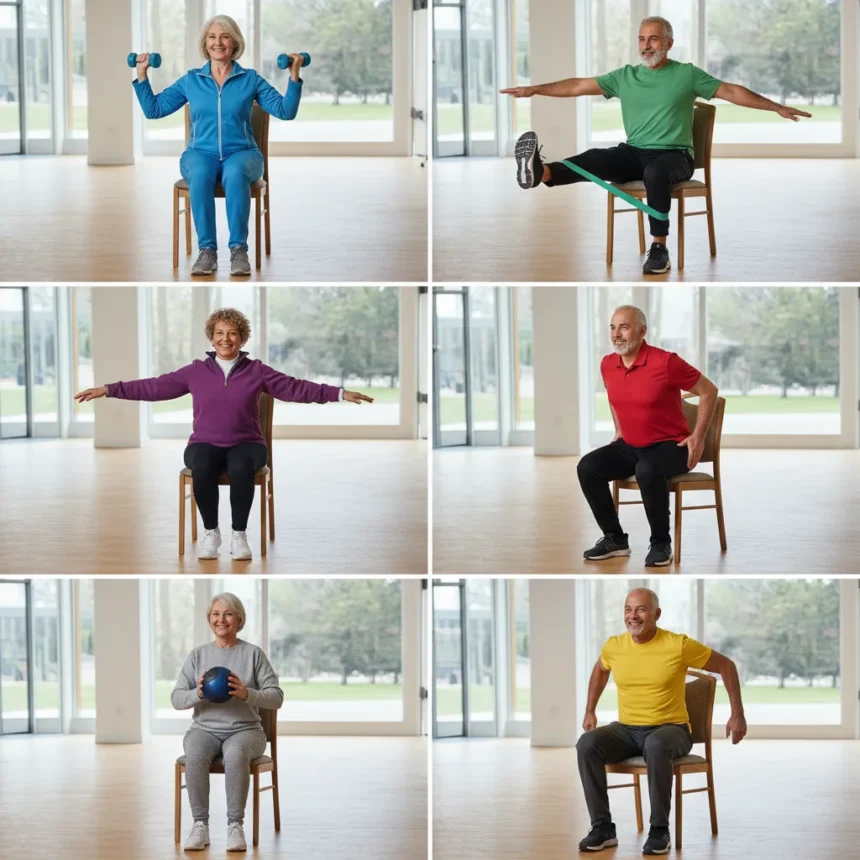
Chair-based exercises for stability offer a practical way for adults over 60 to build strength and move more confidently without leaving their seat. Unlike floor-based routines that demand getting up and down repeatedly, a chair-supported circuit lets you work through full-body movements with minimal impact while maintaining stability and control.
Key Takeaways
- A 6-exercise chair circuit targets strength, mobility, and balance for adults over 60
- The routine should be repeated twice for a complete workout
- Resistance bands and light weights enhance difficulty but are optional
- Seated clams, leg extensions, and bicep curls form the core movements
- Modifications allow you to increase intensity as you progress
The Complete 6-Exercise Chair Circuit
This chair-based exercises for stability routine contains six movements designed to build functional strength without complex equipment or floor transitions. Each exercise targets a specific area—legs, core, arms, or glutes—while keeping you safely supported. The entire circuit repeats twice, giving you a full-body session that takes 15–20 minutes depending on your pace.
Start by sitting tall with your back straight and core engaged before each movement. Proper posture throughout the routine ensures you work the right muscles and avoid strain. If you feel pain (not muscle fatigue), stop and consult a healthcare provider before continuing.
Seated Clams and Leg Extensions Build Lower-Body Strength
Seated clams activate your glutes and outer hips, muscles that stabilize your pelvis during walking and standing. Sit tall with your back straight and core engaged. If a resistance band is available, loop it around your legs just above the knees. Keep your feet flat on the floor and push both knees out to the side, pressing against the band if using one. Squeeze your glutes as you push, then return to the starting position. This movement works better with controlled, deliberate reps than speed.


Leg extensions target your quads—the large muscles on the front of your thighs—which are critical for climbing stairs and standing from a chair. Sit on the edge of your seat. Extend one leg straight out in front of you with your foot flexed (toes pointing toward your shin). Lift the leg only as high as your hip, pause for a moment, then lower it back down with control. Once you’ve completed all reps on one side, switch to the other leg. For a harder version, lift both legs at the same time, though this demands more core stability.
Upper-Body and Core Movements Complete the Circuit
The bicep curl to shoulder press combines arm strength with shoulder mobility in one fluid movement. Hold something heavy—a dumbbell, water bottle, or can of soup—in both hands. Sit tall with your core engaged and the weights resting by your sides. Bend at the elbows to bring both weights up toward your torso, then press them straight overhead. Reverse the movement slowly and with control, lowering the weights back to your sides. This two-part movement teaches your shoulders to move through their full range while building arm endurance.



The seated crunch works your abdominal muscles while you remain safely in your chair. Sit on the edge of your seat and lean your torso back slightly while keeping your back straight—do not round your spine. Squeeze your abdominal muscles, then lift both legs off the floor. Crunch your knees toward your chest, then extend them back down. Tap both feet on the floor, then lift them again and repeat. To increase intensity, lift your arms out to your sides and do not hold onto the chair for support, which forces your core to work harder to maintain balance.
The side bend targets your obliques—the muscles along the sides of your torso—and improves lateral stability. Hold a dumbbell in one hand. Lightly place the fingers of your opposite hand next to your head (not supporting your neck). Squeeze your core and lower the dumbbell toward the floor in a controlled side crunch. Reverse the movement to sit tall again. Complete all reps on one side before switching to the other side and repeating with the dumbbell in the opposite hand.
How to Progress Without Overloading
Most of these movements include a harder version built in. Leg extensions become more difficult when you lift both legs together. The seated crunch intensifies when you release your grip on the chair. Bicep curls feel heavier with a slightly larger weight. Start with the basic version of each exercise and only progress when you can complete all reps with good form and without discomfort. Adding weight too quickly or skipping the modification steps increases injury risk and defeats the purpose of building sustainable strength.
Rest 30–60 seconds between exercises if needed. This is not a speed workout—it is a strength-building routine that works best with deliberate, controlled movement and proper breathing. Exhale as you work (during the curl, the press, the crunch), and inhale as you return to the starting position.



Why Chair-Based Work Matters for Adults Over 60
Floor-based exercises demand getting up and down repeatedly, which can be risky if your balance is shaky or your legs are weak. A chair provides a stable base, allowing you to focus on the movement itself rather than worrying about falling. You can adjust your depth, range of motion, and intensity without leaving your seat. Over time, the strength you build translates directly to real-world movements—standing from a chair, climbing stairs, or walking with confidence.
This routine requires minimal equipment. A chair, optional resistance band, and optional light weights or household items are all you need. You can do this at home, in a living room, or even in a community center. No gym membership, no fancy machines, no excuses about access.
Frequently Asked Questions
Can I do chair-based exercises for stability if I have joint pain?
Chair-based exercises for stability are generally gentler on joints than floor work, but joint pain requires professional guidance. Consult your doctor or physical therapist before starting any new routine. They can modify specific movements or suggest alternatives if certain exercises aggravate your condition.
How often should I repeat this chair circuit?
Perform this routine two to three times per week with at least one rest day between sessions. Your muscles need recovery time to adapt and grow stronger. More frequent training without recovery does not speed up progress and increases injury risk.
What if I cannot complete all reps in the first week?
Start with fewer reps and build up gradually. If seated clams feel too difficult, do five instead of ten. If leg extensions tire you quickly, rest longer between sets. Consistency matters more than perfection. Completing eight good reps is better than struggling through twelve bad ones.
Chair-based exercises for stability transform how older adults approach fitness. By removing the complexity of getting up and down from the floor, you can focus entirely on building real strength that makes daily life easier. Start this week, stick with it for four weeks, and you will notice a difference in how confidently you move.
Edited by the All Things Geek team.
Source: Tom's Guide




