






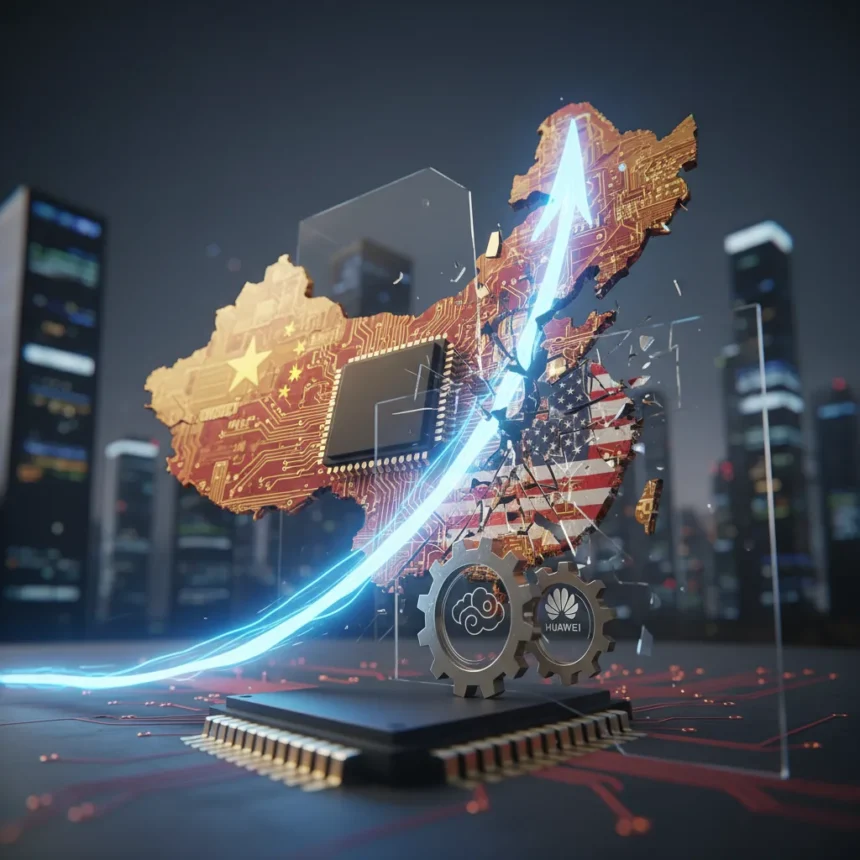
US chip export controls on China have achieved the opposite of their intended effect. According to Huawei’s rotating chairman, Washington’s restrictions on semiconductor access have actually supercharged Chinese firms’ investment in domestic chip development and pushed them toward building a competing tech stack. This paradox sits at the heart of a growing debate over whether America’s export control strategy is weakening rather than strengthening its technological advantage.
Key Takeaways
- Huawei chairman credits US export restrictions with accelerating China’s semiconductor R&D investment and domestic chip development
- Export controls passed in 2022 further constrained Huawei’s access to advanced chips, intensifying the drive for alternatives
- A House Select Committee member called TSMC-manufactured chips reaching Huawei a “catastrophic failure” of US export policy
- Huawei remains behind US chip technology by approximately one generation, according to founder Ren Zhengfei
- US and allied restrictions on semiconductor manufacturing equipment have limited China’s access to advanced production tools
How US export controls reshaped China’s chip strategy
US chip export controls intended to slow Chinese technological progress instead created incentives for domestic semiconductor innovation. Huawei and other Chinese firms responded to Washington’s restrictions by investing heavily in research and development to build their own chip architectures and supply chains independent of American technology. Rather than crippling their capabilities, the export controls forced Chinese companies to accelerate internal development timelines and seek complementary partnerships within China’s technology ecosystem.
The policy shift became more restrictive in 2022, when additional export controls further limited Huawei’s ability to obtain advanced chips. This tightening, intended to constrain the company’s capabilities, instead intensified the urgency of developing domestic alternatives. Huawei invested in HiSilicon, worked with firms possessing complementary semiconductor strengths, and created investment incentives to build a broader Chinese semiconductor ecosystem.
The gap between Chinese and American chip capabilities
Despite Huawei’s progress, Chinese semiconductors still lag behind the most advanced American chips. Ren Zhengfei acknowledged this gap in an interview with People’s Daily, stating that “Huawei is not that great. We have to work hard to reach the U.S.’s evaluation”. Industry analysis suggests Huawei’s current chips trail US leading-edge technology by roughly one generation, particularly in AI applications where Nvidia dominates.


The challenge for China is not just in chip design but in manufacturing capability. US and allied restrictions on advanced semiconductor manufacturing equipment have severely limited China’s access to the tools needed for latest production. This equipment bottleneck remains one of the most significant barriers to Chinese firms achieving technological parity with American semiconductor makers. Without access to the world’s most advanced fabrication technology, even superior chip designs cannot be manufactured at competitive performance levels.
Congressional alarm over export control enforcement
US policymakers have grown alarmed by reports that advanced chips manufactured by Taiwan Semiconductor Manufacturing Company (TSMC) reached Huawei despite export restrictions. Representative John Moolenaar, chair of the House Select Committee on China, called these reports a “catastrophic failure” of US export control policy and demanded immediate action to prevent further breaches. “The U.S. government must take immediate steps to ensure this does not happen again,” Moolenaar stated.



The Department of Commerce subsequently issued new guidance clarifying that Huawei’s Ascend 910B, 910C, and 910D chips face restrictions for certain uses and transactions involving US and non-US persons. This enforcement tightening reflects Washington’s recognition that export control loopholes have allowed Chinese firms to obtain critical semiconductor technology despite official restrictions.
What Huawei’s progress reveals about export control strategy
Huawei’s success in advancing its semiconductor capabilities despite export restrictions raises uncomfortable questions about the effectiveness of America’s technology containment strategy. The company’s ability to develop competitive chips while facing restrictions suggests that export controls alone cannot prevent Chinese technological advancement when domestic investment and ecosystem support are sufficiently strong.
The irony is sharp: controls designed to weaken Chinese competitors instead created a powerful incentive for self-reliance and accelerated the very domestic semiconductor development that Washington hoped to prevent. Chinese firms now have both the motivation and the resources to continue building alternatives to American technology, potentially creating a bifurcated global tech landscape in which Chinese and American semiconductor ecosystems operate independently.
Can US export controls still work?
Export controls remain a critical tool in America’s technology competition with China, but their effectiveness depends on enforcement and the breadth of allied cooperation. Restrictions on manufacturing equipment remain more effective than restrictions on finished chips, since equipment controls target the production capability itself rather than individual products. However, as Chinese firms gain design expertise and seek alternative manufacturing partners, even equipment controls face pressure.



The core tension is that export controls work best when the target country has no viable alternatives. As China builds its own semiconductor ecosystem, the effectiveness of US restrictions diminishes. A purely restrictive strategy may slow Chinese progress but cannot stop it indefinitely, particularly when the restrictions themselves motivate the very investments that create alternatives.
Did Huawei intentionally design chips around US restrictions?
While Huawei’s chip development accelerated after export controls took effect, the company’s architectural innovations appear driven by necessity rather than a pre-planned strategy. The timing suggests Huawei responded to restrictions by redirecting resources toward internal chip design capabilities it had previously deprioritized. This reactive approach became a competitive advantage once the company committed resources to it.
How do Huawei’s chips compare to Nvidia’s AI processors?
Huawei’s AI chips, including its Ascend series, represent a viable alternative to Nvidia in certain markets, particularly in China where Nvidia faces export restrictions. However, Nvidia’s technology remains more mature and widely adopted. Huawei’s chips serve primarily Chinese customers and government applications, whereas Nvidia dominates the global AI infrastructure market. The gap exists not just in raw performance but in software ecosystem maturity and developer adoption.
What happens if US export controls tighten further?
Additional export control restrictions would likely accelerate rather than slow Chinese semiconductor development. Each new restriction would deepen the incentive for Chinese firms to invest in domestic alternatives and seek non-US suppliers for manufacturing equipment and design tools. The paradox of export controls is that their success in limiting technology transfer is often accompanied by their failure to prevent the target from developing alternatives independently.
Huawei’s public acknowledgment that US export restrictions have benefited Chinese semiconductor development represents a significant shift in how China’s tech leaders view American policy. Rather than viewing export controls as a threat to be circumvented, Huawei’s chairman frames them as an accelerant for the very technological independence Beijing has long sought. Whether this reflects confidence in Chinese capabilities or strategic messaging, the underlying reality is clear: export controls alone have not prevented Chinese semiconductor advancement and may have hastened it.
Edited by the All Things Geek team.
Source: Tom's Hardware




