





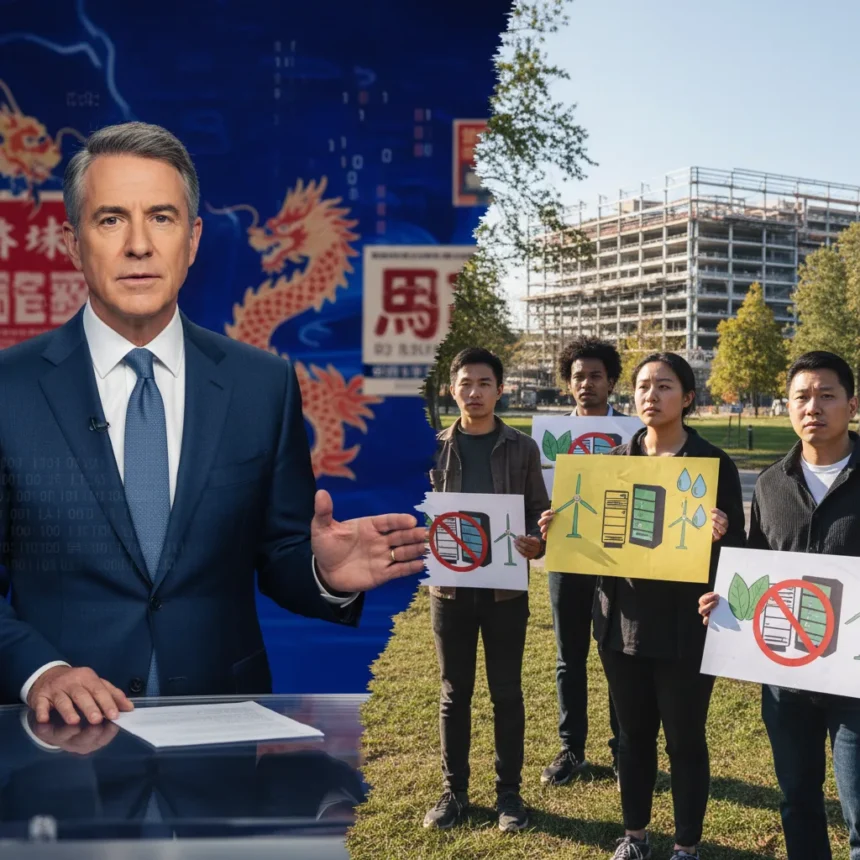
Kevin O’Leary claims Chinese propaganda is fueling opposition to U.S. data-center development, framing the debate as a national-security issue rather than a local land-use conflict. The investor and television personality has accused environmental activists opposing a proposed 40,000-acre data-center campus in Utah of being foreign operatives working to slow American AI compute capacity.
Key Takeaways
- O’Leary alleges two Utah activists are CCP-linked operatives based on IP address analysis, a claim they deny.
- Local opposition centers on environmental impacts, including a potential 50 percent increase in Utah’s greenhouse-gas emissions.
- The dispute connects a specific Utah land fight to broader national debate over AI infrastructure permitting.
- Trump administration policies have accelerated federal permit processes for data-center projects.
- O’Leary promised evidence of foreign interference but had not provided it at time of reporting.
The Accusation and the Response
O’Leary specifically named two Utah women, Ladd Finlayson and Hollie Morgan, claiming his team conducted a “deep dig into the IP addresses” and identified “two cells inside of Utah” affiliated with the Chinese Communist Party: Elevate Strategies and Alliance for a Better Utah. Finlayson responded with sharp skepticism. “You don’t wake up in the morning often thinking, like, maybe I’ll get accused of sedition today on Fox News by Kevin O’Leary, but here we are,” she said.
Both activists rejected the accusation outright, stating their opposition stems from legitimate concerns about the project itself, not foreign funding or coordination. They emphasized that the data-center campus felt “very much imposed upon people” without adequate public input. The local resistance predates O’Leary’s foreign-interference narrative and centers on tangible environmental and community impacts, not geopolitical strategy.
Environmental Stakes and Local Concerns
The 40,000-acre Utah data-center project faces opposition rooted in concrete environmental science. A University of Utah professor cited in reporting estimated the project could increase the state’s net greenhouse-gas emissions by 50 percent. This is not a minor calculation—it represents a dramatic environmental footprint that would reshape Utah’s climate impact for decades.


Local residents have expressed frustration that the project was presented to them as a fait accompli rather than a proposal open to genuine community debate. The lack of transparency in the approval process fueled grassroots organizing. O’Leary’s framing dismisses these concerns as cover for foreign sabotage, but the activists argue they are simply defending their home state against an outsized industrial development. The environmental impact alone justifies serious scrutiny, independent of any geopolitical claims.
National Security Narrative and Federal Policy
O’Leary has positioned Chinese propaganda data-center opposition as a strategic threat to U.S. AI dominance. “Who would want us to stop building our electrical grid? Who would want to stop us from having the compute capacity to develop AI? Which adversary would want that? There’s only one, it’s China,” he argued. This framing ties local activism to a national-security argument and aligns with Trump administration policy accelerating federal permit processes for data-center projects.



The national-security angle serves a purpose: it reframes environmental and community objections as unpatriotic obstruction. If opponents are foreign agents, their concerns become illegitimate by definition. This rhetorical move shifts the burden of proof—instead of defending the project on its environmental merits, O’Leary can dismiss criticism as enemy propaganda. The strategy is politically effective but factually unsubstantiated. O’Leary promised to provide evidence of foreign interference but had not done so at the time of reporting.
The Proof Problem
O’Leary’s central claim rests on IP address analysis that he says reveals CCP-linked organizations operating in Utah. Yet the evidence remains private and unverified. IP addresses can be spoofed, VPNs obscure origin, and attribution is notoriously difficult without forensic rigor and third-party confirmation. Making a public accusation of sedition against named individuals without releasing supporting evidence is a serious charge that demands scrutiny.
The activists have denied the allegations and challenged O’Leary to prove them. Until evidence surfaces, the accusation functions as an unsubstantiated claim designed to discredit legitimate opposition. Readers should distinguish between O’Leary’s allegations and independently confirmed facts about foreign interference in U.S. infrastructure debates.
Is Kevin O’Leary’s claim credible?
O’Leary has not released the IP analysis or forensic evidence he cited. Without third-party verification, the accusation remains an allegation. The activists deny it, and local opposition to the project predates O’Leary’s involvement, suggesting environmental and community concerns are the primary drivers of resistance.



What are the real environmental impacts of the Utah data-center project?
According to a University of Utah professor cited in reporting, the project could increase the state’s net greenhouse-gas emissions by 50 percent. This is a substantial environmental cost that warrants serious evaluation independent of O’Leary’s foreign-interference claims.
How does this fit into broader AI infrastructure debates?
The Utah fight exemplifies a growing tension between AI compute demand and environmental constraints. Data centers require enormous electricity and water. As hyperscale development accelerates, communities are pushing back on projects that were previously approved with minimal public input. O’Leary’s foreign-propaganda narrative attempts to reframe this as a national-security issue, but local activists argue they are simply defending their environment and democratic voice.
The data-center debate will intensify as AI training demands grow. Communities have legitimate reasons to scrutinize these projects—environmental impact, water depletion, energy grid strain, and land use all matter. Dismissing local opposition as foreign sabotage weakens the argument for rapid development and sidesteps the harder work of building projects that communities actually support. Until O’Leary provides verifiable evidence of foreign interference, the Utah fight remains what it appears to be: a clash between development interests and community resistance grounded in environmental and democratic concerns.
Edited by the All Things Geek team.
Source: Tom's Hardware




