






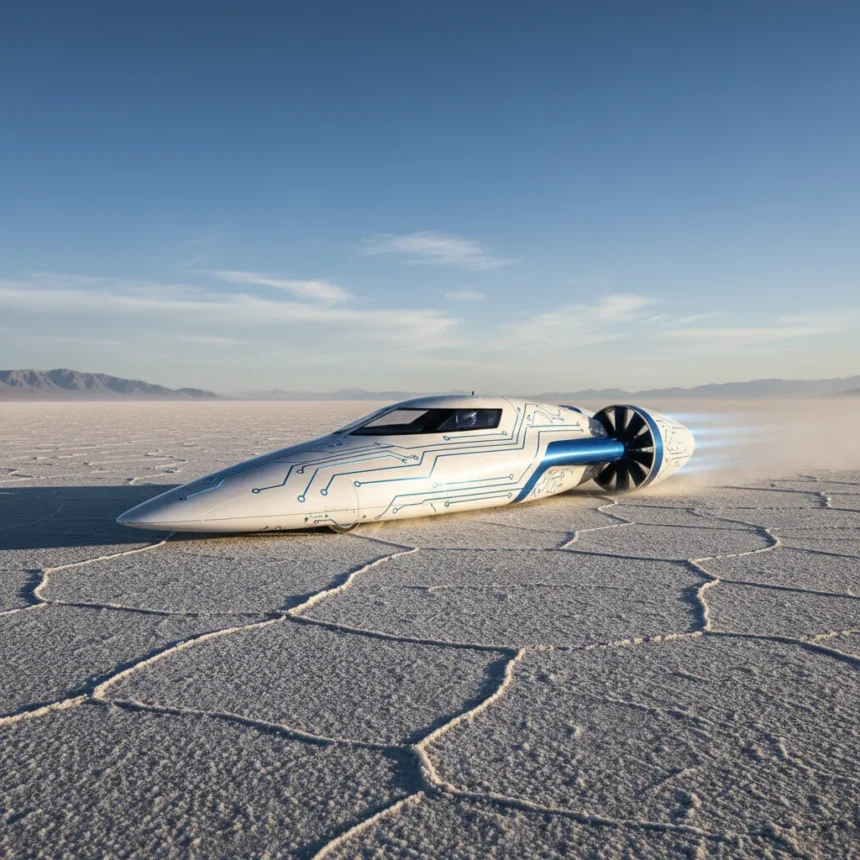
The world’s fastest zero-emissions car is not a battery-electric vehicle—it is a hydrogen-powered land-speed record concept that is aiming to shatter the 350 mph barrier. This ambitious project represents a fundamental shift in how the automotive industry approaches extreme performance while maintaining environmental responsibility.
Key Takeaways
- A hydrogen-powered concept car is being positioned as the world’s fastest zero-emissions car
- The vehicle targets breaking the 350 mph speed barrier
- The project combines extreme speed with zero-emissions technology
- Hydrogen propulsion offers an alternative to battery-electric powertrains for performance vehicles
- The initiative challenges conventional thinking about eco-friendly high-speed vehicles
Hydrogen vs. Battery-Electric Speed Records
The distinction between this hydrogen-powered concept and traditional battery-electric speed record attempts matters significantly. While battery-electric vehicles dominate consumer EV discussions, hydrogen fuel cells offer a fundamentally different approach to zero-emissions performance. Hydrogen produces only water vapor as exhaust, making it genuinely zero-emissions at the point of use. This contrasts with battery vehicles, which depend entirely on the energy grid’s composition—a grid that varies dramatically by region and generation source.
Battery-electric speed records have gained attention in recent years, but hydrogen presents unique advantages for sustained high-speed runs. Fuel cells deliver continuous power without the thermal management challenges that plague battery systems under extreme stress. For a land-speed record attempt where a vehicle must sustain peak performance for extended periods, hydrogen’s thermal characteristics become a critical engineering advantage.
The 350 mph Target and Record-Breaking Context
Breaking 350 mph represents an extraordinary engineering challenge. The world’s fastest zero-emissions car must overcome aerodynamic forces that increase exponentially with speed, manage tire grip at velocities where conventional physics becomes unforgiving, and maintain structural integrity under conditions most road vehicles never encounter. This target is not arbitrary—it represents a genuine leap beyond current electric vehicle speed records.


The concept acknowledges what the title hints at: there is a catch. Land-speed record vehicles operate in specialized environments, on salt flats or closed courses, under conditions that have no bearing on real-world driving. A car that hits 350 mph in a controlled setting is not the same as a production vehicle capable of highway performance. Yet the engineering breakthroughs required to achieve such speeds often trickle down into consumer vehicles—materials science, aerodynamic principles, and power management systems all benefit from extreme performance research.
Why Hydrogen Matters for Performance
Hydrogen fuel cells have struggled to gain traction in the consumer vehicle market, but they excel in high-performance and specialized applications. Unlike batteries, which degrade under thermal stress and require cooling systems that add weight, hydrogen fuel cells maintain consistent output across a wider temperature range. For a world’s fastest zero-emissions car attempting to sustain 350 mph, this reliability becomes essential.



The infrastructure argument that has hindered hydrogen passenger vehicles does not apply to land-speed record attempts. A single refueling station at a test facility is trivial to operate. The real value lies in proving that hydrogen technology can deliver extreme performance safely and repeatably. Success here generates credibility for hydrogen in other high-performance applications—racing, aviation, and heavy transport—where battery-electric solutions face genuine technical limitations.
What This Means for the Future of Zero-Emissions Performance
The world’s fastest zero-emissions car project signals that the automotive industry recognizes hydrogen’s role in performance-critical applications. Battery-electric vehicles dominate consumer discussions, but hydrogen fills a specific niche: scenarios where sustained power, thermal efficiency, and rapid refueling matter more than charging infrastructure. A land-speed record attempt validates hydrogen’s engineering potential in ways that marketing claims cannot.
This concept also challenges the narrative that zero-emissions vehicles must sacrifice performance. The 350 mph target is not a compromise—it is a statement that environmental responsibility and extreme capability are compatible. As global emissions regulations tighten and consumer expectations shift, demonstrating that clean powertrains can outperform conventional engines becomes increasingly valuable.
Is a hydrogen speed record car practical for consumers?
No. Land-speed record vehicles are specialized engineering projects with no direct consumer application. They operate under controlled conditions on salt flats or closed courses, using fuel, tires, and components designed for a single extreme run. The value lies in technological validation and the engineering principles that eventually reach production vehicles, not in creating a car anyone can drive.



Why hydrogen instead of battery-electric for this record?
Hydrogen fuel cells deliver consistent power across extreme temperature ranges and avoid the thermal degradation that batteries experience under sustained peak performance. For a vehicle attempting to maintain 350 mph for extended periods, hydrogen’s thermal efficiency and power delivery characteristics provide engineering advantages that battery systems cannot match in this specific application.
Could this technology influence future hydrogen cars?
Possibly. Breakthroughs in fuel cell efficiency, materials science, and hydrogen storage developed for extreme performance applications often find their way into production vehicles. However, consumer adoption of hydrogen vehicles depends on infrastructure development and cost reduction—factors that a land-speed record project addresses only indirectly.
The world’s fastest zero-emissions car represents more than a speed record chase. It is a statement that hydrogen technology remains viable for performance-critical applications where batteries struggle, and that zero-emissions does not mean zero excitement. Whether this concept translates into consumer hydrogen vehicles depends on market forces and infrastructure investment far beyond the salt flat where it will make its record attempt.
Where to Buy
Edited by the All Things Geek team.
Source: T3




