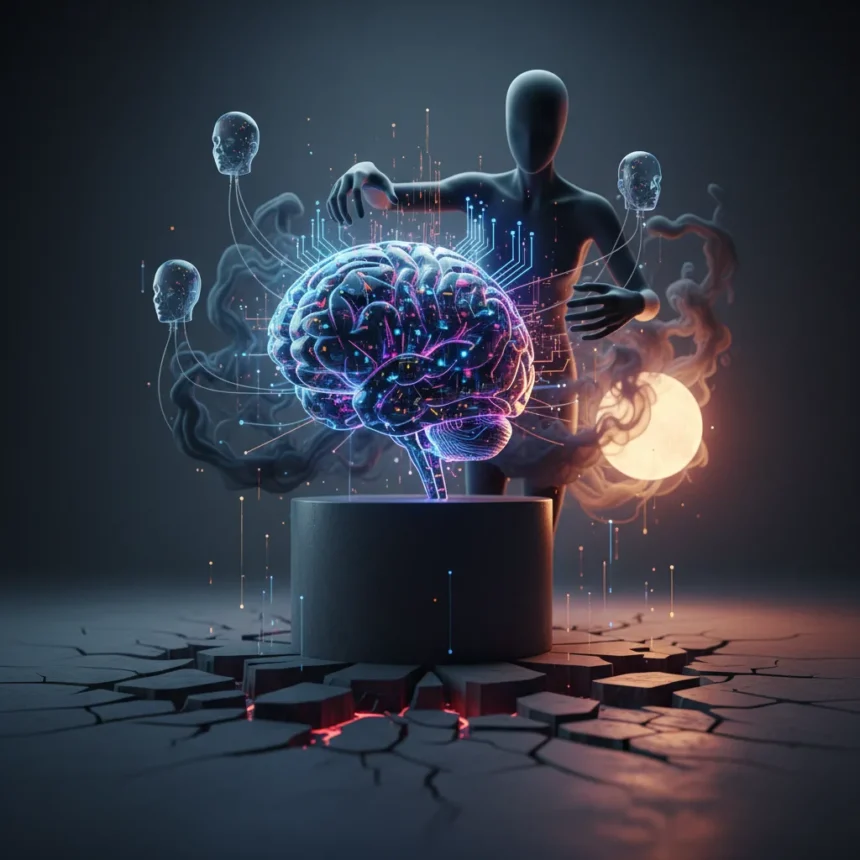
Comedian Ronny Chieng recently warned Harvard graduates about a specific threat: that AI is making mediocre people dumber. His quip landed because it captures a real anxiety about how AI making people dumber could erode cognitive skills and critical thinking. But the actual danger lurking beneath this observation is far more troubling than mere intellectual atrophy.
Key Takeaways
- Ronny Chieng warned Harvard graduates that AI is making mediocre people dumber
- The surface concern about AI making people dumber misses a deeper structural risk
- ChatGPT and Claude enable outsourcing of judgment, not just computation
- The real threat involves how AI making people dumber could reshape institutional decision-making
- Dependency on AI systems may accelerate cognitive decline across entire professions
The Surface Warning About AI Making People Dumber
Chieng’s observation taps into a widespread concern: that access to powerful AI tools like ChatGPT and Claude will atrophy the mental muscles people need to think independently. When you can offload writing, analysis, coding, and research to a language model, why strain to develop those skills yourself? The fear that AI is making people dumber assumes that convenience inevitably breeds intellectual laziness. This worry is not unfounded. Every technology that outsources cognitive work—calculators, GPS, search engines—has reshaped how we think. But framing the risk as simple stupification misses the architecture of what is actually breaking down.
Why AI Making People Dumber Is Only Half the Story
The real risk of AI making people dumber is not that individuals will become less capable of independent thought, though that may happen. The deeper danger is that institutions, organizations, and entire professions will lose the ability to evaluate whether AI outputs are correct. When ChatGPT or Claude generates a memo, a legal argument, a medical recommendation, or a business strategy, someone still has to judge whether it is sound. But if that someone has never developed the skills to think through these problems themselves—because they have always relied on AI—they cannot adequately verify the tool’s work. They become a rubber stamp. This is not stupidity in the traditional sense. It is the erosion of judgment itself. A manager who has never written a strategic plan cannot evaluate whether Claude’s plan is brilliant or dangerously flawed. A junior lawyer who has never drafted a contract cannot spot where ChatGPT has hallucinated a precedent. A doctor who has never reasoned through a diagnosis cannot catch where an AI system has missed a crucial symptom. The system does not need everyone to be dumb—it just needs decision-makers to be unable to decide.
Consider how this compounds across hierarchies. If AI is making people dumber at the entry level, those people eventually become supervisors, directors, and executives. They inherit positions of authority without ever developing the foundational expertise their roles demand. The organization does not collapse immediately. It collapses when the AI system fails in a way that requires human judgment to catch—and no one in the building has the skills to recognize the failure. This is not a hypothetical risk. It is already visible in fields where AI adoption is accelerating fastest: customer service, content moderation, code review, financial analysis.



The Institutional Cascade of AI Making People Dumber
The real catastrophe unfolds not when individuals become dumber, but when entire institutions lose the capacity to think critically about their own tools. An organization that has outsourced all routine decision-making to ChatGPT or Claude becomes dependent on those systems for continuity. When the AI hallucinates, contradicts itself, or encounters an edge case it was not trained on, the institution has no internal expertise to fall back on. The people who might have caught the error have spent five years asking ChatGPT to do the thinking for them. They have atrophied not because they are lazy, but because the incentive structure made delegation rational. Why spend two hours drafting a proposal when Claude can do it in thirty seconds? From an individual perspective, that is efficiency. From an organizational perspective, it is the slow erasure of institutional knowledge and judgment. This is where AI making people dumber becomes a systemic threat rather than a personal one. The risk is not that you will become stupid. The risk is that you will become unable to tell if you are being stupid, because you no longer have the cognitive framework to evaluate your tools.
Can Organizations Reverse This Trend?
The question is whether institutions can adopt AI responsibly while maintaining the human judgment needed to oversee it. Some organizations are building this discipline intentionally: requiring that decisions made with AI input are reviewed by someone who understands the underlying domain deeply enough to challenge the system. But this requires a cultural commitment that most organizations lack. It is easier and cheaper to let AI make the decision and let humans execute it. The pressure toward atrophy is relentless. Chieng’s warning to Harvard graduates was ultimately about personal responsibility—the idea that individuals should resist the temptation to outsource their thinking entirely. That is sound advice. But it is also incomplete. Individual discipline cannot overcome institutional incentives. If your employer rewards speed over verification, if your industry measures productivity by throughput rather than accuracy, then choosing not to use AI becomes a competitive disadvantage. You will be outpaced by colleagues who are willing to accept the risk of AI making people dumber in exchange for faster output. The real question is not whether individuals can stay sharp while using AI. The question is whether we can build institutions that refuse to trade judgment for efficiency. So far, the answer is no.



What Does This Mean for AI Users Today
If you are using ChatGPT or Claude, the implication is clear: the tool is only as good as your ability to evaluate its output. That evaluation requires maintaining the skills the AI is replacing. It means occasionally doing the work yourself, not to be productive, but to stay sharp. It means questioning the system’s answers instead of accepting them. It means building redundancy into your thinking—having multiple ways to verify whether the AI is right. This is not a comfortable position. It is far easier to trust the system. But that ease is exactly where the danger lies. AI is making people dumber not because the tools are inherently corrupting, but because using them without friction is so seductive. The real risk is that we will optimize ourselves into a position where we can no longer tell the difference between a brilliant AI output and a catastrophically wrong one. And by then, it will be too late to rebuild the judgment we traded away.
Is Ronny Chieng’s warning about AI making people dumber actually accurate?
Chieng’s observation captures a real concern, but it is incomplete. AI is not making people dumb in a simple sense—it is creating a situation where people can avoid developing the judgment needed to evaluate AI outputs. The risk is not stupidity but the loss of critical oversight capacity.
Can I use AI tools without becoming less capable at thinking?
Yes, but it requires intentional discipline. Regularly doing the cognitive work yourself—writing, analyzing, coding—without AI assistance helps maintain the skills you need to evaluate AI outputs. The key is treating AI as a tool you oversee, not as a replacement for your judgment.
What is the difference between ChatGPT and Claude in terms of this risk?
Both systems present the same structural risk: they can atrophy human judgment if used as replacements for thinking rather than as tools to augment it. The specific capabilities differ, but the institutional danger is identical regardless of which AI system you adopt.


The real threat from AI making people dumber is not that we will all become less intelligent. It is that we will create a world where intelligence becomes irrelevant because no one retains the ability to judge whether the systems running our institutions are right or catastrophically wrong. Chieng was right to warn Harvard graduates. But the warning is not about personal capability—it is about institutional survival. The question now is whether we are paying attention.
Edited by the All Things Geek team.
Source: Tom's Guide