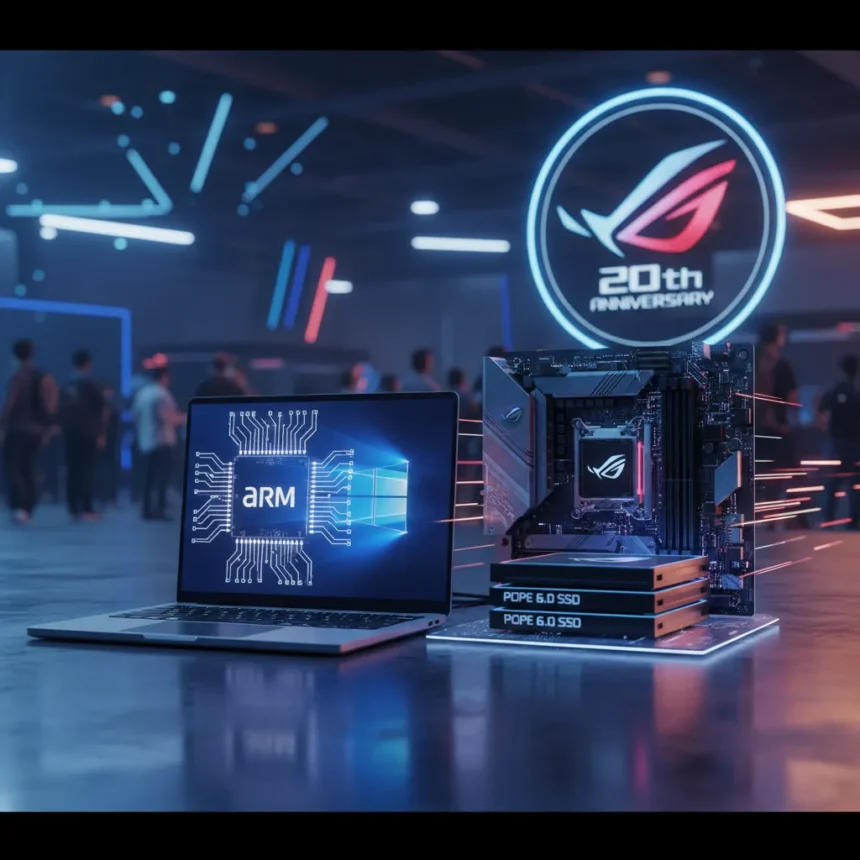
Arm Windows PC ambitions stepped out of the shadows at Computex 2026 on day one, with Nvidia unveiling its RTX Spark platform as a full-featured alternative to traditional x86 Windows machines. The move signals a watershed moment for Arm architecture in mainstream computing, challenging Intel and AMD’s decades-long dominance in the Windows ecosystem.
Key Takeaways
- Nvidia’s RTX Spark brings Arm-based Windows PCs to market with 20 CPU cores and Blackwell GPU architecture.
- Intel Arc G3 and G3 Extreme handheld chips officially launch for gaming portables from Acer, MSI, and OneXPlayer.
- PCIe 6.0 SSD controllers move from prototype to reference designs, signaling imminent market availability.
- Asus marks ROG’s 20th anniversary with black-and-gold hardware design across multiple product lines.
- Computex 2026 runs June 1–5 in Taipei with major announcements reshaping PC gaming and mobile computing.
Nvidia’s RTX Spark: Arm Windows PC Gets Serious
Nvidia’s RTX Spark platform represents the most credible Arm Windows PC push to date. The top-tier configuration packs 20 Arm CPU cores, a Blackwell GPU, 128GB of LPDDR5X RAM, and up to 300 GB/s of memory bandwidth. This is not a mobile-class chip shoehorned into a laptop—it is a purpose-built superchip designed to run full Windows 11 on Arm architecture.
The Arm Windows PC category has simmered for years, with Qualcomm and others testing the waters. Nvidia’s entry changes the calculus. By pairing Arm CPUs with its own discrete Blackwell GPU, Nvidia sidesteps the traditional x86 licensing costs and creates a platform that could undercut Intel and AMD on both power efficiency and performance-per-watt. For OEMs tired of x86 licensing fees and thermal constraints, RTX Spark offers a genuine alternative.
The architecture also positions Nvidia to compete more directly with Apple’s M-series MacBooks, which have already proven that Arm-based silicon can handle demanding creative and gaming workloads. If RTX Spark delivers on its efficiency promise, Windows OEMs finally have a credible answer to the MacBook narrative.


Intel’s Gaming Handheld Chips Break Cover
Intel Arc G3 and Arc G3 Extreme officially arrived at Computex with confirmed designs for three major gaming handhelds: the Acer Predator Atlas 8, MSI Claw 8 EX AI+, and OneXPlayer. The Arc G3 Extreme uses up to Intel Arc B390 graphics alongside a CPU cluster of two P-cores, eight E-cores, and four LPE cores.
This announcement matters because it signals Intel’s determination to reclaim ground in portable gaming. The gaming handheld category exploded after the Steam Deck proved demand existed, but Intel sat on the sidelines while AMD’s Ryzen chips powered most competitors. Arc G3 and G3 Extreme represent Intel’s official entry into this lucrative niche, bundling CPU, GPU, and efficiency features in a single package designed for sustained gaming performance in a compact form factor.



The three confirmed OEM partners suggest strong OEM confidence in the platform. Acer, MSI, and OneXPlayer are not experimental boutique makers—they are established gaming brands with distribution reach. If Arc G3 delivers solid gaming performance and thermal efficiency, Intel could reshape the handheld market in 2026.
PCIe 6.0 SSDs Move From Concept to Reality
Phison’s PCIe 6.0 SSD controller is no longer theoretical. Two reference SSDs using the new X3 controller appeared on display at Computex, marking a shift from development-board demonstrations to reference-design hardware. This progression signals that PCIe 6.0 storage is nearing market readiness, though consumer drives are likely still months away.
PCIe 6.0 represents a generational leap in interface bandwidth, enabling sustained sequential speeds far beyond PCIe 5.0’s capabilities. For content creators, game developers, and data-intensive workloads, the performance jump justifies the transition. The reference designs on display at Computex confirm that controller design is no longer the bottleneck—manufacturing and OEM integration are the remaining hurdles.
Storage vendors are watching closely. Once PCIe 6.0 drives ship, the current PCIe 5.0 generation will age rapidly, much like PCIe 4.0 did after PCIe 5.0 arrived. Early adopters and enthusiasts will upgrade, but mainstream users may stick with PCIe 5.0 for another two years until pricing parity forces the transition.


Asus ROG Turns 20 With Black-and-Gold Branding
Asus is celebrating ROG’s 20th anniversary with a cohesive black-and-gold design language applied across multiple product lines. The gold-accented Harpe II gaming mouse exemplifies the aesthetic—understated luxury rather than aggressive RGB excess. This branding moment reflects ROG’s maturation from niche gaming brand to mainstream hardware authority.
The black-and-gold treatment is not merely cosmetic. It signals Asus’s confidence in ROG as a standalone brand identity, distinct from generic gaming gear. By applying the design language consistently across mice, keyboards, monitors, and other peripherals, Asus is building a cohesive ecosystem that appeals to gamers who want hardware that looks as refined as it performs.
What This Means for PC Gaming in 2026
Computex 2026 day one revealed an industry in transition. Arm Windows PC is no longer a fringe experiment—Nvidia’s RTX Spark legitimizes it as a viable platform. Intel’s gaming handheld chips confirm that portable PC gaming is now a mainstream category worth serious engineering effort. PCIe 6.0 storage is approaching consumer availability, promising a performance boost for content creators and gamers with large game libraries. And Asus’s ROG branding evolution shows that gaming hardware is shedding its adolescent aesthetic in favor of refined design.
None of these shifts will happen overnight. RTX Spark devices will take months to reach shelves. Arc G3 handhelds are just beginning their rollout. PCIe 6.0 drives are still in reference-design phase. But the trajectory is clear: 2026 will see meaningful competition in categories that were previously dominated by one or two players.
Will Arm Windows PCs actually challenge x86 dominance?
Nvidia’s RTX Spark is a credible platform, but winning against x86 requires more than raw specs. Developers must optimize software for Arm, OEMs must price competitively, and the platform must prove reliable over years of real-world use. Apple succeeded with Arm because it controlled the entire ecosystem. Nvidia must convince multiple OEMs and a fragmented software ecosystem to embrace Arm Windows. That is a steeper climb than MacBook adoption, but not impossible.
When will PCIe 6.0 SSDs be available for consumers?
Reference designs at Computex suggest consumer PCIe 6.0 drives are likely six to twelve months away from retail availability. Phison’s controller is ready, but manufacturing ramp and OEM validation take time. Early adopters should expect premium pricing at launch, with mainstream adoption following as production scales and competing controllers arrive.
Is Intel’s Arc G3 competitive with AMD in gaming handhelds?
Intel’s Arc G3 Extreme is designed specifically for handheld gaming, with a CPU and GPU cluster optimized for sustained performance in thermal-constrained devices. Direct performance comparisons require real-world testing, but Intel’s focus on efficiency cores and dedicated GPU design suggests competitive positioning against AMD’s Ryzen-based handhelds. The three confirmed OEM partners indicate confidence in the platform’s viability.
Computex 2026 day one proved that the PC ecosystem is far from stagnant. Arm Windows PC is becoming real, gaming handhelds are entering the mainstream, storage interfaces are advancing, and design language matters more than ever. The next twelve months will determine whether these announcements translate into products that reshape the market or remain impressive engineering exercises. Watch this space.
Edited by the All Things Geek team.
Source: Tom's Hardware