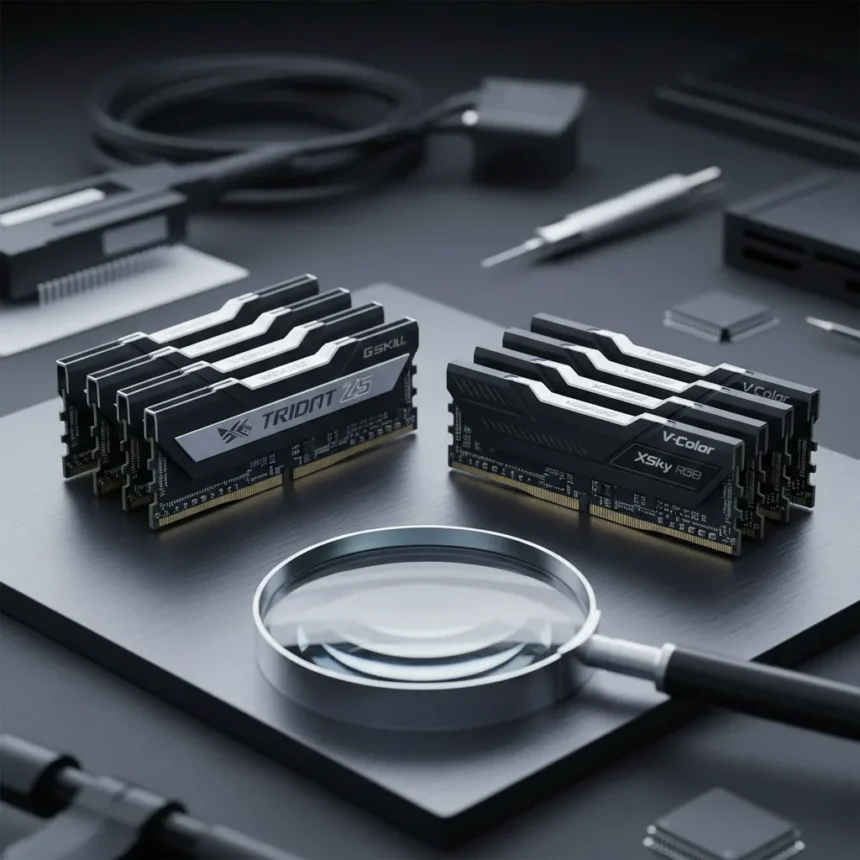
Counterfeit DDR5 memory modules carrying legitimate G.Skill and V-Color branding have infiltrated Chinese marketplaces, and they are getting disturbingly good at impersonating the real thing. The fakes use identical PCBs and heat spreaders to the genuine products, making visual inspection alone nearly worthless for detecting counterfeits. This shift represents a serious escalation in the counterfeit-memory problem affecting the DDR5 market, where appearance-based authentication has traditionally been a buyer’s last line of defense.
Key Takeaways
- Counterfeit DDR5 modules now use identical PCBs and heat spreaders, making them visually indistinguishable from authentic products
- G.Skill and V-Color are confirmed targets of the counterfeiting operation on Chinese marketplaces
- The fakes are sold at significantly lower prices than genuine DDR5 memory
- Counterfeiting affects multiple brands in the DDR5 market, including Samsung and SK Hynix modules
- Buyers risk performance degradation, instability, and potential hardware damage when purchasing counterfeit memory
How Counterfeit DDR5 Memory Became Nearly Undetectable
The sophistication of modern counterfeit DDR5 memory has jumped several levels. Fake modules no longer rely on crude mislabeling or obvious cosmetic differences. Instead, counterfeiters are manufacturing PCBs and heat spreaders that match authentic designs so closely that even experienced technicians struggle to spot the difference without specialized testing equipment. This means a module sitting in your hand could look, feel, and appear identical to a genuine G.Skill or V-Color product while containing entirely different internal components or substandard memory chips.
The implications are serious. A buyer purchasing what appears to be a legitimate DDR5 module at a steep discount from a Chinese marketplace now faces genuine uncertainty about what they are actually receiving. Visual inspection—checking for font quality, logo sharpness, packaging details—has been the traditional way consumers verify memory authenticity. Counterfeit DDR5 memory has neutralized that advantage entirely by copying the physical design so accurately.
Why Chinese Marketplaces Have Become Counterfeiting Hubs
Chinese online marketplaces have emerged as primary distribution channels for counterfeit DDR5 modules, partly because the volume of legitimate memory sales in those regions provides excellent cover for fakes. The sheer number of listings makes enforcement difficult, and the geographic distance from Western markets means affected brands struggle to monitor and respond quickly. Additionally, the price-sensitive nature of the Chinese market creates demand for cheaper alternatives, even if those alternatives are fraudulent.


The problem extends beyond G.Skill and V-Color. Reports indicate that counterfeit DDR5 modules masquerading as Samsung and SK Hynix products are also circulating, suggesting this is a systemic issue rather than isolated to one or two brands. When multiple major memory manufacturers are targeted simultaneously, it signals an organized counterfeiting operation rather than opportunistic fraud.
The Real Cost: Brand Damage and Consumer Risk
Counterfeit DDR5 memory creates a dual problem for legitimate manufacturers. First, it directly undercuts their sales—customers who buy fakes at half the price never purchase genuine products. Second, it damages brand reputation when counterfeit modules fail or cause system instability, leaving buyers convinced the brand itself is unreliable. G.Skill and V-Color are losing sales revenue while simultaneously watching their reputations take hits for problems they did not cause.



For consumers, the risks are concrete. Counterfeit memory may use inferior chips that fail under load, cause random crashes, or degrade performance unpredictably. In worst-case scenarios, fake modules could damage other system components or cause data corruption. A buyer who unknowingly installs counterfeit DDR5 memory faces not just wasted money but potential hardware damage and lost work.
What Makes Detection So Difficult Now
Traditional authentication methods have become unreliable. You cannot rely on visual inspection of the PCB or heat spreader anymore because counterfeits now replicate these components. Serial numbers and holograms can be faked. Even packaging can be duplicated convincingly. This forces buyers into a position where they must either purchase from trusted retailers with verified supply chains or accept significant risk.
The only reliable verification methods now involve functional testing—running the memory through stress tests like MemTest86 or checking performance against known specifications. But most buyers lack the technical knowledge or equipment to perform these tests before installation. By the time a module fails, the purchase is already complete and the counterfeiter is long gone.
Can Buyers Protect Themselves?
The most practical defense is purchasing from authorized retailers and avoiding suspiciously cheap deals on memory modules. If a G.Skill or V-Color DDR5 kit is selling for 40 or 50 percent below market rates on a third-party marketplace, that price discount is a red flag. Authorized distributors maintain supply-chain verification that protects against counterfeits, while marketplace sellers often cannot guarantee the origin of their inventory.



For buyers who have already purchased DDR5 memory from uncertain sources, running comprehensive memory diagnostics before relying on the system is essential. Tools like MemTest86 can reveal whether a module is functioning as advertised, though they cannot determine authenticity directly. If a module fails testing, returning it and purchasing from a verified retailer is the safer path, even if it costs more.
Is counterfeit DDR5 memory a widespread problem?
Yes. Multiple brands including G.Skill, V-Color, Samsung, and SK Hynix are targeted by counterfeiters, and fakes are actively sold on Chinese marketplaces. The problem is significant enough that it is impacting legitimate manufacturers’ sales and is part of a broader wave of fake DDR5 in Asian markets.
How can I tell if my DDR5 memory is counterfeit?
Visual inspection is no longer reliable because counterfeit modules now replicate PCBs and heat spreaders accurately. The safest approach is purchasing from authorized retailers with verified supply chains. If you suspect a module is fake, run memory diagnostic software like MemTest86 to check for performance anomalies or failures.
Should I buy DDR5 memory from Chinese marketplaces?
Buying from Chinese marketplaces carries significant risk given the prevalence of counterfeit DDR5 modules. Authorized retailers and established distributors offer supply-chain verification that protects you from fakes, even if prices are slightly higher. The cost savings from a discount marketplace are not worth the risk of installing defective or counterfeit memory into your system.
The counterfeit DDR5 memory problem reveals a hard truth about modern electronics: appearance alone cannot guarantee authenticity anymore. Buyers must shift from relying on visual cues to relying on trusted retailers and supply-chain verification. For manufacturers like G.Skill and V-Color, the challenge is defending their brands against increasingly sophisticated counterfeiting while helping customers understand that the cheapest deal is often the riskiest one.
Edited by the All Things Geek team.
Source: Tom's Hardware