




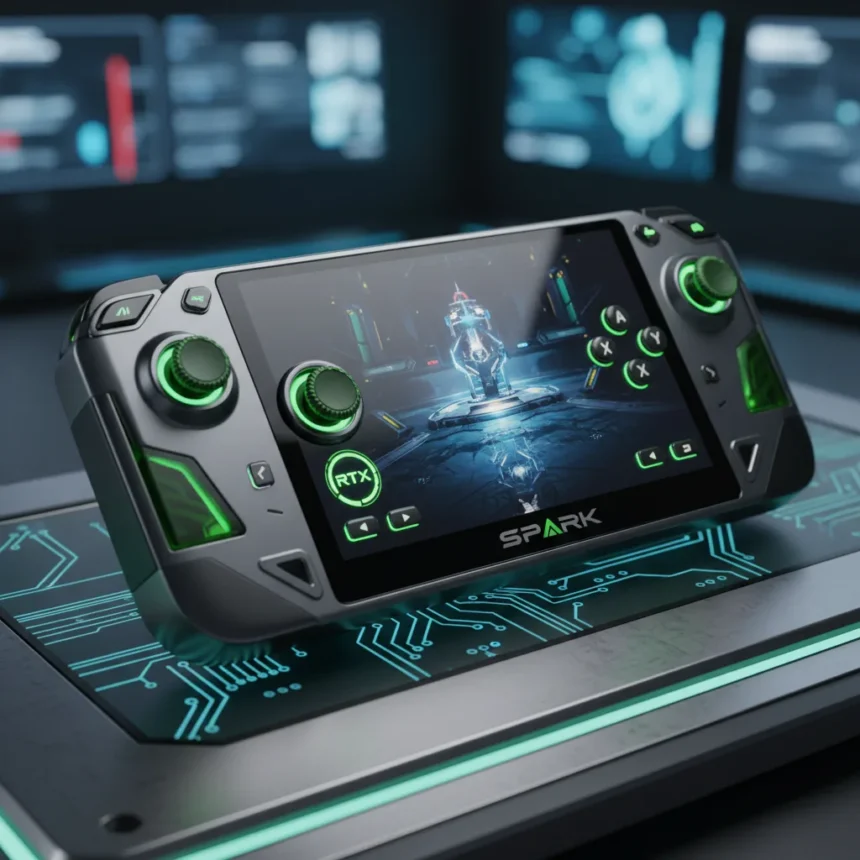
The RTX Spark handheld represents a product that should exist but almost certainly won’t—at least not from Nvidia. On paper, an RTX Spark handheld combines everything portable gaming enthusiasts claim to want: RTX 5070-level graphics, extended battery life, and the promise of real desktop-class gaming in a pocket-sized form factor. Yet Jensen Huang and Nvidia show no appetite for making such a device, leaving a gap in the market that competitors may eventually exploit.
Key Takeaways
- RTX Spark could deliver RTX 5070-class performance paired with superior battery efficiency in a handheld form factor
- Nvidia leadership appears uninterested in pursuing a dedicated handheld PC product despite the apparent market opportunity
- An RTX Spark handheld would likely command a price high enough to deter mainstream buyers
- The handheld gaming market continues expanding without Nvidia’s direct participation in the segment
- Competitors may fill the void if Nvidia remains committed to ignoring the portable PC space
Why RTX Spark Makes Sense for Handhelds
The case for an RTX Spark handheld is straightforward: the platform’s architecture appears tailor-made for portable gaming devices. RTX 5070-class graphics would represent a genuine leap in handheld performance, matching or exceeding what current portable gaming PCs can deliver. Paired with the power efficiency that RTX Spark promises, such a device would theoretically offer hours of continuous gaming without constant charging—a persistent pain point for existing handheld PC owners. The combination of performance and battery life is rare enough that it would justify a dedicated product launch.
Handheld gaming has evolved into a serious category. Steam Deck’s success proved that PC gamers would embrace portable form factors if the experience remained compelling. An RTX Spark handheld would push that experience further, offering desktop-grade graphics in a device you could carry in a backpack. The market exists. Demand exists. Yet Nvidia has chosen to ignore both.
The Nvidia Indifference Problem
Jensen Huang and Nvidia’s broader strategy reveals little interest in the handheld space. While other chipmakers explore portable gaming platforms, Nvidia has concentrated its efforts on data centers, AI infrastructure, and traditional desktop/laptop markets. The company’s silence on handheld gaming is not accidental—it reflects a conscious decision to prioritize higher-margin segments where Nvidia already dominates. Handhelds, by contrast, operate on thinner margins and demand sustained support for niche communities that Nvidia may view as secondary to its core business.


This indifference is puzzling precisely because RTX Spark exists as a platform. Nvidia invested in developing the technology. The architecture works. Porting it to a handheld would not require fundamental innovation—just product engineering and a willingness to compete in a market Nvidia apparently considers beneath its current focus. That gap between capability and commitment is where opportunity lives, and where Nvidia’s competitors may eventually step in.
The Price Problem Nobody Wants to Admit
Even if Nvidia wanted to build an RTX Spark handheld, the economics would be brutal. Early analysis suggests that a device pairing RTX 5070-level performance with extended battery life would carry a price tag high enough to alienate mainstream buyers. The cost of the silicon, the engineering required to optimize thermals and power draw in a compact chassis, and the R&D investment needed to launch a new product category would all compress margins or inflate the final price beyond what consumers expect to pay for a handheld.

Existing handheld PCs already struggle with pricing perception. Most gamers balk at spending more than $800 to $1,000 on a portable device, no matter how powerful. An RTX Spark handheld with premium positioning could easily exceed $1,200, pushing it into a category where buyers question whether a traditional laptop might serve them better. That psychological barrier is real, and Nvidia likely calculated that the addressable market at a profitable price point is simply too small to justify the investment.
Who Will Fill the Void?
Nvidia’s absence from the handheld space does not mean the category will stagnate. Other chipmakers are actively developing portable gaming platforms. Intel, AMD, and Qualcomm all have incentives to compete in handhelds, especially as AI integration becomes a selling point for portable devices. If RTX Spark genuinely offers the performance and efficiency gains that Nvidia claims, competitors will eventually develop their own equivalents or pursue alternative architectures that deliver similar results.
The irony is that Nvidia’s dominance in graphics and AI could have given it a commanding position in next-generation handhelds. Instead, the company’s strategic focus elsewhere leaves an opening. Whether that opening gets filled by a startup, a traditional PC maker, or an existing handheld vendor remains to be seen—but the opportunity exists precisely because Nvidia chose not to pursue it.
Is an RTX Spark handheld coming from Nvidia?
No confirmed Nvidia handheld using RTX Spark has been announced. Jensen Huang and Nvidia show no public interest in developing such a product, despite the platform’s apparent suitability for portable gaming. The device remains speculative rather than planned.


Why would an RTX Spark handheld be expensive?
The cost of integrating RTX 5070-class graphics with efficient power management in a compact handheld chassis, combined with R&D and manufacturing investment, would likely push the price above what most handheld buyers expect to spend. Nvidia’s historical pricing strategy and the premium positioning of RTX products suggest a launch price that could exceed $1,200.
What alternatives exist to an RTX Spark handheld?
Existing handheld PCs use Intel and AMD processors, while Steam Deck relies on custom AMD silicon. Competitors may develop their own platforms if Nvidia continues to ignore the market, but no direct RTX Spark alternative currently exists at retail.
The RTX Spark handheld represents a road not taken. It is a product that makes technical and market sense, yet remains unlikely to materialize because Nvidia’s leadership has decided to pursue other priorities. That mismatch between capability and commitment is frustrating for handheld enthusiasts, but it is also a reminder that not every good idea gets built—especially when the company with the best tools to build it simply does not care.
Where to Buy
Edited by the All Things Geek team.
Source: TechRadar