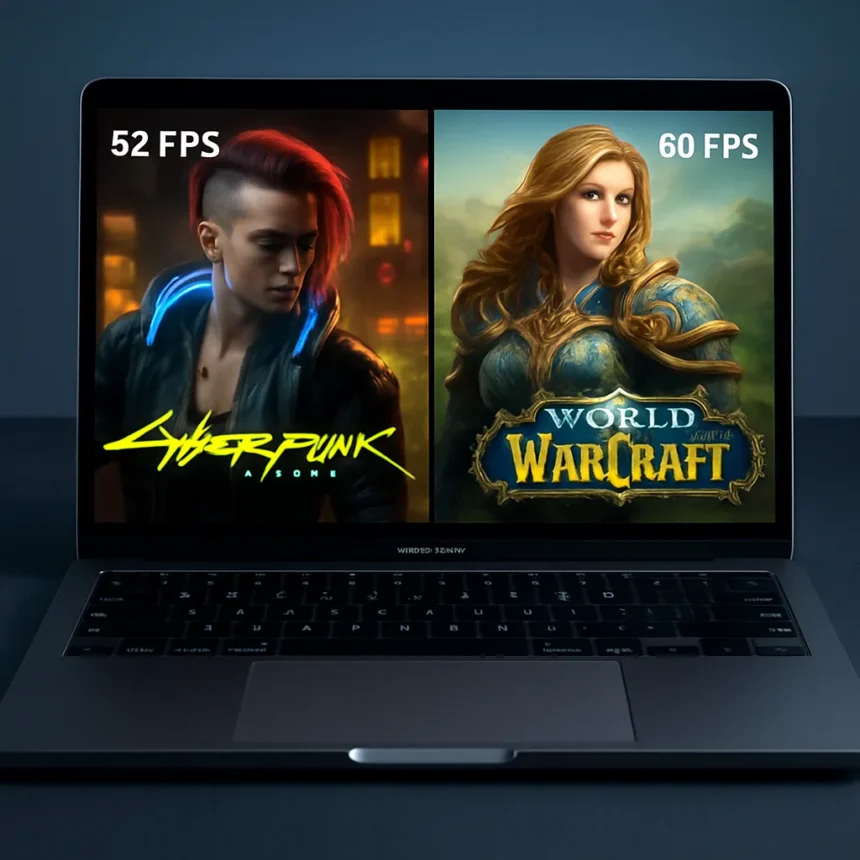
MacBook Neo gaming performance has turned heads in a way nobody expected from Apple’s 2026 entry-level laptop. The MacBook Neo is a budget laptop made by Apple, announced in March 2026, powered by the Apple A18 Pro chip — the same silicon found in iPhone hardware — with a 6-core CPU, 5-core GPU, and 16-core Neural Engine. YouTuber Andrew Tsai tested 10 games on the device and the results challenge every assumption about what a fanless, affordable Apple machine can actually do.
What the MacBook Neo Gaming Performance Actually Looks Like
The headline result is Cyberpunk 2077 running at 52 frames per second on a budget, completely silent laptop. That figure comes with important caveats — the game ran using the “For this Mac” settings, which automatically adjusts resolution, detail levels, and enables frame generation. Motion scenes showed heavy artifacts, and this is not a machine for maxing out ray tracing. But playable Cyberpunk on a fanless laptop with no dedicated GPU is a genuine surprise, and Andrew Tsai’s testing confirmed it is not a fluke.
World of Warcraft reached 60 fps at the screen’s native resolution with decent detail settings — a result that will matter to a large and loyal player base. Minecraft, League of Legends, and Roblox all ran smoothly without issue. Apple Arcade titles like Gear Club and Ocean Horn 3 ran, in Tsai’s words, “like butter.” The pattern is clear: the MacBook Neo handles light-to-mid gaming with confidence, and even pushes into AAA territory under the right conditions.
Why MacBook Neo Gaming Performance Beats Comparable Windows Laptops
The A18 Pro chip’s architecture is a meaningful part of the story here. Apple claims the MacBook Neo is up to 50 percent faster than a bestselling PC with an Intel Core Ultra 5 for everyday tasks like web browsing, up to three times faster for on-device AI workloads, and up to two times faster for photo editing. Those benchmarks are based on Apple’s controlled testing using pre-release software on preproduction units, so real-world results will vary — but the directional advantage is consistent with what Tsai’s gaming tests showed.


Single-core performance sits faster than the M1 MacBook Air and closer to M2 territory, with multicore performance slightly better. That generational positioning matters for gaming: the A18 Pro is not a desktop-class chip, but it is significantly more capable than what Intel’s current budget silicon delivers in thin, fanless form factors. A Windows ultrabook at a similar price point running an Intel Core Ultra 5 is simply not going to match these gaming numbers in a passively cooled chassis.
The Real Limits of MacBook Neo as a Gaming Machine
The base model’s 8 GB of RAM is the most significant constraint for anyone taking gaming seriously. It is adequate for light multitasking, streaming, and the kinds of games Tsai tested, but it is not a foundation for heavy workloads running alongside games. The port selection is also limited, which will frustrate users who want to connect external displays or peripherals for a more capable gaming setup.



The fanless design is a double-edged sword. Silent operation is genuinely pleasant, and the long battery life — 15 hours and 35 minutes in an independent 720p video loop test, close to Apple’s claimed 16-hour figure — is a real advantage for portable use. But without active cooling, sustained gaming sessions may hit thermal limits that a laptop with a fan would push past. The thick bezels and lack of keyboard backlighting on the base model are minor complaints in context, but they are concessions that reflect the budget positioning.
Should you buy the MacBook Neo for gaming?
The MacBook Neo is not a gaming laptop in any traditional sense, and positioning it as one would be misleading. But if gaming is one of several things you want a portable machine to do — alongside browsing, creative work, and everyday productivity — the A18 Pro chip delivers a level of gaming capability that would have seemed implausible on a budget, fanless Apple device even two years ago. Students, casual users, and Apple ecosystem devotees who also want to run Minecraft, League of Legends, or even occasional Cyberpunk sessions will find the Neo genuinely capable.
Can the MacBook Neo run Cyberpunk 2077?
Yes, Cyberpunk 2077 runs on the MacBook Neo at approximately 52 frames per second using the “For this Mac” settings, which adjusts resolution, detail levels, and enables frame generation. Motion scenes show visible artifacts, and this is not a high-fidelity experience, but the game is playable on Apple’s budget fanless laptop.
How does the MacBook Neo compare to the MacBook Air for gaming?
The MacBook Neo’s A18 Pro chip delivers single-core performance faster than the M1 MacBook Air and closer to M2 levels, with slightly better multicore results. For gaming specifically, the Neo’s A18 Pro architecture handles titles like World of Warcraft at 60 fps and Cyberpunk 2077 at around 52 fps — results that put it ahead of older Air models in raw gaming capability.



Is 8 GB RAM enough for gaming on the MacBook Neo?
For the games tested — Minecraft, League of Legends, Roblox, World of Warcraft, and Cyberpunk 2077 at adjusted settings — 8 GB of unified memory proved sufficient. It is not recommended for running demanding games alongside heavy background workloads, and it rules out serious 4K editing or professional graphics work, but for casual-to-moderate gaming it holds up.
The MacBook Neo gaming performance story is ultimately one of recalibrated expectations. This is not a machine that competes with dedicated gaming laptops, and nobody should buy it expecting otherwise. But as a budget, fanless, long-battery Apple laptop that can also run Cyberpunk at a playable framerate and handle WoW at 60 fps, it is a more capable all-rounder than the entry-level category has any right to produce. The A18 Pro chip, borrowed from Apple’s phone lineup, turns out to be a quietly serious piece of silicon in a laptop chassis.
Edited by the All Things Geek team.
Source: Tom's Guide