






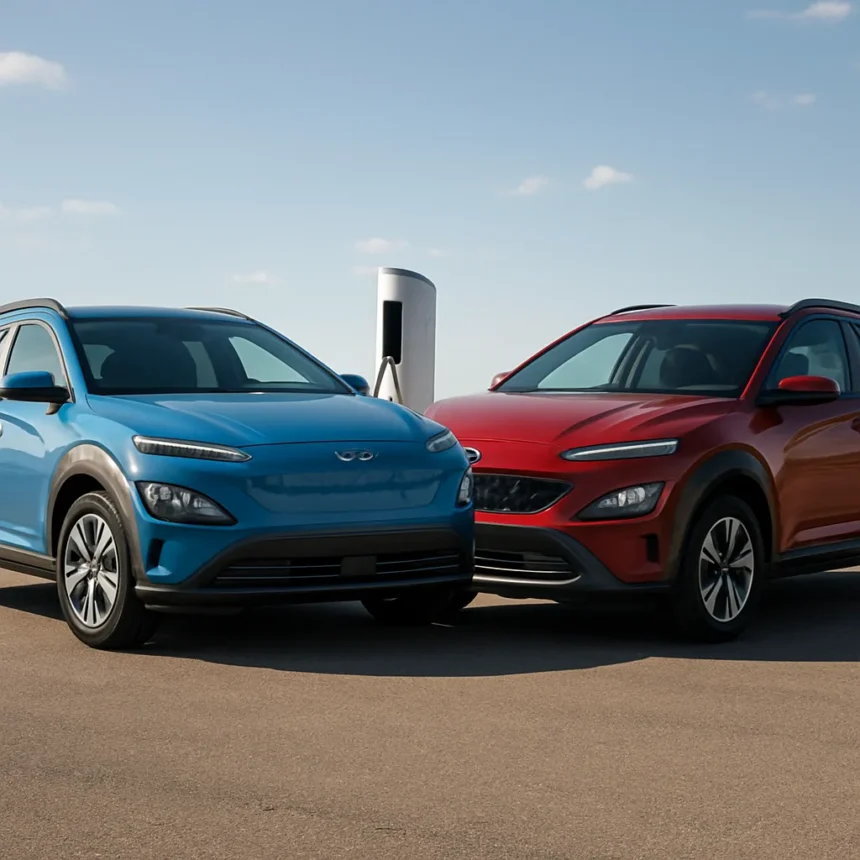
Is the Hyundai Kona Electric worth the premium over gas?
The Hyundai Kona Electric is a compact electric SUV made by Hyundai, available in standard-range and extended-range configurations, sitting alongside the gas-powered Kona in the same lineup. After a week behind the wheel of both the all-gas Kona Limited AWD and the Kona Electric, the conclusion is clear: the running cost gap between these two versions is large enough to change the buying decision for most drivers.
What separates the Hyundai Kona Electric from the gas model?
The mechanical differences go deeper than just the powertrain. The gas Kona comes with a 2.0-litre four-cylinder producing 147 horsepower and 132 lb-ft of torque, with an optional 1.6-litre turbocharged engine pushing 190 to 195 horsepower and 195 lb-ft. It is available in both front-wheel and all-wheel drive, can tow up to 1,500 lbs in AWD configuration, and carries an EPA rating of 26 to 30 mpg city and 29 to 35 mpg highway. The Kona Electric, by contrast, offers a single electric motor producing either 133 horsepower on the standard-range 48.6 kWh battery or 201 horsepower on the extended-range 64.8 kWh unit, with torque figures between 188 and 291 lb-ft depending on trim. The extended-range version delivers an EPA-estimated 260 to 261 miles per charge, while the standard-range manages around 200 miles.
There are meaningful trade-offs in both directions. The gas Kona is roughly 700 lbs lighter than the electric version, which shows up in braking and handling figures — the gas model stops from 60 mph in 119 feet compared to 138 feet for the EV, and edges out the Kona Electric in a figure-8 test at 26.9 seconds versus 27.8 seconds. The EV uses low-rolling-resistance tyres that prioritise efficiency over grip, which explains part of that gap. The gas version also retains AWD availability and towing capacity, making it the practical choice for anyone who needs to haul a trailer or regularly drives on loose surfaces. The Kona Electric is front-wheel drive only.
Where the Hyundai Kona Electric pulls decisively ahead
The EV’s case is built on two things: the driving experience and the cost per mile. On the road, instant torque delivery means the Kona Electric feels more responsive in urban traffic than the gas model, which relies on either a CVT or an eight-speed automatic and exhibits the lag typical of turbocharged engines under load. The EV is also noticeably quieter, with no engine noise intruding at any speed. Above 60 mph, the Kona Electric matches the gas version in the quarter mile despite the heavier kerb weight.


The financial argument is harder to ignore. The gas Kona costs approximately $0.12 per mile to run, while the Kona Electric comes in at around $0.03 per mile — a four-to-one ratio that compounds quickly over annual mileage. Add to that the elimination of oil changes and significantly reduced brake wear thanks to regenerative braking, and the long-term maintenance picture tilts sharply in the EV’s favour. The second-generation Kona Electric also charges faster than its predecessor: the 64.8 kWh battery accepts up to 11 kW on Level 2 AC (a full charge in roughly six hours) and up to 85 to 100 kW on DC fast chargers, reaching 10 to 80 percent in 40 to 43 minutes. That is a meaningful improvement over the earlier model’s 7.2 kW AC and 75 kW DC limits.
How the Kona Electric compares to rivals
The extended-range Kona Electric’s 260 to 261 miles of EPA range puts it in direct competition with the Chevrolet Bolt EV, which offers 259 miles — essentially identical on paper. The Bolt has historically been priced aggressively, so buyers cross-shopping the two should factor in available tax incentives, which can substantially close the Kona Electric’s higher upfront cost relative to the gas version. That premium sits somewhere between $2,500 and $11,000 before incentives depending on trim. For buyers in markets where EV incentives are generous, the effective price gap can narrow considerably.



The gas Kona’s loaded tester came in at $28,980, which underlines just how accessible this platform is on the combustion side. The EV commands more, but the per-mile running cost advantage means the crossover point — where the EV has paid back its premium — arrives faster than many buyers expect, particularly for high-mileage commuters.
Which version of the Kona should you actually buy?
The gas Kona makes sense in a narrow set of circumstances: you need AWD for genuine off-road use, you tow regularly, or you live somewhere with limited charging infrastructure and long distances between stops. The 13.2-gallon tank and up to 396-mile range give the gas model a flexibility advantage that no amount of fast-charging can fully replicate on a long road trip.
For everyone else — urban commuters, suburban drivers, anyone with home charging access — the Kona Electric’s economics are compelling. The lower centre of gravity improves stability in everyday cornering, the instant torque makes it more enjoyable to drive in traffic, and the running costs are dramatically lower. The second-gen improvements to charging speed and battery capacity make the 2024 and 2025 models the most convincing versions yet.
Does the Kona Electric work for long road trips?
The extended-range Kona Electric’s 260-mile EPA range and 40-to-43-minute DC fast charge time make longer journeys manageable, though they require more planning than a gas vehicle. Drivers comfortable with charging stops will find the experience workable; those who regularly cover 400-plus miles in a single day without stopping may prefer the gas model’s flexibility.



What is the real running cost difference between the two Konas?
The gas Kona costs approximately $0.12 per mile to run while the Kona Electric costs around $0.03 per mile. Over 15,000 miles annually, that difference amounts to roughly $1,350 in fuel savings per year — before factoring in reduced maintenance costs from fewer oil changes and less brake wear.
Can the Kona Electric tow?
No. The Kona Electric has no rated towing capacity. If towing is a requirement, the gas Kona AWD supports up to 1,500 lbs, making it the only viable choice between the two for buyers who need to haul a trailer or small boat.
The Hyundai Kona Electric is not the right vehicle for every buyer, but for the majority of drivers who use a compact SUV for daily commuting and weekend errands, the combination of lower running costs, improved driving feel, and faster second-gen charging makes it the more rational long-term choice. The gas version earns its place in the lineup — just for a narrower audience than it used to have.
This article was written with AI assistance and editorially reviewed.
Source: Tom's Guide