





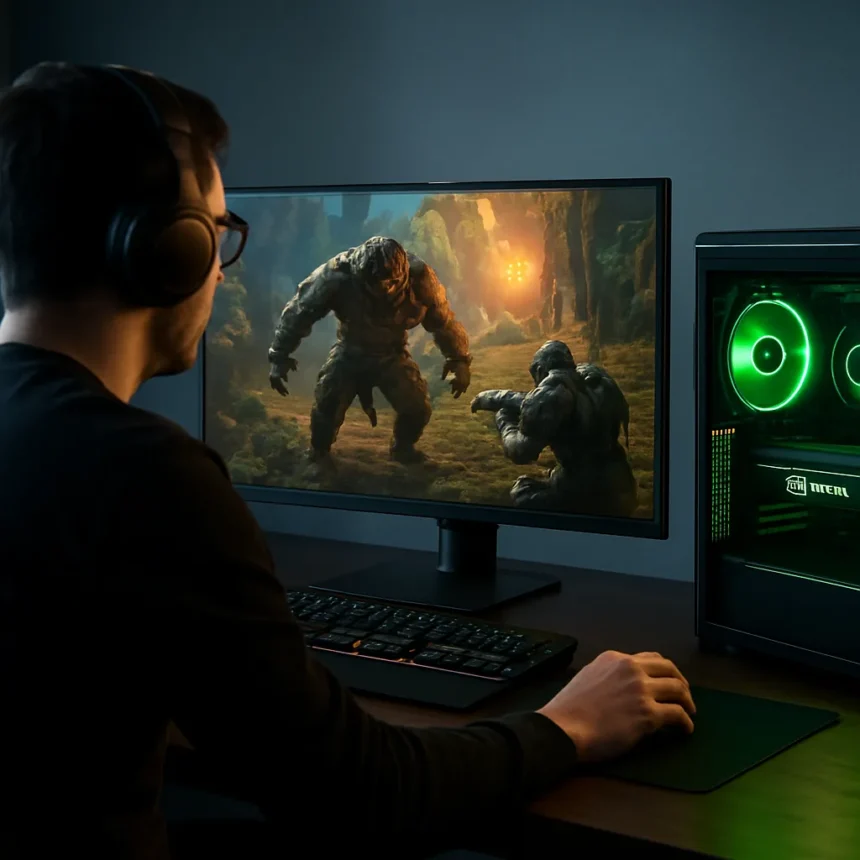
Neural rendering refers to using AI and machine learning to generate game graphics, replacing or augmenting the traditional pixel-by-pixel rasterization that GPUs have relied on for decades. At CES 2026, Nvidia CEO Jensen Huang declared that “the future is neural rendering,” signalling a fundamental shift in how PC games will look — and how GPUs will need to work to get there.
TL;DR: Nvidia is betting that neural rendering — AI-driven graphics pipelines replacing traditional rasterization — will eventually deliver film-quality visuals in real-time PC gaming, with a stated target of 1 million times better path tracing performance. GTC 2026 is where the roadmap gets real.
What neural rendering actually means for PC gaming
Neural rendering replaces traditional shader-based rasterization with AI-driven techniques — tools like DLSS for texture compression and decompression, neural radiance fields, frame generation, and eventually full pipeline replacement using matrix math and AI models. The goal is not just prettier graphics but a fundamentally different approach to how a GPU constructs an image.
Traditional rasterization works by projecting 3D geometry onto a 2D screen and calculating lighting per pixel. It’s fast, but it’s an approximation. Path tracing, by contrast, simulates how light actually behaves — bouncing rays through a scene to produce physically accurate shadows, reflections, and global illumination. The problem is that path tracing is brutally expensive to compute in real time. That’s the gap neural rendering is designed to close.



Huang’s CES 2026 comments didn’t push back on the idea that the RTX 5090 might represent the peak of traditional rasterization performance growth. That’s a significant admission. If the raster race is effectively over, AI is the only frontier left.
The 1 million times path tracing target: what it means
Nvidia’s stated target for neural rendering is a 1 million times improvement in path tracing performance, which would bring real-time film-quality rendering to PC gaming. No specific timeline or benchmark methodology accompanies that figure, so it should be read as a directional ambition rather than a product promise — but the direction itself is striking.



Path tracing at film quality currently requires render farms running for hours per frame. Real-time path tracing in games today, even on the RTX 5090, is a heavily approximated version of that process. Closing a gap of that magnitude requires more than faster silicon — it requires a different computational approach entirely. Neural rendering, with its reliance on trained AI models doing inference rather than brute-force ray calculations, is Nvidia’s answer.
At GDC 2026, Nvidia demonstrated several technologies that sit on this path. RTX Mega Geometry targets dense path-traced foliage — one of the hardest geometry problems in real-time rendering. ReSTIR PT handles path-traced indirect lighting inside the RTX Dynamic Illumination SDK. RTX Hair, currently in beta, brings strand-based acceleration to the Unreal Engine 5 Nvidia branch. These are not consumer features yet, but they show the toolchain being built for developers.
How neural rendering compares to the rasterization era
The shift from rasterization to neural rendering mirrors the earlier transition from fixed-function graphics pipelines to programmable shaders in the early 2000s. That transition also seemed radical at the time and also required developers to rebuild their workflows. The difference now is the pace — and the role of AI hardware.
Traditional rasterization scales with raw shader compute: more CUDA cores, faster clocks, more memory bandwidth. Neural rendering scales with tensor cores and AI inference throughput, which is a different kind of silicon entirely. Nvidia’s RTX architecture has been building toward this for years, with each generation adding more tensor core capacity alongside traditional shader units. The RTX 5090 may be the last GPU where rasterization performance is the headline number.



AMD and Intel both have competing GPU architectures with their own AI acceleration features, but Nvidia’s DLSS ecosystem — now spanning texture compression, frame generation, and ray reconstruction — gives it a significant head start in the neural rendering pipeline. That ecosystem advantage may matter more than raw hardware specs in the transition ahead.
GTC 2026 and what Nvidia is expected to reveal
GTC 2026, running March 16 to 19 in San Jose, is where Nvidia’s neural rendering roadmap is expected to take shape. Jensen Huang’s keynote covers chips, software, models, and applications, with more than 700 sessions across accelerated computing, AI infrastructure, and physical AI. A dedicated session, “Introduction to Neural Rendering,” focuses specifically on embedding machine learning for performance gains and fidelity in real-time graphics and simulation.
Beyond graphics, Nvidia’s ACE platform for AI-driven game characters is also advancing. NVIDIA Riva v1.1 ASR now supports English, Chinese, Korean, French, German, Italian, and Japanese with a reduced memory footprint, alongside production-quality on-device text-to-speech. The Nemotron 3 Nano 4B small language model, targeting in-game agent capabilities and hybrid reasoning, was set to release in the week following GDC. Smarter NPCs and film-quality visuals are two sides of the same neural coin.
Is neural rendering only for high-end GPUs?
Not permanently. The pattern with Nvidia’s AI features has been consistent: capabilities debut on flagship hardware, then trickle down to mid-range cards as efficiency improves. DLSS followed this path, and neural rendering is expected to do the same. The RTX 5090 is the proving ground, but the technology is designed to scale.
When will PC games actually look like films?
Nvidia hasn’t given a specific date, and the 1 million times path tracing improvement target has no attached timeline. What GDC 2026 demonstrated — RTX Mega Geometry, ReSTIR PT, RTX Hair — represents the developer tooling phase. Consumer-facing film-quality rendering is a generation or more away, but the infrastructure is being built now.
The honest answer is that film-quality real-time rendering is a horizon that keeps moving. But the tools Nvidia is building at GDC and the roadmap taking shape at GTC 2026 suggest the gap between a game and a Pixar film is narrowing faster than most people expect.
Edited by the All Things Geek team.
Source: Tom's Guide




