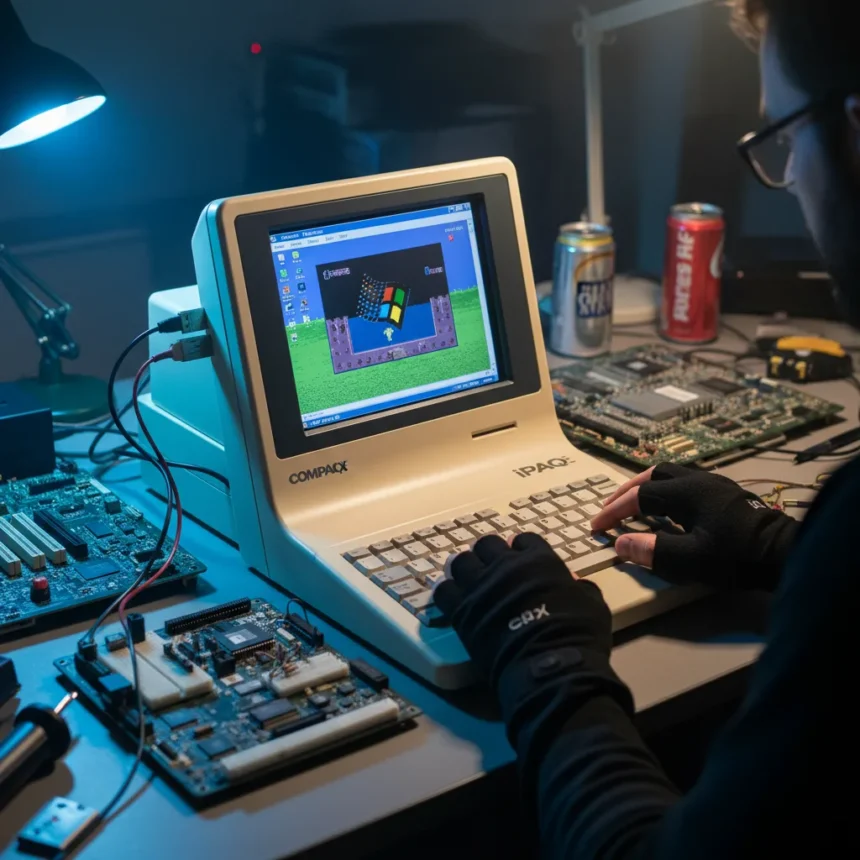
The Windows 98 internet appliance hack is exactly what it sounds like: someone took a Compaq iPAQ IA-2 from the year 2000 and, through a series of clever workarounds, got Windows 98 running on it. Dave Luna, the hacker behind the project, accomplished what most would call pointless—and that is precisely the point.
Key Takeaways
- Dave Luna installed Windows 98 on a Compaq iPAQ IA-2 internet appliance from 2000 via chain booting from NAND Flash.
- The device originally ran a Microsoft CE-based OS designed for MSN dial-up service, not full Windows.
- Hardware includes a 266 MHz Geode GX1 CPU, up to 256 MB SDRAM, and 800×600 resolution via external VGA.
- Successfully runs DOOM, confirming retro gaming functionality on decade-old locked-down hardware.
- The hack demonstrates the ongoing retro computing trend, reviving obsolete appliances into playable machines.
What Was the Compaq iPAQ IA-2?
The Compaq iPAQ IA-2 was an internet appliance released around 2000, designed as a low-cost, no-frills gateway to the web for users who wanted to avoid buying a full personal computer. It ran a Microsoft CE-based operating system optimized for MSN dial-up service, offering a limited web browser experience on what amounted to a closed, single-purpose device. The hardware shipped with a 266 MHz Geode GX1 processor, support for up to 256 MB of SDRAM, and a maximum resolution of 800×600 pixels (requiring an external monitor connected to an internal VGA port). Think of it as a retro Chromebook—functional for web browsing and email, but locked down tight.
These appliances were the answer to a specific market moment: households that wanted internet access without the complexity and cost of a full PC. The device included a 16 MB NAND Flash drive for storage and an IDE connection on the mainboard, though the BIOS could not boot directly from IDE. That limitation would later become the key technical hurdle Luna had to overcome.
How the Windows 98 Internet Appliance Hack Actually Works
Installing Windows 98 on the Compaq iPAQ IA-2 required three distinct steps, each one a workaround to bypass hardware restrictions that were never meant to be circumvented. Luna’s approach was chain booting: starting from one storage device, then jumping to another, to sidestep BIOS limitations.


First, Luna wrote MS-DOS to the device’s 16 MB NAND Flash drive using a non-standard workaround—the Flash drive is not a typical IDE device, so direct writing required special handling. From that MS-DOS environment on Flash, the second step involved booting Windows 98 from an external IDE drive by emulating the IDE connection as an ATAPI IDE device. This emulation trick dodged the BIOS restriction that prevented direct IDE boot, a clever architectural hack that exploited the firmware’s flexibility in how it interprets storage devices. Finally, Luna connected an external monitor to the internal VGA port and configured Windows 98 to run at 800×600 resolution, the maximum the hardware could handle.
The result is a functioning Windows 98 installation on hardware that was never designed to run it. Luna confirmed the hack’s success by launching DOOM, proving that the system could handle basic retro games despite its weak 266 MHz processor and limited RAM.



Why This Hack Matters in the Retro Computing Boom
This Windows 98 internet appliance hack is symptomatic of a broader retro computing trend gaining momentum, where enthusiasts are reviving and repurposing obsolete hardware for nostalgic gaming and computing. The hack was published around March 2026, arriving at a moment when content creators and hobbyists are increasingly focused on breathing new life into locked-down devices from the 1990s and early 2000s.
The Netpliance i-Opener, a competitor internet appliance from 1999, offers a historical parallel. It shipped with a 180 MHz WinChip C6 CPU, 9-inch LCD, and QNX OS on 16 MB Flash, but like the iPAQ IA-2, it was designed as a closed system for dial-up service. However, modders quickly discovered that the i-Opener could be hacked to run Windows 98 and even DOOM II. The i-Opener was sold as a loss leader at $99 retail (despite production costs of $300–400), tied to paid dial-up contracts. Hackers bypassed the service lock-in, and the resulting modding community contributed to Netpliance’s eventual closure. The iPAQ IA-2 hack follows the same spirit of creative defiance—users taking locked-down consumer hardware and repurposing it for their own ends.
What distinguishes Luna’s achievement is not that Windows 98 runs faster or better on the iPAQ than it did in 1998—it does not. The 266 MHz processor is glacially slow by any modern standard. Rather, the hack is a testament to ingenuity: solving a series of hardware and firmware puzzles just to prove it could be done. That is the ethos of retro computing culture right now.
Practical Limitations of the Hack
It is important to be clear: this is not a usable Windows 98 machine in any practical sense. The 266 MHz Geode GX1 processor and limited RAM make the system suitable for running DOOM and perhaps a handful of lightweight 1990s applications, but anything more demanding will crawl. The 800×600 resolution is tight by modern standards and requires an external monitor, making the device less portable than it might appear. The original MSN dial-up service is still available today, but modern websites are far too heavy for this appliance to render meaningfully.



The hack’s value lies entirely in the achievement itself—proof that determined reverse-engineering can unlock hardware that manufacturers deliberately restricted. For collectors and retro computing enthusiasts, that is enough.
Is the Windows 98 internet appliance hack worth attempting?
Only if you own an iPAQ IA-2 and have deep knowledge of BIOS architecture, chain booting, and IDE emulation. Luna’s process required multiple workarounds and non-standard techniques. This is not a beginner-friendly project—it demands patience, technical expertise, and willingness to potentially brick the device.
Can you still buy a Compaq iPAQ IA-2 to hack?
Used units appear in retro computing markets and online auctions, though prices vary. The device is now over 25 years old, so availability is limited and condition varies widely. If you are hunting for one to replicate Luna’s hack, expect to pay collector prices rather than the original retail cost around 2000.
Why does the MSN dial-up service still exist?
MSN dial-up persists as of 2026, primarily serving legacy users who never migrated to broadband and a small community of retro enthusiasts. The service is no longer competitive, but Microsoft maintains it for backward compatibility and the tiny remaining subscriber base.
Luna’s Windows 98 internet appliance hack is a perfect encapsulation of modern retro computing: taking obsolete, locked-down hardware and forcing it to do something its creators never intended. It serves no practical purpose. It is slower than a smartphone from a decade ago. And that is exactly why it matters. In a world where devices are increasingly glued shut and software is increasingly restricted, the ability to modify and repurpose old hardware remains a small but defiant act of digital freedom.
Edited by the All Things Geek team.
Source: Windows Central