






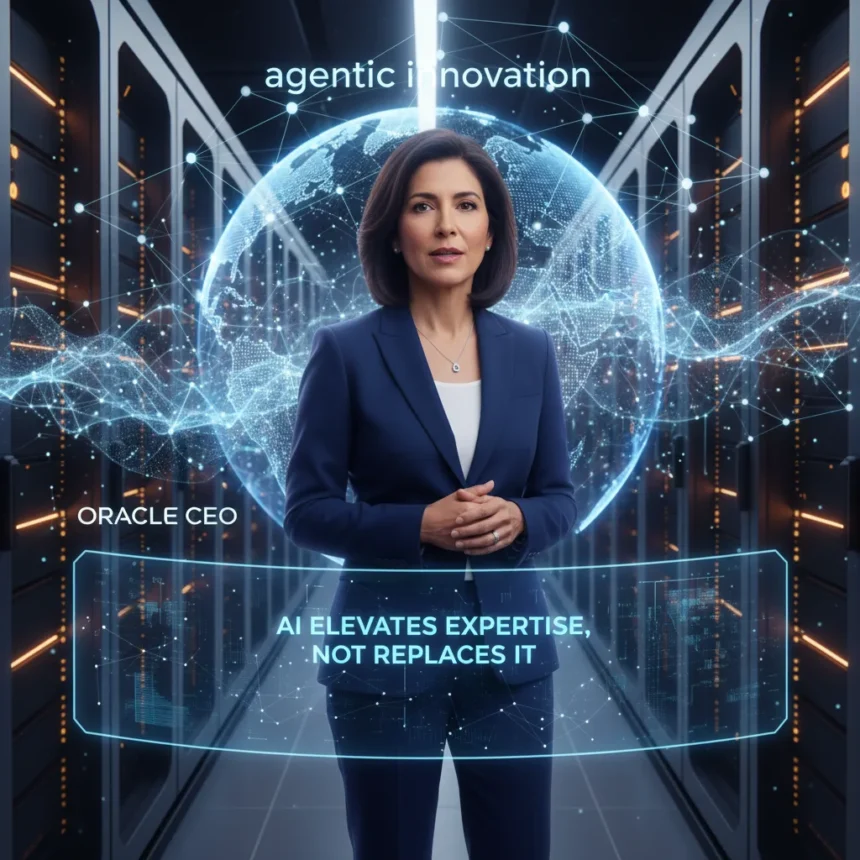
Agentic innovation is reshaping how enterprises think about AI’s role in the workplace, and Oracle CEO Safra Catz is betting the company’s future on it. In a statement that cuts against the grain of automation anxiety, Catz argued that artificial intelligence is fundamentally about elevation, not elimination. “AI is not here to replace expertise, it’s here to elevate,” she said, emphasizing that the best is still to come when it comes to agentic innovation.
Agentic innovation refers to the development and deployment of AI agents—autonomous systems capable of taking independent actions, making decisions, and executing tasks with minimal human intervention. Unlike chatbots or static AI tools, agentic AI systems can learn, adapt, and operate across multiple domains simultaneously. Oracle’s pivot toward this technology signals a major shift in how the company views its cloud infrastructure strategy and competitive positioning in an increasingly AI-driven market.
Key Takeaways
- Safra Catz emphasizes agentic innovation elevates expertise rather than replacing human workers.
- Oracle is building the world’s largest AI cloud to support autonomous AI agents at scale.
- Cloud infrastructure revenues grew 55% to $3.3 billion, with pending contracts reaching $455 billion.
- Oracle AI World event in Las Vegas next month will showcase new AI products and capabilities.
- Larry Ellison calls the AI opportunity unprecedented in scale, saying he has never seen anything comparable.
Why Agentic Innovation Matters Now
The distinction between traditional AI and agentic systems is critical. Traditional AI tools augment human decision-making—a data analyst uses AI to surface insights, a lawyer uses AI to review contracts. Agentic innovation flips the script: the AI system itself can initiate workflows, coordinate across departments, and resolve problems without waiting for human approval at every step. This requires massive computational infrastructure, which is precisely what Oracle is building. The company’s cloud infrastructure revenues grew 55% to $3.3 billion, with pending contracts jumping 359% to $455 billion, signaling enterprise confidence in Oracle’s ability to deliver at scale.
Catz’s framing—elevation over replacement—addresses a legitimate concern haunting boardrooms and worker forums alike. If AI can autonomously execute tasks, what happens to the people who currently do them? Her answer reflects a broader industry consensus among analysts and executives: agentic systems create new roles and new value, they don’t simply eliminate old ones. Mark Hurd, Oracle’s former CEO, predicted years ago that AI “will actually create more jobs, not less jobs,” a claim supported by analysts like Steve Hoffenberg at VDC Research and Holger Mueller at Constellation Research, who argue AI augments humanity and creates entirely new service categories.


Oracle’s AI Cloud Ambitions and Scale
Oracle signed four multi-billion dollar contracts with three customers in a single quarter, a win rate that underscores enterprise appetite for AI cloud infrastructure. The company is positioning itself as the foundational layer for agentic systems—the backbone that allows autonomous AI agents to operate reliably and securely at enterprise scale. This is not Oracle’s first bet on AI. The company has made strategic acquisitions like Data Fox, an AI data specialist, and built the Oracle Digital Assistant, an enterprise chatbot designed for HR, ERP, CRM, and customer experience workflows.
Oracle Executive Chairman and Chief Technology Officer Larry Ellison has been blunt about the opportunity. “Oracle is entering the AI era. I’ve never seen an opportunity on this scale before. The immense impact of AI across our economy is hard to grasp,” Ellison said, adding that “the colossal size of the AI endeavor and the colossal size of the responsibility that goes along with it is difficult to imagine”. This rhetoric signals Oracle’s intent to position itself not as a niche AI player but as a foundational infrastructure provider—competing directly with Amazon Web Services and Microsoft Azure on cloud compute, but with a specific focus on AI workloads and autonomous agent deployment.



The Competitive Landscape
Oracle’s cloud push comes as the broader enterprise software market consolidates around cloud-native suites. The B2B apps market sits at roughly $125 billion, with 70% focused on back-office operations (ERP, finance, supply chain) and 30% on front-office (sales, marketing, customer service), and the entire market is shifting toward cloud and SaaS delivery models. Competitors like Amazon and Microsoft have already scaled cloud infrastructure; Oracle’s differentiation lies in its deep ERP and database heritage, combined with new AI capabilities. Earlier Oracle systems claimed to cost less and operate faster than Amazon’s offerings, though such claims require independent validation.
The timing of Oracle AI World—the company’s flagship event launching next month in Las Vegas—suggests Oracle is ready to showcase how agentic innovation fits into its broader product ecosystem. This is not a one-off AI announcement but a strategic repositioning of the entire company around autonomous agent technology.
Does AI Elevation Mean Job Security?
Catz’s elevation-not-replacement framing sidesteps a more nuanced reality: some jobs will be disrupted while new ones emerge. The timeline and distribution of that disruption remain unclear, and claims about net job creation lack precise quantification. What is clear is that Oracle’s executives believe the market opportunity justifies massive investment, and enterprise customers are voting with their wallets—$455 billion in pending contracts is not speculative hype.
What Should Enterprise Leaders Expect?
Agentic innovation is not science fiction—it is already being deployed in narrow domains like customer service, supply chain optimization, and financial analysis. Oracle’s bet is that as these systems mature and interconnect, they will become the default way enterprises manage complex workflows. The question for CIOs and business leaders is not whether to adopt agentic AI, but when and how to integrate it without disrupting existing operations. Catz’s message is clear: the technology is coming, and it will elevate the people who work alongside it.


Is agentic innovation the same as general artificial intelligence?
No. Agentic systems operate within defined domains and organizational structures—they can execute tasks autonomously within those boundaries but are not conscious or sentient. General AI (artificial general intelligence) remains theoretical and far removed from current technology. Agentic innovation focuses on practical, deployable autonomous systems for enterprise use.
When will Oracle AI World reveal new agentic products?
Oracle AI World is scheduled for next month in Las Vegas. Based on the company’s recent contract wins and infrastructure investments, expect announcements focused on autonomous agent frameworks, AI-powered ERP modules, and enterprise-grade deployment tools.
How does Oracle’s agentic innovation differ from competitors?
Oracle’s advantage lies in its integrated suite approach—ERP, database, and cloud infrastructure combined with new AI capabilities. Competitors like Amazon and Microsoft lead on raw compute scale, but Oracle argues its legacy in enterprise workflows gives it an edge in building agents that understand business logic and data relationships at a deep level.
Safra Catz’s elevation-over-replacement message is both reassuring and strategic. It acknowledges legitimate workforce concerns while positioning Oracle as the infrastructure partner enterprises need to navigate the agentic AI era responsibly. Whether that promise holds depends on execution—and on whether the $455 billion in pending contracts translates into deployments that genuinely augment human expertise rather than quietly consolidating power and efficiency gains for shareholders alone.
This article was written with AI assistance and editorially reviewed.
Source: TechRadar