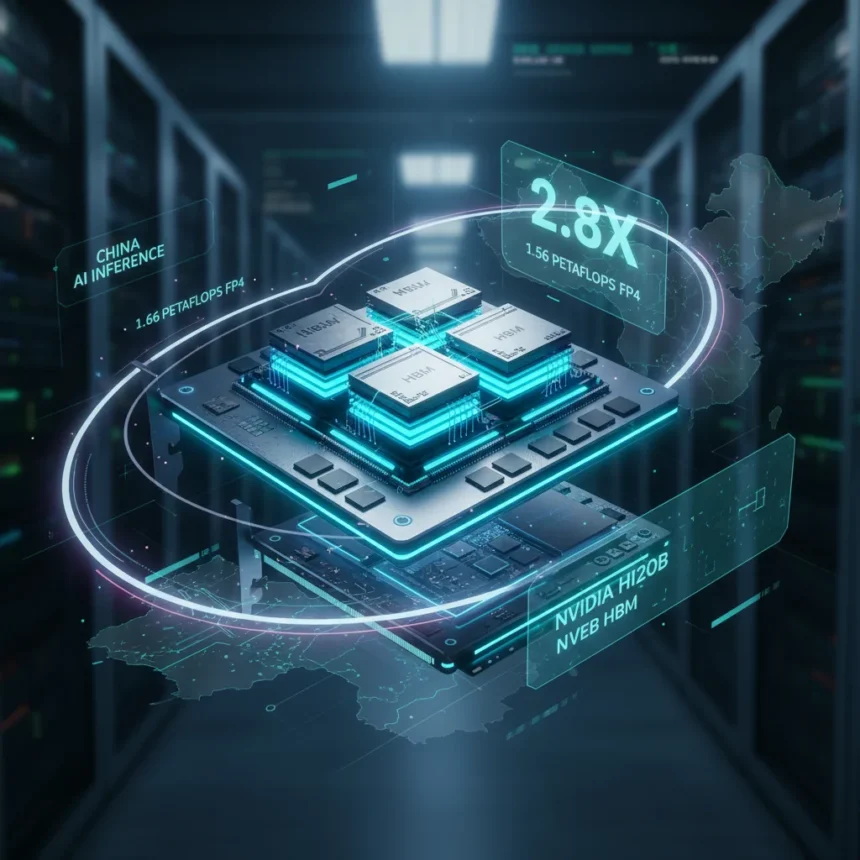
Huawei Atlas 350 is an AI accelerator card powered by the Ascend 950PR neural processing unit, unveiled at the Huawei China Partner Conference 2026 on March 20, 2026. The card delivers 1.56 petaflops of FP4 compute performance, up to 112GB of high-bandwidth memory (HBM), and claims 2.8x more performance than Nvidia’s H20 chip for inference workloads including prefill, recommendation systems, search, multimodal generation, and large language models.
Key Takeaways
- Huawei Atlas 350 achieves 1.56 PFLOPS FP4 compute, roughly 2.8 times Nvidia H20 performance.
- 112GB HBM capacity exceeds H20 by 1.16x; memory bandwidth reaches 1.4 TB/s.
- Multimodal generation speed up to 60% faster than H20, though power consumption is 1.5x higher at 600W.
- Ascend 950PR represents first product from Huawei’s three-year AI chip roadmap announced September 2025.
- Designed for China’s AI inference market amid US export controls limiting Nvidia’s H20 availability.
Huawei Atlas 350 Performance vs Nvidia H20
Zhang Dixuan, head of Huawei’s Ascend computing business, claims the Atlas 350 delivers 1.56 petaflops of FP4 computing power—roughly 2.8 times that of Nvidia’s China-focused H20. This performance advantage targets inference workloads where low-precision formats enable faster data throughput without sacrificing accuracy for many AI applications. The card’s 112GB HBM capacity is 1.16x larger than H20, providing more on-device memory for handling bigger models and longer context windows.
Beyond raw compute, Huawei claims multimodal generation tasks run up to 60% faster on the Atlas 350 than on H20. This matters for real-world applications like image captioning, vision-language models, and cross-modal retrieval where latency directly impacts user experience. The trade-off is power consumption: Atlas 350 draws 600W compared to H20’s roughly 400W, a 1.5x increase that affects total cost of ownership in large-scale deployments.
Ascend 950PR Architecture and Self-Developed HBM
The Ascend 950PR chip powering Atlas 350 represents a significant step forward for Huawei’s neural processing unit line. The full Ascend 950PR specification reportedly reaches 128GB HBM and 2 PFLOPS FP4, but the Atlas 350 is a cut-down variant optimized for inference rather than training. Key improvements over previous Ascend chips include native support for low-precision data formats, enhanced vector compute capabilities, increased interconnect bandwidth, and—critically—Huawei’s self-developed HBM.


The self-developed memory is strategically important. Huawei’s reliance on in-house HBM reduces supply chain vulnerability amid US export restrictions and semiconductor sanctions. Memory bandwidth of 1.4 TB/s supports rapid data movement between compute units and storage, essential for inference workloads that shuffle tokens and embeddings constantly. This architectural foundation suggests Huawei is building an independent AI chip ecosystem rather than chasing Nvidia’s specifications through brute-force scaling.
Market Context: China’s AI Inference Challenge
Huawei Atlas 350 arrives at a pivotal moment for China’s AI infrastructure. Nvidia’s H20 is China-focused but subject to US export controls, creating supply uncertainty and pricing pressure. Recently, Nvidia resumed H200 production for China—a middle-tier offering more capable than H20 but below Blackwell—potentially opening a $30B market opportunity via 1.5M units. Huawei’s announcement signals it will not cede inference acceleration to Nvidia even in restricted markets.


The timing also reflects Huawei’s three-year AI chip roadmap outlined in September 2025. Atlas 350 is the first product from that plan, suggesting follow-up announcements for training accelerators, edge inference, and specialized workloads are likely. For Chinese cloud providers and AI startups facing Nvidia supply constraints, Atlas 350 offers a domestic alternative with credible performance claims—though independent benchmarks remain absent.
What We Don’t Know Yet
Huawei’s 2.8x performance claim versus H20 is a company assertion without third-party verification. Real-world performance depends heavily on software optimization, compiler maturity, and specific workload characteristics. The Atlas 350 is optimized for FP4 (ultra-low precision), which excels at inference but may not reflect performance on mixed-precision or higher-precision tasks where H20 might hold advantages.
Pricing, availability dates, and regional distribution remain unannounced. Production capacity, software maturity, and ecosystem support—factors that determine whether Atlas 350 becomes a genuine Nvidia alternative or remains niche—are also unclear. The card targets inference, not training, which is a narrower market than the full AI accelerator landscape.
Can Huawei sustain Atlas 350 momentum against Nvidia?
Sustaining momentum depends on three factors: software maturity, supply reliability, and ecosystem adoption. Huawei must prove its compiler and libraries match Nvidia’s CUDA ecosystem in ease of use and optimization. Supply chain resilience—demonstrated through consistent Atlas 350 production—will determine whether customers trust it as a long-term platform. Finally, Chinese AI companies must integrate Atlas 350 into their infrastructure, creating network effects that make the chip harder to abandon.



How does Atlas 350 memory compare to other AI accelerators?
Atlas 350’s 112GB HBM is competitive for inference. Nvidia H20 carries less HBM; H200 offers more but faces export restrictions to China. The 1.4 TB/s memory bandwidth supports rapid token throughput in large language model inference, where memory bandwidth often bottlenecks performance more than compute.
Is Huawei’s 2.8x performance claim credible?
The claim is credible within its scope: FP4 compute on specific inference workloads. However, it lacks independent verification. Real-world performance varies by model architecture, batch size, and optimization. Readers should treat it as a performance target, not a guaranteed improvement across all use cases.
Huawei Atlas 350 represents a genuine challenge to Nvidia in China’s inference market, backed by credible specifications and strategic timing. Whether it becomes a mainstream alternative or remains a regional player depends on execution—software maturity, production scale, and ecosystem adoption will determine the card’s long-term impact far more than its launch-day performance claims.
Edited by the All Things Geek team.
Source: Tom's Hardware